
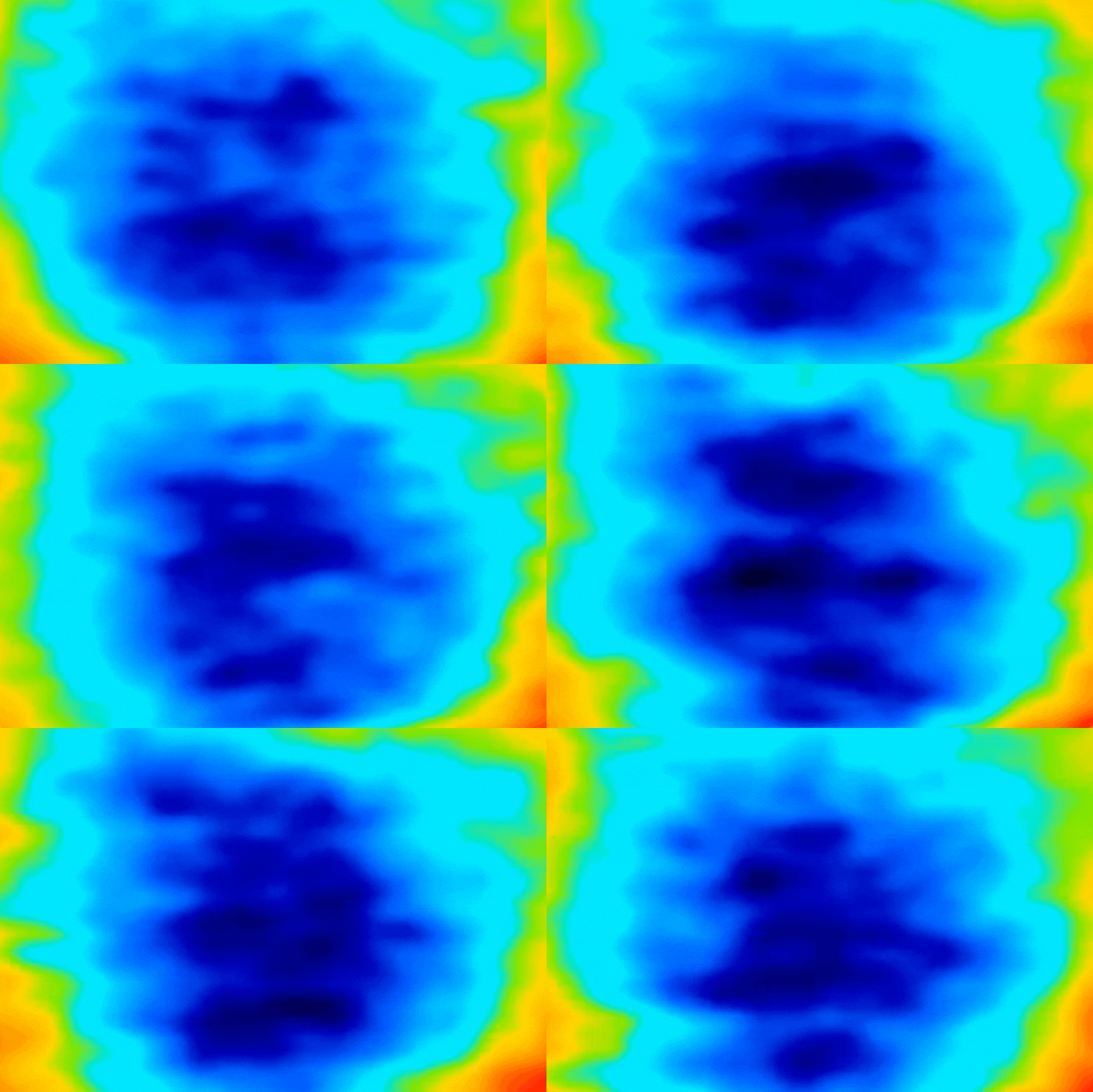
The center of the nuclear pore complex with highly dynamic FG repeat filaments wiggling. (Credit: Lim lab)
The nuclear pore complex (NPC) is an active and highly selective barrier that controls what enters and exits the cell nucleus through passive filtering.
New work published in Nature Cell Biology shows that the NPC's central transport machinery is an extraordinarily dynamic system, continually remodeled by transport factors and the flux of passing cargoes. The study reveals how these factors interact with flexible proteins to reshape the pore in real time, providing a unified framework for understanding one of the cell's most intricate transport machines and its involvement in diseases ranging from cancer to neurodegeneration.
"By probing the nuclear pore complex with a range of in situ and in vivo methods, we've uncovered how it operates as a remarkably elegant and sophisticated transporter," says Michael Rout, one of the study's lead investigators and head of Rockefeller's Laboratory of Cellular and Structural Biology.
A virtual gate
Traffic in and out of the nucleus is tightly controlled, and the nuclear pore complex is the gatekeeper. Built from dozens of nucleoporin proteins, the NPC forms a ring-shaped scaffold surrounding a narrow central channel lined with flexible, unstructured regions called FG domains. These FG domains control the rapid and selective exchange of proteins and RNA between the nucleus and the cytoplasm-creating a selective barrier that allows the nucleus to communicate with the rest of the cell while protecting its genetic material.
How this barrier works, however, has been hotly debated. Although the NPC was first assumed to be a mechanical gate, Rout, along with Rockefeller colleague Brian Chait and collaborators had previously shown that this view was incompatible with the NPC's composition and architecture. Instead, they had proposed a "virtual gate" model, that suggested that the nuclear pore is filled with flexible, constantly moving protein chains that create a dynamic, crowded environment-keeping most molecules out while allowing transport receptors and their cargo to pass through. Meanwhile, other groups proposed an alternative model that suggested the barrier was formed from a crosslinked, gel-like filter that transport factors had to dissolve in order to pass through.
In order to investigate their hypothesis, Rout and Chait, in collaboration with researchers from the United States, Switzerland, the Netherlands, Israel, and Spain, combined advanced imaging, biochemical analysis, and nanoscale engineering to uncover the nature of the NPC's selective barrier.
Using high-speed atomic force microscopy, the team recorded individual NPCs in action at millisecond resolution-fast enough to match the pace of molecular transport. This work revealed that the barrier fluctuates continuously, moving in distinct patterns. With mass spectrometry, the team confirmed that a dense structure hovering within the pore is formed from a mobile cluster of nuclear transport factors and cargoes.
These observations agreed well with a computational framework that Rout and colleagues recently published in PNAS, showing how transport factors slide between these flexible protein chains to mediate transport.
To firmly establish how architecture may influence function, the researchers then rebuilt the pore's geometry from scratch, constructing synthetic nanopores that mimicked its shape and dimensions. When they added transport factors to these artificial pores, the same transport factor-driven organization reappeared, confirming that the NPC's unique, ring-shaped structure is essential for its dynamic behavior. Together, the findings revealed that the NPC's extraordinary efficiency arises from a geometrically confined, self-organizing system-one sculpted and sustained by nuclear transport factors; the NPC's confined architecture paired with its crowded environment are what keep its barrier fluid, dynamic, and distinct from macroscopic static gels created outside the cell.
"This work shows the importance of observing microscopic cellular machines in their native context," says Chait.
A nanopore blueprint
The findings reshape our understanding of one of biology's most essential molecular machines. The NPC emerges as an adaptive, self-regulating gate in which transport factors continuously remodel intrinsically disordered FG domains, enabling it to rapidly adapt to changes in the cell. Together, these results unify long-standing structural, biochemical, and biophysical observations into a single framework.
"Restraining the pore's dynamic state impeded selective transport into the nucleus, which reveals just how essential this behavior is for proper cellular function," says Roderick Lim, Argovia Professor for Nanobiology at the University of Basel, who co-led the work.
Next, the team plans to investigate how the dense cluster of transport factors enriched in the pore adapts to changing cellular demands. Future studies will also examine how the pore maintains its fluid, dynamic state without collapsing into a more rigid or tangled form, a problem seen when its protein components become too concentrated or aggregated.
By combining genetic tools with high-resolution imaging, the researchers hope to learn whether molecular chaperones or stress-response pathways help keep the NPC flexible and functioning properly. The findings may shed light on why disruptions to the NPC are linked to diseases such as cancer, viral infections, and neurodegeneration. The results also open a path toward technological innovation, potentially providing a blueprint for engineering smart nanofilters and drug-delivery systems inspired by nature's most efficient molecular gate.


