• Researchers identified a rare group of cells with the potential to regenerate sensory hair cells in the inner ear.
• The discovery could advance the development of future treatments for irreversible hearing loss.
• The study combined live tissue imaging with single-cell multi-omics technologies.
• The findings were published in Science Advances.
• Researchers suggest environmental changes may have shaped both human technology and cognitive development.
A groundbreaking study by a team of researchers from the Gray Faculty of Medical and Health Sciences at Tel Aviv University offers new hope to millions of people suffering from irreversible hearing loss. The researchers have identified a unique biological mechanism that could, in the future, enable the regeneration of sensory hair cells in the inner ear - a process previously thought to be impossible in humans.
The study was conducted under the leadership of Prof. Karen Avraham, Dean of the Gray Faculty of Medical and Health Sciences Drs Sarah and Felix Dumont Chair for Research of Hearing Disorders incumbent. It was spearheaded by Lama Khalaily, a Tel Aviv University doctoral student, in collaboration with Prof. David Sprinzak of TAU's Wise Faculty of Life Sciences, Shahar Kasirer from Prof. Sprinzak's laboratory, Dr. Litao Tao of Creighton University in Omaha, and additional researchers. The findings were published in the journal Science Advances.
Why Hearing Loss Is Permanent
Hearing loss is often caused by damage to hair cells in the cochlea - cells responsible for detecting sound and converting it into electrical signals transmitted to the brain. Unlike many other species, mammals, including humans, are unable to regenerate these cells once they are damaged, making the loss permanent.
Discovering Cells That Can Regenerate
Using live tissue imaging and single-cell multi-omics methods, the researchers focused on supporting cells - cells adjacent to the hair cells that, under normal conditions, cannot regenerate or transform into hair cells. To explore whether and how this limitation could be overcome, the research team inhibited the Notch signaling pathway, a key communication mechanism between cells that is responsible for hair cell differentiation during embryonic development. The team uncovered a rare subset of supporting cells with an unexpected regenerative potential. Rather than responding uniformly, only a distinct group of cells entered a transitional state and began converting into hair cells.
These cells, termed transdifferentiating Deiters' cells (tDCs), are capable of making the transition from supporting cells to hair cells - a step that is essential for hair cell regeneration. The researchers found that these cells exhibit unique genetic and epigenetic characteristics, enabling them to respond to stimulation and initiate the regeneration process.
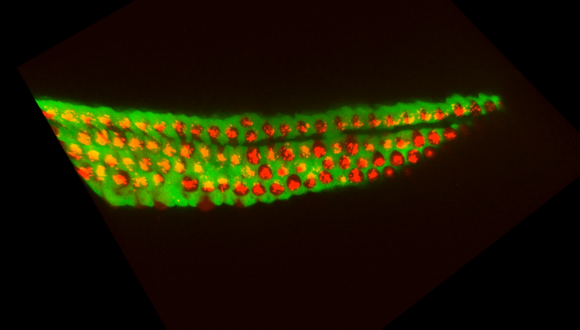
Live imaging of the cochlear sensory epithelium: Supporting cells are shown in green and hair cells in red.
The researchers note that a deeper understanding of the mechanisms that allow certain cells to regenerate may pave the way for the development of innovative treatments that activate this regenerative ability in additional cells. Future approaches may involve a combination of genetic and epigenetic interventions designed to bypass existing biological barriers. According to the research team, this represents a significant step toward the development of regenerative treatments for hearing loss - a field in which no restorative medical solutions currently exist, only assistive measures such as hearing aids and cochlear implants and limited gene therapy.
"A First but Significant Step"
Prof. Karen Avraham concludes: "Our study shows that even in tissues long considered incapable of regeneration, such as the cochlea of the inner ear, there is in fact a hidden regenerative capacity, though it is very limited and appears only in a rare subpopulation of cells. The major challenge now is to understand how this ability can be expanded and activated in additional cells. If we succeed in doing this, we may lay the foundation for the development of innovative biological treatments that restore hearing, rather than merely compensate for its loss. This is a first but significant step toward a deeper understanding of regeneration in the auditory system and in neural systems in general."
The study was supported by a Breakthrough Research grant from the Israel Science Foundation, the Ernest and Bonnie Beutler Research Program of Excellence in Genomic Medicine, and the Sagol Center for Regenerative Medicine at Tel Aviv University.