
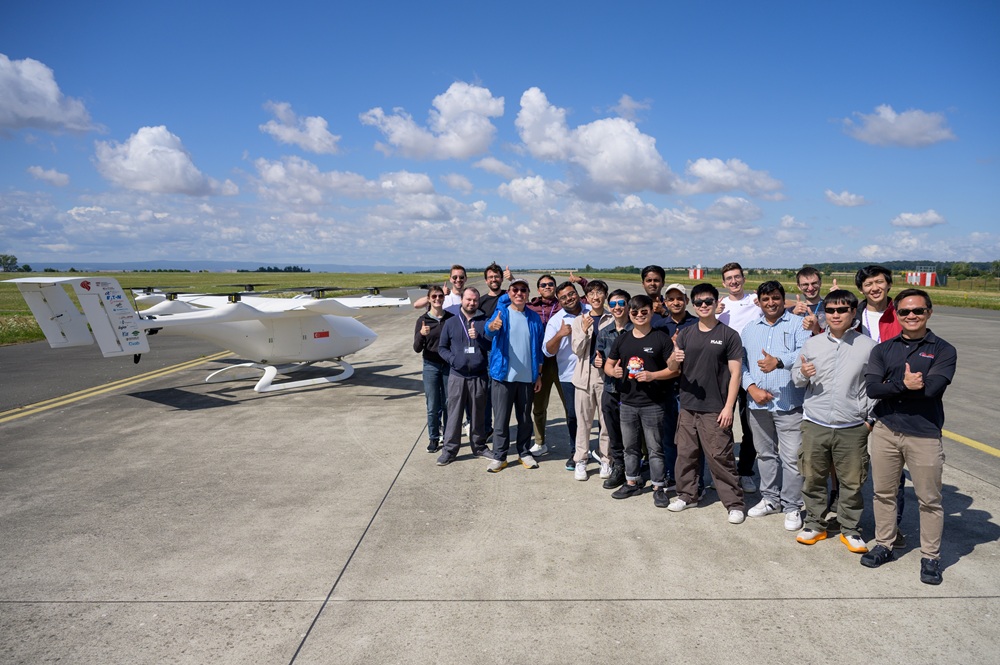
Image: The NTU team and their collaborators with the 8-metre wingspan eVTOL prototype, at the DLR National Experimental Test Center for Unmanned Aircraft Systems.
Nanyang Technological University, Singapore (NTU Singapore) has completed a month-long flight-test campaign in Germany with Singapore's first indigenously designed, engineered and built electric vertical take-off and landing (eVTOL) aircraft.
The prototypes, comprising 8-metre and 3-metre wingspan variants, are research technology demonstrators, currently not designed to carry passengers.
Working with flight-test experts from the German Aerospace Center (DLR), the NTU team flew the larger 8-metre wingspan demonstrator to heights above 90 metres, while the 3-metre wingspan demonstrator reached speeds of more than 120 km/h. The flights generated critical data on the aircraft's performance.
The flights mark a historic first for Singapore, demonstrating the country's ability to design, engineer, build, integrate and fly a complete electric aircraft. The milestone adds a new capability to Singapore's established aerospace sector and lays the groundwork for further research into electric aviation.
The month-long mission from July to August 2026, was conducted at the DLR National Experimental Test Center for Unmanned Aircraft Systems in Cochstedt, Germany. The prototypes demonstrated the eVTOL design's ability to hover, fly using its fixed wings and transition between the two modes.
Professor James Wang, Director of the eVTOL Research and Innovation Centre at NTU's School of Mechanical and Aerospace Engineering, said: "This is a historic feat for an aircraft designed, engineered and built in Singapore. Reaching these heights, and going from hover to forward flight, marks a new milestone for Singapore-made electric aircraft.
"It is a wonderful birthday present for Singapore as it marks its 61st year of independence."
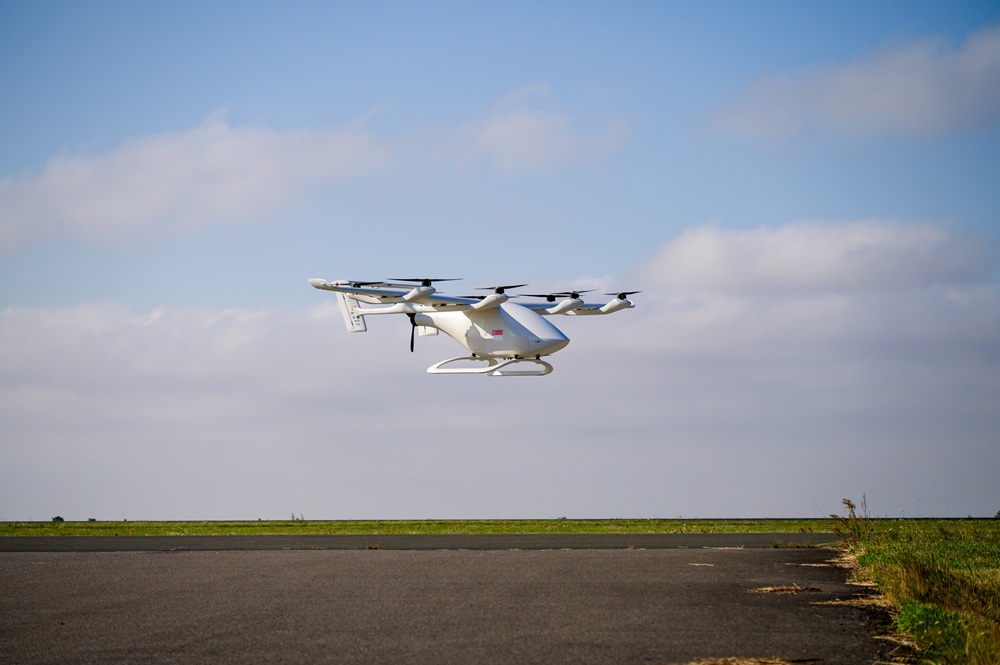
Image: The 8-metre wingspan eVTOL prototype taking flight at DLR.
Proving the aircraft in real flight
The NTU eVTOL design uses electrically powered lift rotors mounted on its wings to take off vertically and hover.
As the aircraft gains forward speed, its wings increasingly generate lift while a rear propeller provides forward thrust, allowing it to fly like a conventional aeroplane.
This fixed-wing mode enables efficient flight over long distances, consuming the energy of one motor, compared to conventional eVTOLs that may use up to eight rotors to hover and fly.
Transitioning between these modes is a key engineering challenge. The flight-control system must continuously manage changes in propulsion, aerodynamic forces and aircraft stability as the aircraft moves between rotor-borne hovering and wing-borne flight.
During the tests, the prototypes were remotely piloted by Prof Wang, Martin Laubner of DLR, and Mr Lu Weiyao, Co-founder and Technical Director of Flare Dynamics Pte Ltd and an NTU alumnus.
Prof Wang has 30 years of aircraft industry experience and joined NTU in 2019 as a professor teaching aircraft design, where he launched the NTU eVTOL Centre. He has worked on more than 30 manned and unmanned VTOL aircraft development programmes and is an avid model aircraft and helicopter designer and pilot, with more than 10,000 flights under his belt.
The team successfully flew the technology demonstrators beyond line of sight and transferred piloting control between outdoor and indoor pilots while the aircraft remained airborne.
One outdoor pilot will control the hover flight via line of sight. As the aircraft transitions to its fixed-wing mode, another pilot will take over the flight controls in a remote pilot station, before handing it over back for the landing.
The successful piloting control transfers further validated the flight-control systems and operating procedures.
Working closely with DLR flight-test specialists, the NTU team collected performance data under controlled test conditions.
Designed, engineered and built in Singapore
The eVTOL demonstrators are the result of more than three years of engineering at NTU. Following Prof Wang's configuration design and guidance, researchers carried out structural and aerodynamic analysis, detailed design, system testing and systems integration.
Prof Wang's motto is: "If it can be dreamt, it can be built."
The NTU eVTOL Centre operates as a vertically integrated innovation lab consisting of about 30 research engineers.
The small but agile research team designed the electric motor, developed the electrical architecture, integrated and assembled the propulsion systems, avionics and sensors, developed the flight-control algorithms and telemetry solutions, and engineered and assembled the entire airframe.
Bringing these technologies together gave team members a rare opportunity to experience the full aircraft development cycle, from aerodynamics and structural design to propulsion, electrical integration, avionics and real-world flight testing.
Team members and industry partners from 11 countries worked together on the programme. Prof Wang explained that the hardest part of a successful programme is not always engineering but often getting a team to work towards the same goal and achieve a "1 + 1 equals 3" result.
Professor Louis Phee, NTU's Vice President (Innovation and Entrepreneurship), who played a role in establishing the University's eVTOL research centre, said: "When we started this programme, we set ourselves a moonshot goal: to gain the capability to design, engineer and build an airworthy electric aircraft with a novel design, useful for transportation of goods and people.
"This milestone shows that Singapore can punch above its weight in aerospace innovation. We may be a small country, but we have the technologies and talent to build a novel Made-in-Singapore electric aircraft, paving the way for Singapore to carve out a place in this emerging industry.
"This project also reflects the DNA of NTU. Like an agile start-up, the team was prepared to try, fail, learn and find another way forward. The achievement came not because every step worked the first time, but because we never gave up until it did."
Building Singapore's eVTOL capabilities
The NTU eVTOL research is supported by the University and the Industry Alignment Fund - Pre-Positioning initiative, under Singapore's Research, Innovation and Enterprise 2025 plan, in collaboration with the Agency for Science, Technology and Research (A*STAR).
Local and international industry partners include Eaton Aerospace, Syensqo, Luminator, Diab, AVL, Embention, Volz Servos, WingTeck, Bitec, BJO and CEVA, as well as Singapore aerospace companies Admiralty and Flare Dynamics.
A*STAR and Republic Polytechnic have also contributed valuable research and technical expertise, while DLR supported the research with flight-test expertise and facilities in Germany.
The eVTOL research project aims not only to develop individual aircraft technologies, which are protected intellectual property, but also to build systems-engineering know-how and nurture the talent required for Singapore to design, engineer, build, test and eventually support advanced electric aircraft, vertical flight and advanced air mobility.
Prof Wang, an electric vertical flight pioneer who coined the term "eVTOL" in 2008, and in 2010 led the development of AgustaWestland's Project Zero, the world's first all-electric tiltrotor technology demonstrator, said the NTU flight tests in Germany were an important part of the engineering development process, beyond validating the aircraft's design.
"Every flight generated new data, every test provided feedback and every result was an opportunity for the team to learn, improve and move forward together," he added.
"As our team motto says, 'Failure is not an option.' The journey from zero to one has been made. Now, the journey from one to the future begins."


