
About one in three employees in Singapore report feeling burnt out - one of the highest rates globally. Burnout and chronic fatigue carry a substantial economic cost and pose serious risks in professions where alertness is critical. Yet diagnosing fatigue and related mental health conditions today relies largely on self-reported questionnaires, which tend to be subjective, intermittent and poorly suited to real-time evaluation.
Wearable devices could fill the gap by continuously tracking cardiovascular markers linked to the autonomic nervous system, but their readings degrade sharply during everyday movement. Motion artefacts from muscle activity, body movement and physiological interference overwhelm the faint heart and blood pressure signals these devices are trying to capture, and current mitigation strategies typically address only one type of noise or a narrow frequency band.
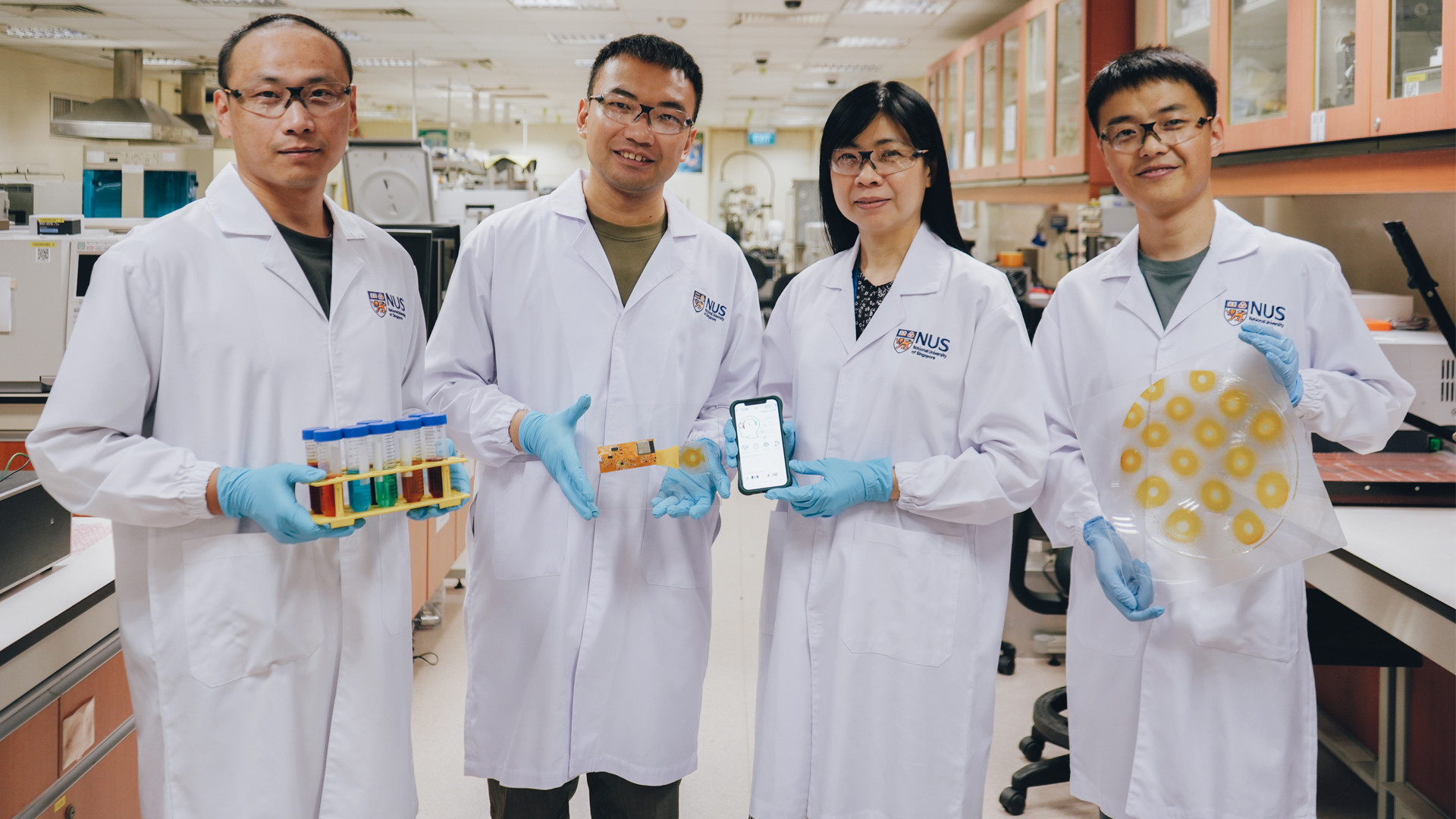
A research team led by Professor Ho Ghim Wei from the Department of Electrical and Computer Engineering under the College of Design and Engineering at the National University of Singapore, with Research Fellow Dr Tian Guo as first author, has developed a metahydrogel platform integrated with AI-driven signal processing that suppresses multiple sources of motion noise simultaneously. The system delivers an electrocardiograph (ECG) signal-to-noise ratio (SNR) of 37.36 dB and blood pressure deviation as low as 3 mmHg during movement - accuracy that meets ISO clinical-grade standards and outperforms commercial trackers currently available in the market. Combined with machine learning, the platform classifies fatigue levels with 92 per cent accuracy, pointing towards objective, continuous mental health monitoring in real-world settings.
The findings were published in Nature Sensors on 24 March 2026.
Filtering noise at the source
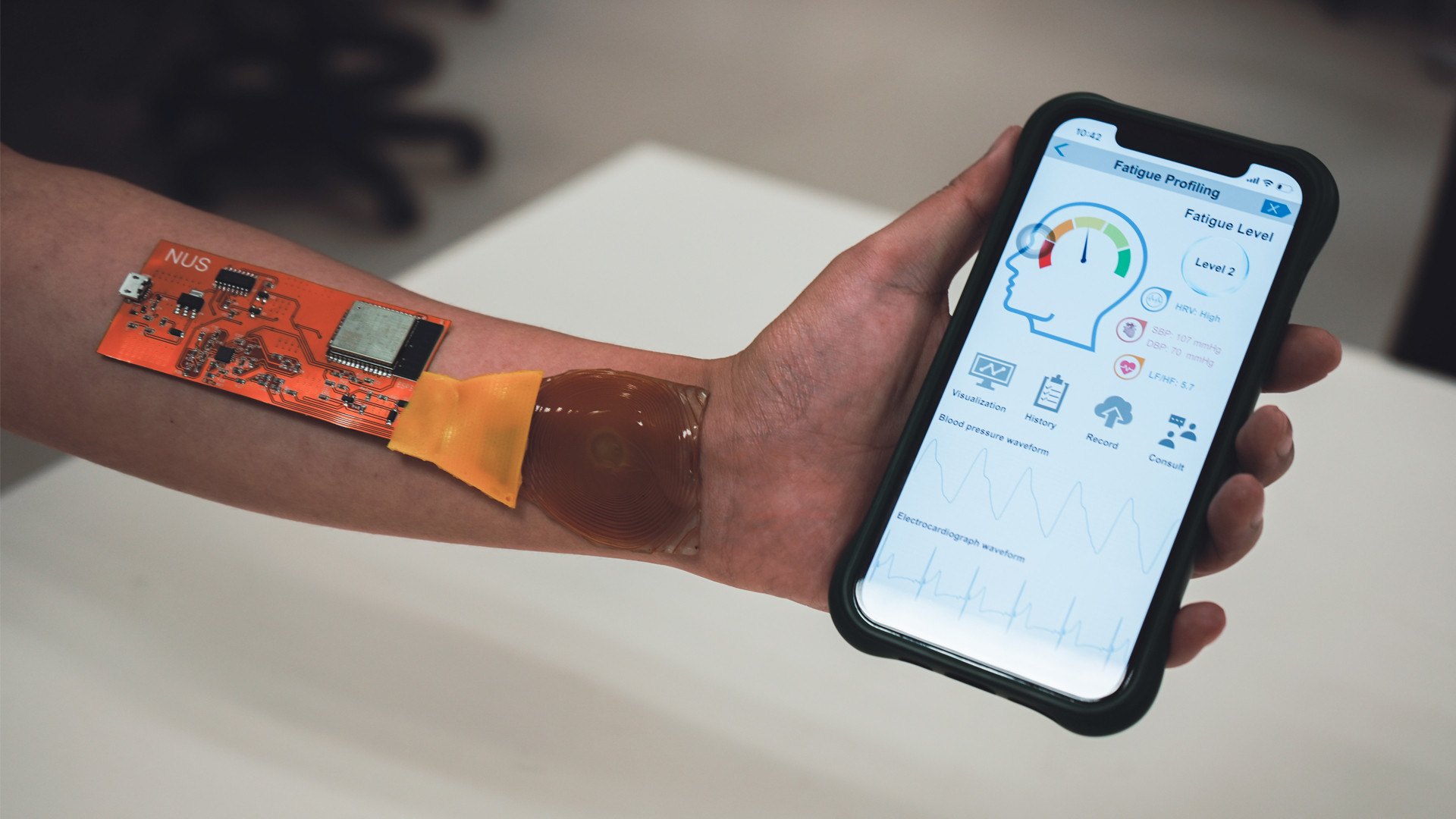
Rather than relying solely on software to clean up noisy data, the team tackled the problem at the sensor-body interface itself. The metahydrogel artefact-mitigating platform (MAP) combines two filtering mechanisms in a single material. Nanoparticles self-assembled into periodic bands within the hydrogel scatter and absorb mechanical vibrations, much like how a soundproofing panel traps sound energy, blocking movement noise within targeted frequency ranges. At the same time, a biocompatible glycerol-water electrolyte controls how quickly ions travel through the gel, letting low-frequency heart signals (below 30 Hz) pass through, while suppressing higher-frequency muscle electrical noise. A machine-learning denoising algorithm then removes any remaining unstructured noise while preserving critical physiological features.
The platform is soft enough to match the mechanical properties of biological tissue, breathable with a water vapour transmission rate exceeding that of human skin and durable under repeated stretching. By combining improved hardware with smart algorithms, the system made the ECG signal much cleaner, boosting signal quality from 5.19 dB to 37.36 dB. This clearer signal helps it detect key ECG peaks more reliably, raising peak-detection accuracy from 52 per cent to 93 per cent and making it easier to tell fatigue-related patterns from normal heart rhythms.
"Compared with current commercial devices, our metahydrogel platform demonstrates superior performance, particularly under motion conditions where artefact suppression is critical. Current smartwatches typically achieve ECG signal-to-noise ratios of 10-20 dB, which can decrease by approximately 40 per cent under motion due to artefacts and unstable contact. Our system achieves around 37 dB during daily activities," said Dr Tian.
From stable signals to mental-state decoding
Because fatigue disrupts the autonomic nervous system, it leaves measurable traces in heart rate variability, blood pressure patterns and ECG waveform features - but only if those signals can be captured cleanly during everyday activity. The team built a fully integrated, flexible wearable MAP system with wireless transmission and used it to monitor participants over multiple days, including simulated driving tasks designed to induce fatigue.
Using high-quality cardiovascular data collected from the hydrogel sensor, a deep-learning system identified fatigue levels with 92 per cent accuracy, versus 64 per cent when trained on data collected without MAP. The team also showed that the system meets the ISO 81060-2 gold-standard requirements for blood pressure monitoring.
Beyond fatigue tracking, MAP suppressed artefact across diverse biosignal types, including heart sounds, respiratory sounds, voice, brain-wave and eye-movement recordings, highlighting its potential for broader neurophysiological and mental health monitoring.
Towards real-world mental-health monitoring
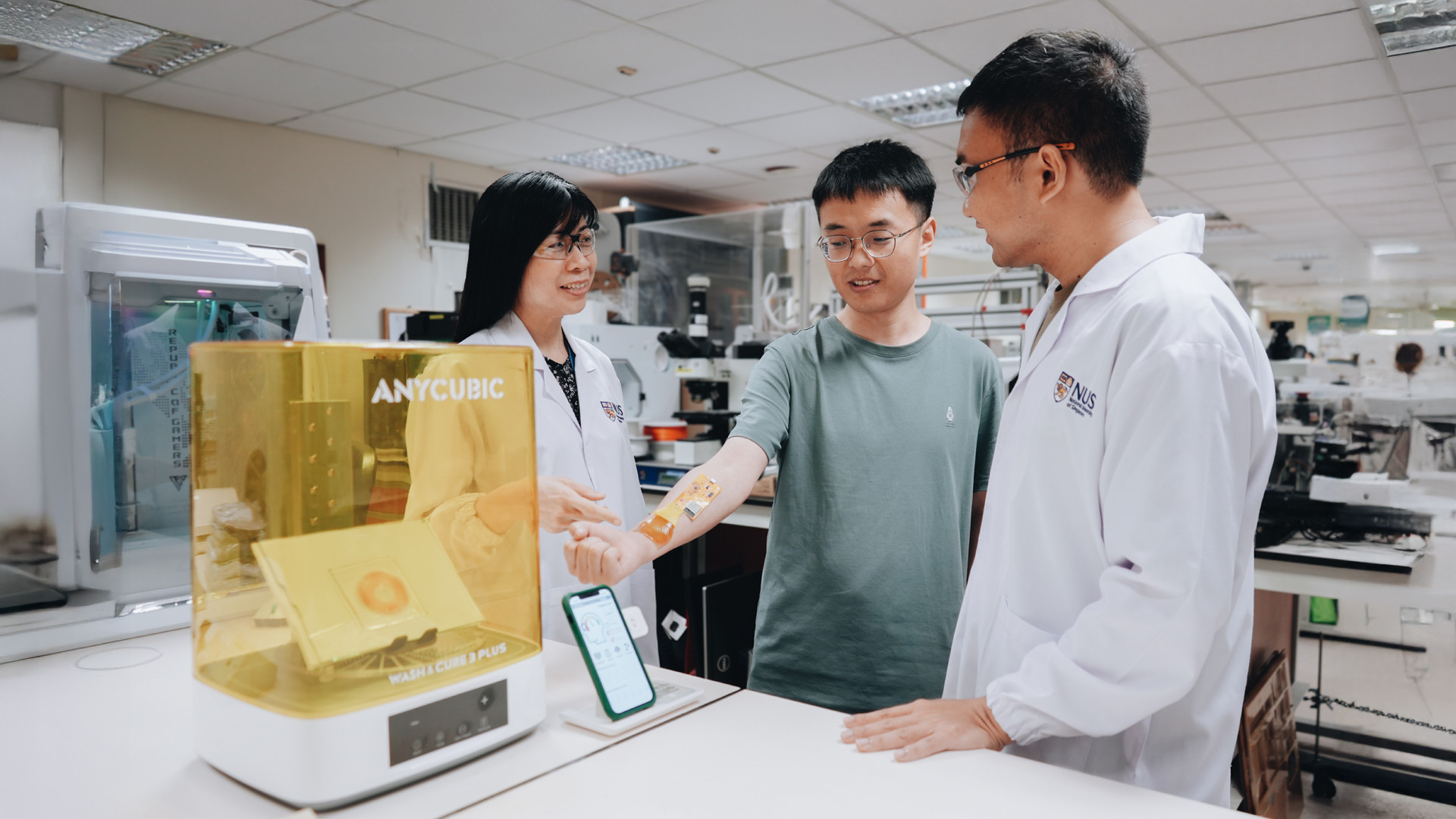
The team spent about four years developing the underlying sensing technologies before arriving at the metahydrogel concept about two and a half years ago. Designing and fabricating the platform took about a year, during which the researchers built a library of metahydrogels with different material systems to target noise across different frequency ranges. A further year of system integration and application validation followed, including exploration of its potential for mental-health monitoring.
"We hope to work closely with mental-health physicians to better understand what types of physiological data are most relevant in real-world settings, as well as the level of accuracy required to meet clinical needs. Clinicians can provide valuable insights to help us establish meaningful links between the data and pathological conditions," said Prof Ho.
On the industry side, the team is seeking partners to improve device consistency and scalability. "Our current material synthesis and system fabrication are still largely based on laboratory processes. We aim to collaborate with industrial partners to optimise manufacturing strategies and advance the platform toward practical, product-level implementation," she added.


