
Two outstanding Oxford University researchers are among 75 leading figures elected by the Royal Academy of Engineering to its Fellowship this year.

The Royal Academy of Engineering, which this year celebrates its 50-year anniversary, works to deliver public benefit from engineering and technology, convene a leading community across the profession, and to provide expert advice to policymakers. Fellows are elected for having made exceptional contributions to their own sector, pioneered new innovations, lead progress in business or academia, provided high level advice to government, and/or promoted wider understanding of engineering and technology.
Sir John Lazar, President of the Royal Academy of Engineering, said: 'Our Fellowship has been at the core of our work for the past 50 years, connecting the businesses leaders, entrepreneurs, researchers and policymakers who are at the heart of the UK's technological progress. This year's cohort will be joining a community of over 1,700 top engineers and innovators in the UK and around the world.'
About the new Fellows:
Martin Booth , Professor of Electrical Engineering in the Department of Engineering Science, and Professorial Fellow at St Hugh's College
Professor Booth's research focuses on optics and, in particular, on developing new ways to control and manipulate light. A major strand of his work is adaptive optics, where optical systems are adjusted to correct distortions in a beam of light. This has important applications in high-resolution microscopy, helping researchers to obtain clearer images from deep within biological specimens.
His wider research spans advanced microscopy, including techniques used in biomedical and neuroscience research, as well as ophthalmic imaging and laser-based microfabrication. Much of this work centres on using precise control of light to improve how we can image, measure and manipulate materials at microscopic scales.
Professor Booth is also Founder Director of Opsydia Ltd, an Oxford University spin-out company that uses advanced laser technology to create microscopic structures and features within transparent materials, including security features in diamonds and glass-based devices for optical computing.

"I'm honoured to be elected a Fellow of the Royal Academy of Engineering. This recognition reflects not only my own work, but also the support, collaboration and achievements of many colleagues over the years. I look forward to contributing to the Academy's community and its work to advance engineering for the benefit of society."
Tom Melham , Professor of Computer Science, Department of Computer Science
Professor Tom Melham's research develops mathematical and computational methods for making complex digital systems reliable and trustworthy. He specialises in automated reasoning and formal verification, particularly techniques for finding subtle design errors in computer chips before manufacture.
His work combines foundational research with sustained, hands-on collaboration across the semiconductor and electronic design automation industries. This has influenced industrial verification practice and led to new techniques being incorporated into commercially deployed tools used by chip designers worldwide.
More recently, his group's verification of secure processor designs has helped improve their quality and accelerate their adoption in commercial products.
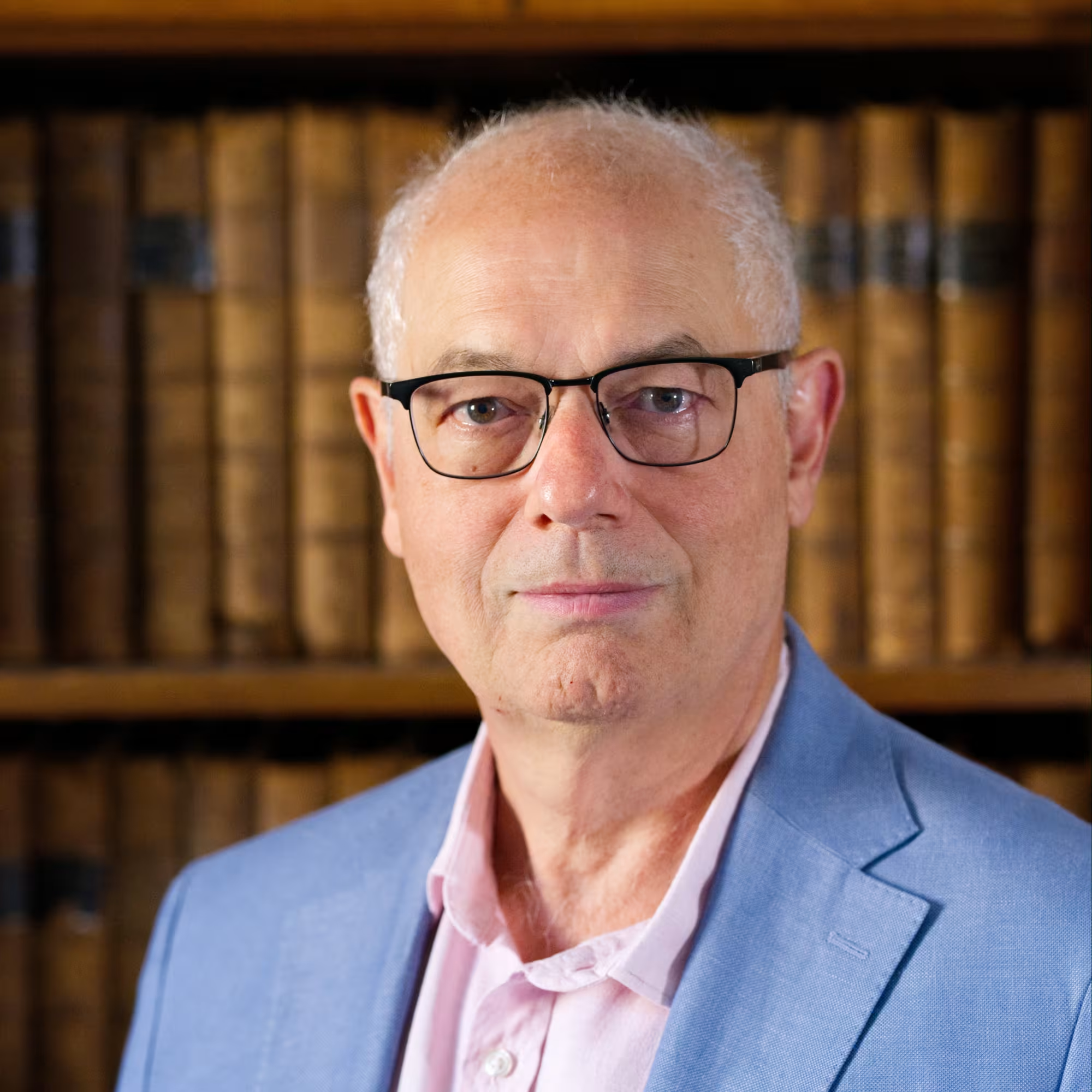
"I am delighted and honoured to be elected a Fellow of the Royal Academy of Engineering. I see this recognition as reflecting the work of the many colleagues, students and industrial collaborators with whom I have had the privilege to work -and our shared commitment to translating rigorous academic research into practical engineering impact."
The new Fellows will be formally admitted to the Academy at a special ceremony in London on 19 October, when each Fellow will sign the roll book.
Further information about the new Fellows for 2026 can be found on Royal Academy of Engineering's website .


