
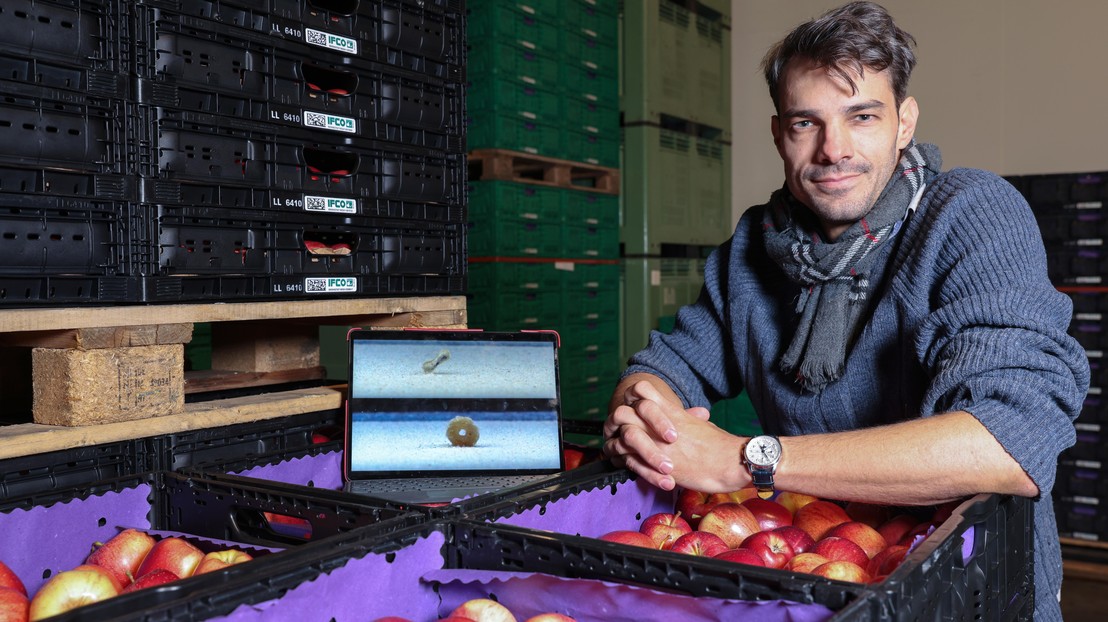
Bertil Trottet, an EPFL physicist who also runs a family tree farm in Féchy. 2026 EPFL / Alain Herzog - CC-BY-SA 4.0
A new study sheds light on a previously overlooked mechanism of soil erosion that occurs just after raindrops hit the ground. The research was conducted in part by Bertil Trottet, an EPFL physicist who also runs a family tree farm in Féchy.
What does the study of the physics of particle entrainment have to do with apple-growing along the coast of Lake Geneva? The answer lies in the parallel activities carried out by Bertil Trottet. He's a coauthor of a new study - "Sandball genesis from raindrops," published in Proceedings of the National Academy of Sciences (PNAS) - and will soon take over his family's 45-hectare farm, where they grow several varieties of apples (Gala, Braeburn, Boskoop, Jazz and more) as well as pears and grapevines.
Trottet's vocation at the crossroads of physics and agriculture gives him a unique perspective on his research findings and potential applications. The PNAS study, carried out jointly by scientists from EPFL and the University of Pennsylvania, seeks to answer an ostensibly simple question: what happens after a raindrop falls on dry soil? Until now, most soil erosion models have focused almost entirely on the raindrop splash at impact. But Trottet and his colleagues found that some raindrops falling on dry, sloping surfaces tend to bounce and roll downhill, collecting grains of sand along the way - in some cases moving up to ten times as much of the substance as at impact. This corresponds to much more erosion than originally thought. The team's findings mean we need to rethink our understanding of soil erosion, especially in dry and mountainous environments.
For this interview, we spoke with Trottet among the apple trees at Vergers de Féchy, his family's farm, where issues related to soil stability and potential erosion take on particular significance.
Your study starts with the simple question of what happens to a raindrop after it hits the ground. How did you come to realize that this question was still unanswered?
The right questions are often the simplest ones! Until now, most research looked at the processes occurring at the moment of impact, or splash, but didn't consider what happens immediately afterwards. Yet under certain conditions, raindrops don't just disappear - they remain compact and begin to roll. This post-impact phase has been largely overlooked, yet it could play a major role in the erosion process.
What prompted you to study the post-impact phase in particular?
The idea came from a rudimentary observation I made with my colleague Hugo Ulloa [another coauthor of the study] while hiking in the mountains after it had rained. We saw that small aggregates had formed and were rolling down a sandy slope. I was researching avalanches at the time and was naturally struck by the analogy with snowballs - especially how they grow in size as they roll. We were sure that a similar mechanism was occurring with the sand and rainwater, and that we would be able to examine and quantify it.
You discovered that some raindrops do in fact form "sandballs" analogous to snowballs. What surprised you the most about this process?
The fact that it was so clear-cut and could be reproduced consistently. We had a pretty clear hypothesis about the underlying mechanism but didn't expect to see such interesting shapes! They could be grouped into two categories, which we named "peanuts" and "donuts." The "donuts" - or toroidal forms with a hole in the center - had never before been observed in this context.
Some raindrops you studied carried up to ten times more sand than the amount moved just upon impact.
This proves that the splash is just the first step. If the impact is the only thing you consider in your model, then you'll substantially underestimate the amount of soil that's eroded. The mechanism we found is especially important when rain first hits dry, sloping surfaces and water runoff hasn't yet formed. And it could play a role in initiating larger phenomena that occur later.
You ran your experiments in conditions with no water runoff. In what natural environments is the mechanism you discovered likely to occur?
Primarily in arid or semi-arid environments, but also on steep mountain slopes. Our field observations show that such conditions do actually exist, such as when it first starts to rain after a dry spell. Our research can also help scientists better understand the onset of events like debris flow, when large masses of sediment suddenly start moving.
You also grow trees - how does that shape the way you view these kinds of scientific questions?
I see myself more as a "project designer" than a tree grower or researcher. I find that direct contact with nature, the ground, soil, and the elements fuels your imagination and sparks new ideas. Then you can draw on your experience and the challenges you've overcome to turn your ideas into projects and carry them out.
Do you see commercial applications for your research?
Today, aggregates such as fertilizer, food pellets and even some kinds of candy are manufactured using mainly mechanical processes like rotating drums, which consume a lot of energy and generate dust. With the mechanism we discovered, however, manufacturers could simply use gravity and droplets to form aggregates in a controlled manner. In theory, this would create particles of a known size and shape without too much friction and without any loss of the material. We're still fleshing out this idea, but I think it has potential.
You completed your PhD research on avalanches. How does that tie into your current work on sandballs?
Both topics involve granular materials and a rapid transition between the solid and liquid state. As snow breaks down, it becomes a granular substance that behaves surprisingly like sand. Here, we did the opposite! We took sand particles and found a natural process that gathers them into an aggregate. It's these thresholds, phase transitions and dynamics at various scales that I find interesting.
What did your study teach you about how simple processes shape our landscapes?
I learned that dramatic mechanisms aren't necessarily what causes major changes. Even simple mechanisms repeated over and over again - like a raindrop rolling on the ground and collecting a few particles - can help sculpt a landscape. This continuity between the microscopic and the macroscopic scales makes such processes fascinating. I feel that true elegance lies in simplicity - just look at Coco Chanel, Leonardo da Vinci and Antoine de Saint-Exupéry.
From the lab to the field
To investigate the process of sandball formation, the research team started by running experiments in the laboratory. They created a 1.2-meter-long granular test bed that was tilted at a 30° angle, which is close to the material's angle of repose. Then they placed droplets of a water-glycerol mixture with a set viscosity at the top of the test bed. They observed how the droplets bounced and rolled down the slope, using high-speed cameras together with a backlight system along the test bed to enable clearer snapshots of the sandballs as they form. The sandballs were collected at the bottom of the slope and weighed in order to determine the mass of sand that had aggregated along the whole rolling process.
Next, the researchers headed out to the field to compare their lab results with real-world data. They made field observations using a dry granular test bed (also at 30°), along Route de la Sorge in Ecublens at the start of a rain event. This procedure was subsequently repeated at a site in Valais. The field data confirmed that sandball formation by raindrops does occur in nature.


