New paper of the Cluster of Excellence ctd.qmat in "Science": The Kardar-Parisi-Zhang equation has been experimentally verified for the first time on 2D surfaces - thanks to sophisticated material design and polaritons.
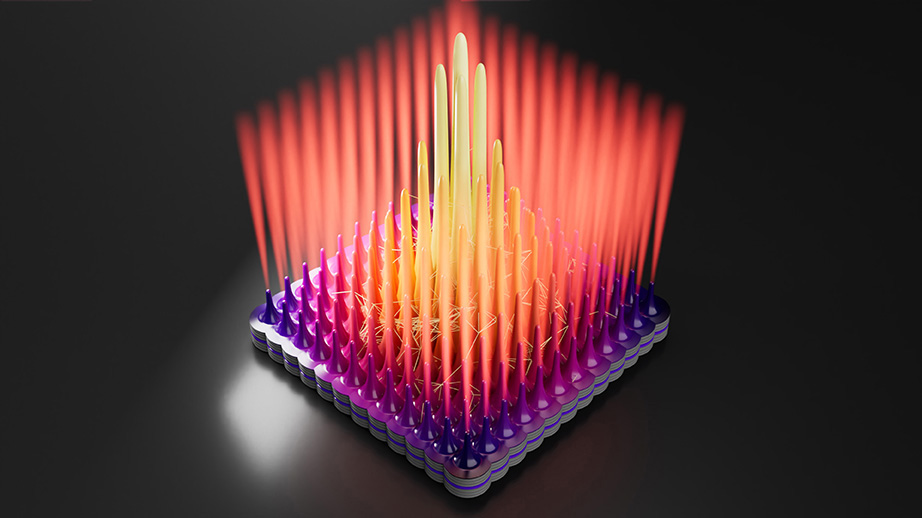
The question of how surfaces grow is one of the most fundamental problems in physics. In 1986, three physicists laid the foundation for a universal theory of growth with the Kardar-Parisi-Zhang (KPZ) equation-a framework with wide-ranging applications across physics, mathematics, biology, and computer science. From the dynamics of crystal formation and mathematical system analysis to the growth of cells, populations, and flame fronts-and even the development of machine-learning algorithms-the KPZ universality class applies wherever growth processes are modeled.
After the model was first experimentally confirmed for one-dimensional systems based on polaritons in 2022, a Würzburg research team has now tested this powerful framework again in the lab, delivering the world's first experimental proof for two-dimensional systems and interfaces.
Würzburg researchers achieve breakthrough in 2D quantum system
"When surfaces grow-whether crystals, bacteria, or flame fronts-the process is always nonlinear and random. In physics, we describe such systems as being out of equilibrium," explains Siddhartha Dam, a postdoctoral researcher in the Würzburg-Dresden Cluster of Excellence ctd.qmat at the University of Würzburg's Chair of Technical Physics. "Engineering a system capable of simultaneously measuring how a non-equilibrium process evolves in space and time is extremely challenging - especially because these processes unfold on ultrashort timescales. That's why verifying the KPZ model in two dimensions has taken so long. We have now succeeded in controlling a non-equilibrium quantum system in the laboratory - something that has only recently become technically feasible."
To achieve this, the researchers cooled a semiconductor sample based on gallium arsenide (GaAs) to -269.15°C and continuously excited it with a laser. Through precise materials engineering, polaritons-hybrid particles made of photons (light) and excitons (matter)-formed within a specific layer of the structure. Polaritons exist only under non-equilibrium conditions: they are generated by laser excitation and decay within just a few picoseconds before leaving the system.
"We can precisely track where the polaritons are in the material. When we pump the system with light, polaritons are created-they grow. Using advanced experimental techniques, we were able to quantify both the spatial and temporal evolution of this growing quantum system and found that it follows the KPZ model," Dam explains.
The key idea-testing a universal theory of growth in a quantum system using polaritons, which themselves exist only within a highly dynamic growth process-was developed by Sebastian Diehl, a professor at the Institute for Theoretical Physics at the University of Cologne and a member of the research team. The theoretical groundwork dates back to 2015. In 2022, a research group in Paris provided the first experimental evidence of KPZ behavior-but only in a one-dimensional system. "The experimental demonstration of KPZ universality in two-dimensional material systems highlights just how fundamental this equation is for real non-equilibrium systems," says Diehl, commenting on the Würzburg team's achievement.
Targeted materials design enables injection of polaritons
To inject polaritons into the material, the researchers engineered a highly complex sample structure. Mirror layers confine photons within a central "quantum film" layer where they can couple with excitons in the gallium arsenide to form polaritons, grow, and be measured.
"By precisely controlling the thickness of individual material layers using molecular beam epitaxy, we were able to tune their optical properties and hence fabricate the necessary highly reflective mirrors under ultra-high vacuum conditions," explains Simon Widmann, a doctoral researcher at the Chair of Engineering Physics, who conducted the experiments together with Siddhartha Dam. "We control how the material grows atom by atom and can fine-tune all experimental parameters-for example, the laser, which must excite the sample with micrometer precision. This level of control was essential for successfully demonstrating KPZ universality."
Cluster of Excellence ctd.qmat
The Cluster of Excellence ctd.qmat - Complexity, Topology and Dynamics in Quantum Matter - at Julius-Maximilians-Universität Würzburg and Technische Universität Dresden explores and develops novel quantum materials with tailored properties. Around 300 researchers from over 30 countries work at the interface of physics, chemistry, and materials science to lay the foundations for tomorrow's technologies. In 2026, the cluster entered the second funding period of the German Excellence Strategy of the Federal and State Governments - with an expanded focus on the dynamics of quantum processes.
Publication
Observation of Kardar-Parisi-Zhang universal scaling in two dimensions. Simon Widmann, Siddhartha Dam, Johannes Düreth, Christian G. Mayer, Romain Daviet, Carl Philipp Zelle, David Laibacher, Monika Emmerling, Martin Kamp, Sebastian Diehl, Simon Betzold, Sebastian Klembt, Sven Höfling, Science, Vol 392 Issue 6794, 9 April 2026, pp. 221-224, DOI: 10.1126/science.aeb4154