
A small, counterintuitive tweak to advanced materials can improve how quantum computers hand off information inside their systems, making them more efficient, reliable and scalable.
In a paper recently published in Advanced Electronic Materials, a team from Sandia National Laboratories, the University of Arkansas and Dartmouth College found they improved the flow of electrical current through a specialized semiconductor device called a quantum well. This device is increasingly used to make telecommunications faster and more efficient, and researchers have been exploring if it can have the same impact on quantum computers.
To visualize a quantum well, imagine a marble rolling in a groove between two raised edges. The marble can only move back and forth. A quantum well controls electrical current in a similar way, confining it in an ultrathin layer of material. This confinement improves how quickly you can encode information in light.
The new paper shows how to make these wells work even better, whether for quicker downloads and smoother online experiences or for better qubits and more efficient transmission of quantum information.
Supported by a grant from the Department of Energy's Office of Science, the study is part of the Manipulation of Atomic Ordering for Manufacturing Semiconductors initiative, a DOE Energy Frontier Research Center based at the University of Arkansas. This collaborative effort has involved Sandia and nine universities working together since 2022 to uncover the scientific principles that govern the arrangement of atoms in semiconductor alloys. By discovering and using these scientific principles, the µ-ATOMS team seeks to develop materials that advance semiconductor technologies.
This newly published paper was led by the Sandia team at the Center for Integrated Nanotechnologies, an Office of Science user facility supporting national nanoscale science research, jointly operated by Sandia and Los Alamos national laboratories.
A little tin and silicon help current glide through semiconductors
Most studies on the same type of quantum well this team used have focused on barriers that are made of pure germanium to keep electrical current confined. Unexpectedly, the improvement the team reported came from adding two impurities, tin and silicon.
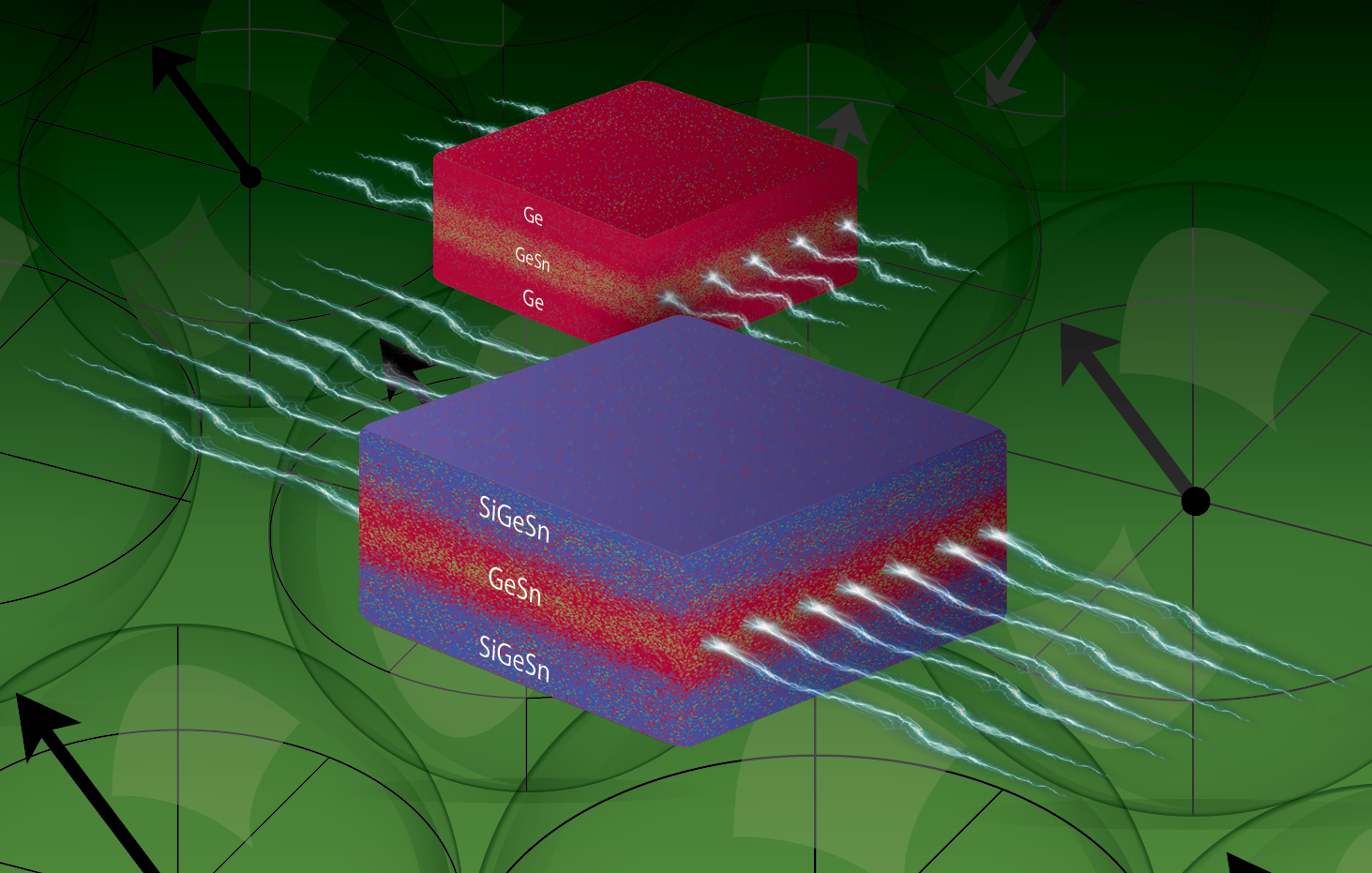
This challenges previous assumptions that adding impurities would only slow electricity down, like adding bumps in the marble track. But remarkably, instead of getting in the way, the presence of tin and silicon may have made energy roll through the quantum well more efficiently. Scientists measured an increase in an electrical transport characteristic called mobility.
"We thought it would be worse because we mixed things together. But we found the mobility is higher," said Shui-Qing "Fisher" Yu, professor of electrical engineering and computer science at the University of Arkansas and a lead investigator on the study.
That surprising boost in mobility suggests that tiny patterns in how atoms arrange themselves, called short-range order, may be helping, rather than hindering, the flow of current.
Sandia's Chris Allemang, the first author on the paper, added, "The unexpected high mobility result hints at short-range order effects in the Group-IV silicon-germanium-tin system, which is particularly exciting due to the system's optical properties and its potential for monolithic integration with conventional silicon CMOS. This short-range order may provide an additional control knob, beyond alloying and strain, for engineering material properties that will impact national priorities in microelectronics and quantum information science."
Quantum wells are nanometers thick but full of possibilities
The collaboration explored the effects of silicon-germanium-tin barriers to better understand how different materials can enhance performance. The University of Arkansas produced the high-quality quantum well material that Sandia used to build experimental devices and then analyzed their electrical performance. Dartmouth College examined the atomic short-range ordering in the silicon-germanium-tin barriers to gain insights into their electrical behavior.
Recent research from Lawrence Berkeley National Laboratory and George Washington University has revealed that trace elements in semiconductors, such as silicon and tin, exhibit short-range ordering. This means that these elements do not scatter randomly but instead arrange themselves in relation to the main material.
Short-range ordering could explain why the silicon-germanium-tin barriers produced a quantum well with higher mobility. If further research confirms this hypothesis, it could open new avenues for manipulating atomic arrangements to dramatically enhance performance.
"It is exciting to reveal the potential impact of atomic short-range ordering on the electrical performance of quantum wells," said Jifeng Liu from Dartmouth College, a co-author of the study. "It offers a new degree of freedom for device engineering."
Yu said, "Even on that tiny scale, on the order of a nanometer, you still have hundreds of thousands or millions of atoms. That means you have a larger room to play to enhance the property."
Taken together, the results point to new ways of designing semiconductor materials that could benefit both conventional microelectronics and emerging quantum information systems.


