
Crown-of-thorns starfish are native to the Great Barrier Reef and play a natural role in the ecosystem. But when their populations explode, they can devastate coral reefs at an alarming scale.
While we have effective tools to control outbreaks, finding crown-of-thorns starfish is no easy task. The Great Barrier Reef spans an area roughly the size of Italy, and these elusive predators are experts at hiding among the Reef's complex coral structures.
Now, a breakthrough innovation is helping us detect outbreaks earlier than ever before, giving reef managers a critical headstart in the fight to protect coral reefs.
#What are crown-of-thorns starfish?
Crown-of-thorns starfish (COTS) are not your typical starfish. They are large, venomous, coral-eating animals covered in sharp spines, capable of consuming huge amounts of live coral. During an outbreak, tens of thousands of starfish can gather on a single reef and consume up to 90% of live coral cover.
#What animals eat crown-of-thorns starfish?
For many years, researchers believed COTS had very few predators because of their sharp venomous spines. However recent research conducted by the COTS Control Innovation Program - our dedicated research program developing new tools to better predict, detect and respond to COTS outbreaks - has shed new light on the role of predators across both their adult and juvenile stages.
Examples of confirmed predators of adult COTS include the giant triton snail, titan trigger fish, starry pufferfish and especially the spangled emperor, a fish species that is commonly targeted in reef fisheries. Researchers have also discovered that small, decapod crabs eat juvenile COTS, which was confirmed by using environmental DNA (eDNA) technology to detect COTS DNA inside the stomachs of crabs collected across the Reef.
Research shows that reefs protected from fishing pressure, such as marine park green zones, often experience fewer COTS outbreaks. Healthy ecosystems with balanced predator populations may help naturally suppress outbreaks before they escalate.
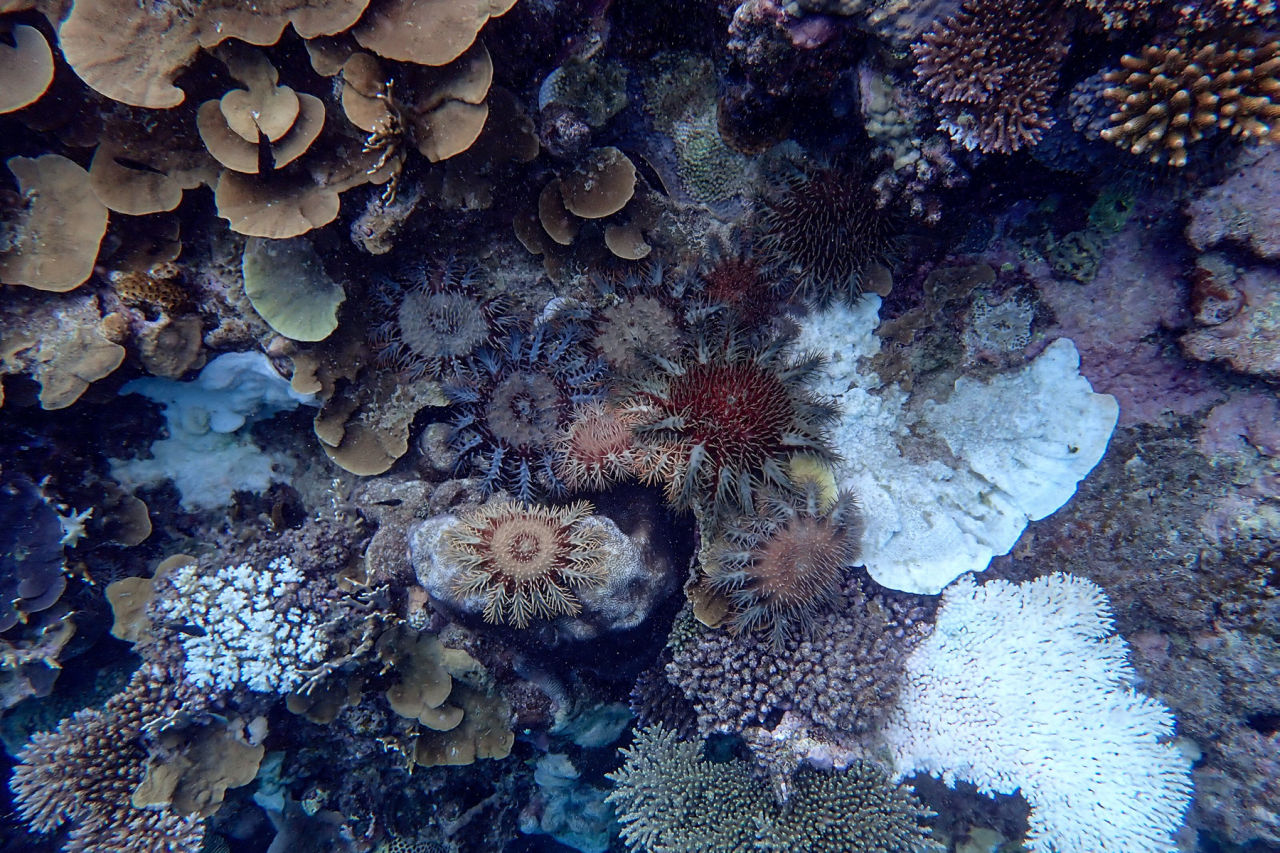
Multiple crown-of-thorns starfish residing on the Reef. Credit: Australian Institute of Marine Science.
#What role do crown-of-thorns starfish play in the ecosystem?
In low numbers on healthy coral reefs, COTS prefer to eat the faster growing corals which gives the slower growing species a chance to compete, enhancing the coral diversity of our reefs. However, when the coral-eating starfish appear in outbreak proportions, they eat all types of coral and the impact on coral reefs can be devastating.
#How much damage have crown-of-thorns starfish outbreaks caused on the Great Barrier Reef?
Since the 1960s, the Great Barrier Reef has experienced five major outbreak waves of crown-of-thorns starfish. Historically, these outbreaks have caused around 40% of coral loss across the Reef.
While reefs can recover from disturbances if given enough time, repeated pressures from bleaching, cyclones and starfish outbreaks are making recovery on the Great Barrier Reef much harder.
#What is being done to control crown-of-thorns starfish outbreaks?
Australia operates one of the world's largest coral protection efforts: the Crown-of-Thorns Starfish Control Program.
Managed by the Great Barrier Reef Marine Park Authority, the program deploys six dedicated vessels and more than 100 crew to cull COTS and protect vulnerable reefs. Trained divers inject the starfish with bile salt (made in the liver of oxen) or vinegar. This kills the starfish but does not harm the surrounding ecosystem.
The results show early intervention works. When control teams can respond early, starfish numbers can be six times lower and coral cover up to 44% higher compared to unmanaged reefs.
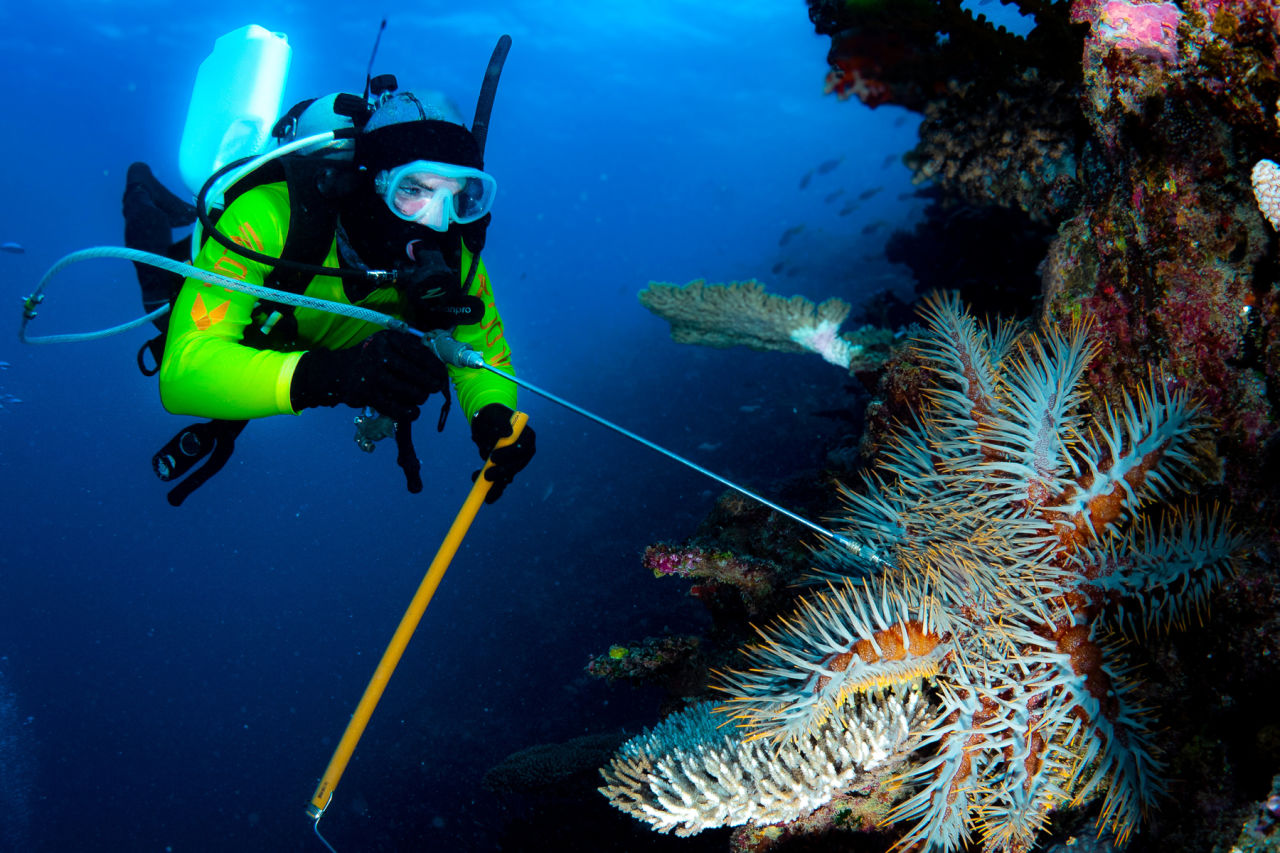
A diver injecting a crown-of-thorns starfish for culling purposes. Credit: Rickard Abom.
#How are outbreaks currently detected?
Detecting outbreaks early is challenging because crown-of-thorns starfish are skilled at hiding within complex reef structures, making them difficult to spot until populations are already well established.
Outbreak detection relies heavily on a method called manta tow surveys. In this process, a trained diver is towed behind a boat, searching for signs of outbreaks such as coral scarring or the starfish themselves.
While this approach is effective, it has limitations. It is labour intensive, difficult to scale and often only detects starfish populations once they have already reached outbreak levels. One of the biggest challenges in controlling outbreaks is detecting them early across the enormous scale of the Great Barrier Reef.
#How can scientists detect outbreaks earlier?
A new tool is changing the way we detect outbreaks at scale: eDNA.
Just like humans shed skin and hair into the environment, crown-of-thorns starfish release tiny fragments of DNA into seawater.
Working as part of the COTS Control Innovation Program, our partners at the Australian Institute of Marine Science (AIMS) have developed a genetic monitoring tool capable of detecting microscopic traces of starfish DNA in seawater samples.
The process is simple. People working out on the water collect seawater samples by pumping water through small filter papers. Those samples are then analysed in a laboratory to quantify the crown-of-thorns starfish DNA present.
This new early warning capability is a game changer. In fact, this eDNA method helped scientists detect the early stages of the fifth outbreak wave now occurring on the Great Barrier Reef. This allowed control crews to begin proactive management earlier than ever before.
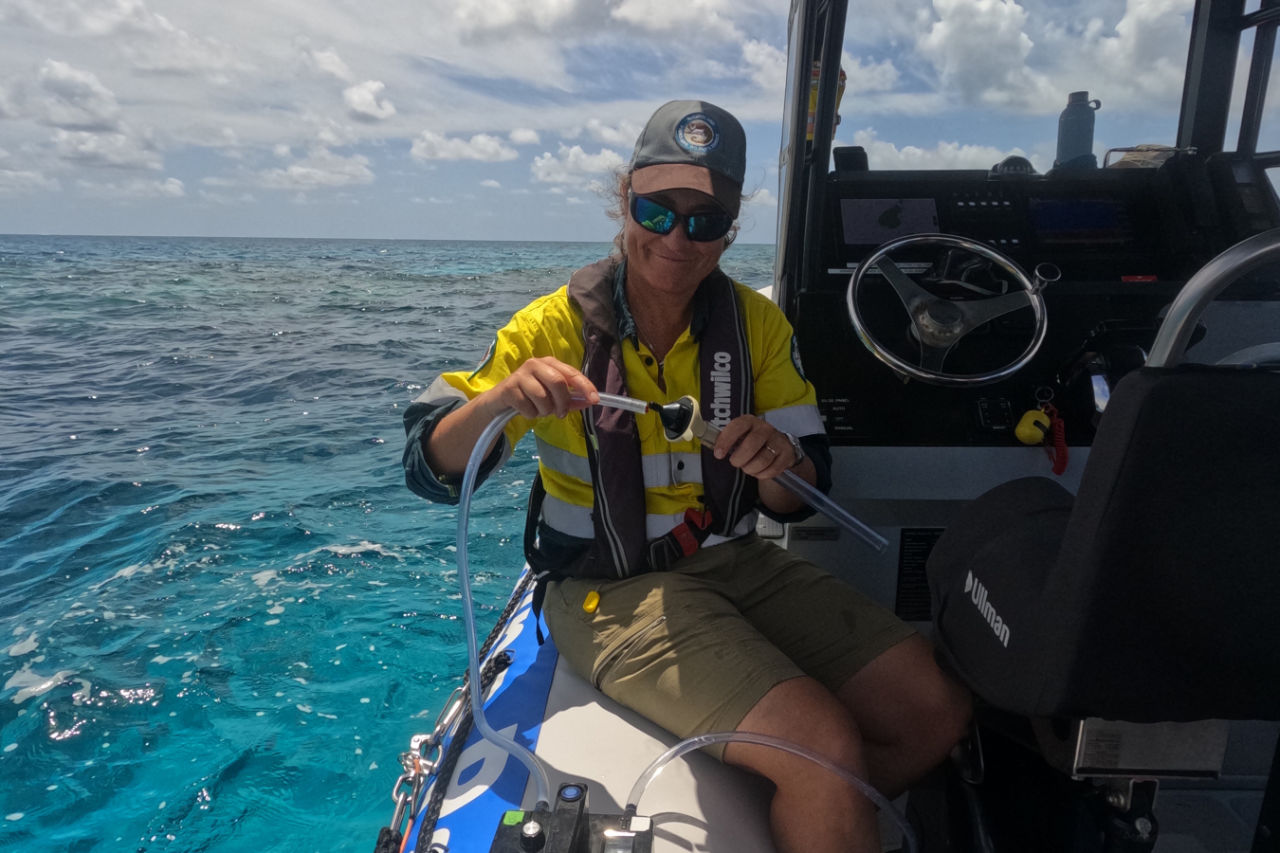
A Marine Parks ranger collecting samples of seawater for processing in the lab.
# Why is eDNA a breakthrough for crown-of-thorns starfish monitoring?
As crown-of-thorns starfish are native to the Great Barrier Reef, simply detecting whether they are present or absent is not especially useful, as you would expect to find them across many parts of the Reef.
What makes eDNA technology so powerful is that recent advances now allow researchers to quantify how much COTS DNA is present in seawater samples, helping estimate population levels and identify outbreaks much earlier than traditional methods.
The technology also has the potential to dramatically expand monitoring coverage across the Reef. As samples can be collected without divers entering the water, surveys are safer, faster and more accessible, even in poor weather or dangerous conditions.
Researchers are now working to make the method more cost effective. New laboratory techniques currently being tested could reduce analysis costs by up to 25%, helping scale the technology further across the Reef.
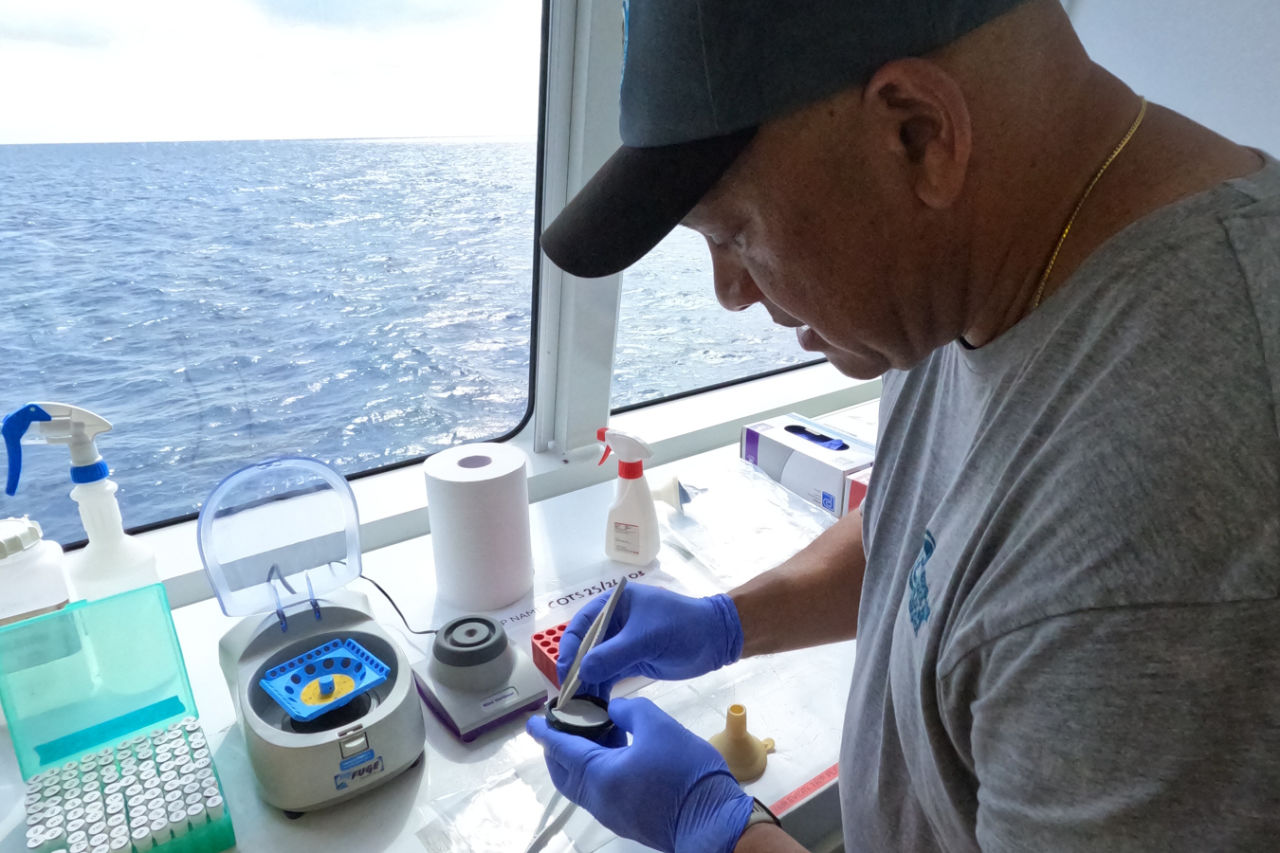
A Marine Parks ranger using eDNA technology to monitor crown-of-thorns starfish populations on the Reef.
#Is there a risk to culling a native species in terms of ecosystem balance?
The goal is to control crown-of-thorns starfish numbers, not eradicate them entirely. Control efforts aim to bring their numbers back into balance when outbreaks occur.
The COTS Control Innovation Program uses sophisticated models to help guide control teams and set culling targets. Our goal is ecological balance, not removing the species from the Reef.
#What can I do to help the Great Barrier Reef?
While the challenges facing the Reef are significant, the solutions are already underway.
Scaling this work depends on continued support. If you'd like to help drive the science and innovation that will power the future of coral reef protection and restoration, please make a donation today. Every donation helps us take this work further, faster.
The COTS Control Innovation Program (CCIP) is a targeted research program aimed at boosting capacity to predict, detect and respond to COTS outbreaks at scale across the Great Barrier Reef. The innovation program is delivered as a collaborative partnership between the Great Barrier Reef Foundation and leading institutions with expertise in COTS research - AIMS, CSIRO, James Cook University, and the University of Queensland.


