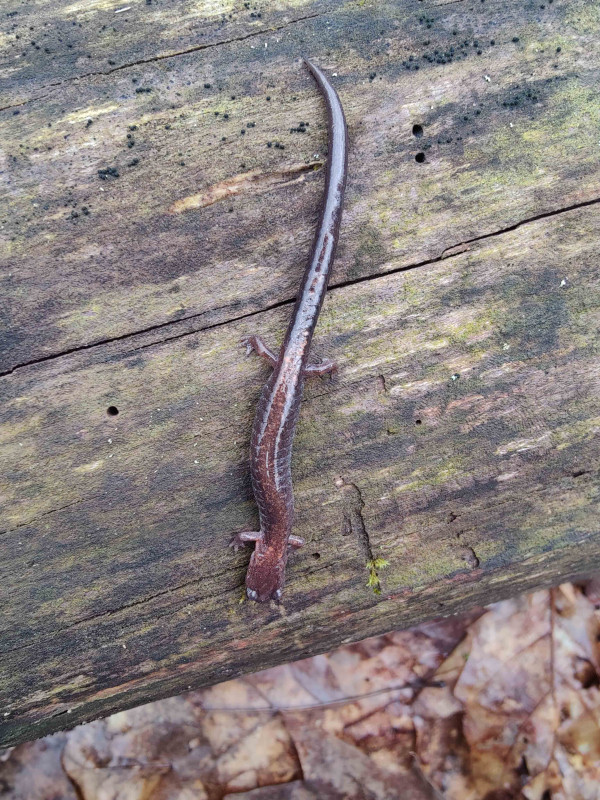
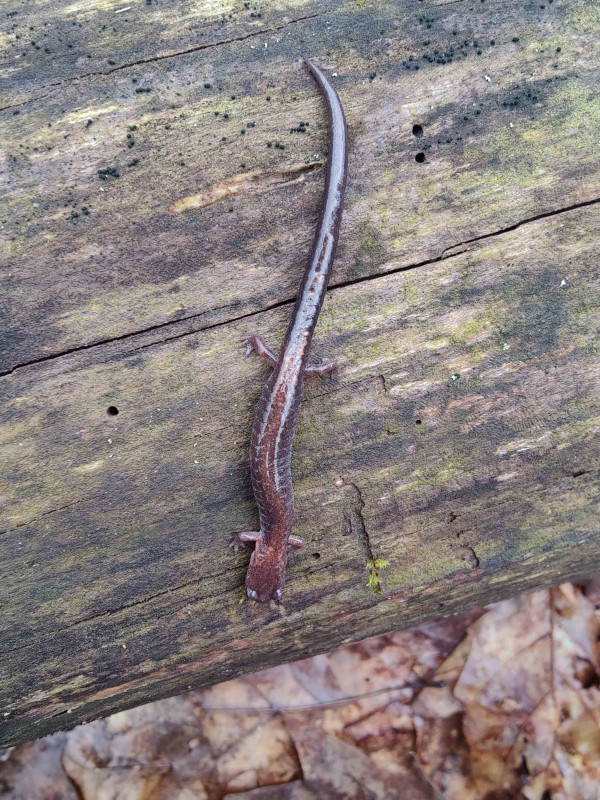
If the eastern red-backed salamander has an equivalent of Usain Bolt, Sophia Zaslow is determined to find it.
Since her undergraduate years, the Binghamton University doctoral student in biological sciences has conducted sprint trials on the common salamander species, to determine aspects of its physiological fitness. Co-authored with her graduate and undergraduate advisors, Binghamton University Assistant Professor of Biological Sciences Lindsey Swierk and David S. Steinberg of the University of New Hampshire, Zaslow's article on her undergraduate research "Intra-morph body colouration may correlate with performance in the eastern red-backed salamander" recently appeared in the Canadian Journal of Zoology.
A morph is a visually distinct variant within a species, in which a physical characteristic accompanies a genetic difference. Red-backed salamanders have three: the standard form, with a red stripe running from head to tail; a "lead" variant without the stripe that's uniformly slate gray; and a rare variant that's fully red-orange.
"Differences in color could potentially distinguish where they're living, predation, or their ability to live in certain habitats," said Zaslow, a Connecticut native who earned her BS in zoology from the University of New Hampshire.
Morphs can eventually become their own species, if the trajectory toward genetic differentiation continues; Zaslow's project focused on the red-striped variant.
"The stripe color really varies across individuals, and so we looked if that difference in color had any sort of potential physiological benefit, and used sprint speed as the corresponding trait to look at physiology," she explained.
When eastern red-backed salamanders are startled, they can run quickly, although typically not far. After all, their legs are rather short.
Zaslow gathered her test subjects from three different New Hampshire locations, including the campus nature preserve, another spot in the woods two hours north, and another spot two hours west.
After scooping them from the forest floor, Zaslow put them on a "performance track" to conduct sprint trials. The track was made of wood, with sides that prevented the amphibians from scampering off the edge. After setting up the camera, she laid down a damp piece of paper to keep the creatures from drying out.
"I put them on the end of the track, tapped them with a paintbrush, and just had them run down the track to the best of their ability," she said. "The track had little markers to denote distance."
Salamanders that refused to run were excluded from the study. All were returned safely to their forest homes.
On the campus site, she didn't find any correlation between sprint speed and color. However, she found a significant positive relationship between the factors at the northern site, and a negative relationship at the western site.
Rather than physiology, the researchers speculate that a site's resource availability or predation pressure may determine the salamanders' likelihood of sprinting.
Zaslow is continuing to focus on red-backed salamanders in her doctoral research, this time in the Broome County area. During the summer, she plans to again conduct behavioral trials focused on sprint speed and movement and will track respiration rates as a proxy for metabolism.
The red stripe on newly hatched salamanders is typically solid and very bright, she explained. She's curious to see if salamanders experience color changes in concert with physiological aging.
"They're long-lived; they can get to 8 or 9 years in age, which is pretty impressive for a small animal," she said. "Across any species, as we age, we start to senesce; things move more slowly, and you're not able to eat and process food as well."
"I'm very glad that I get to continue the research I was doing in my undergrad years here at Binghamton," she added.