
The rapid expansion of renewable energy to tackle the climate crisis is systemically violating the claims and livelihoods of local communities across the planet.
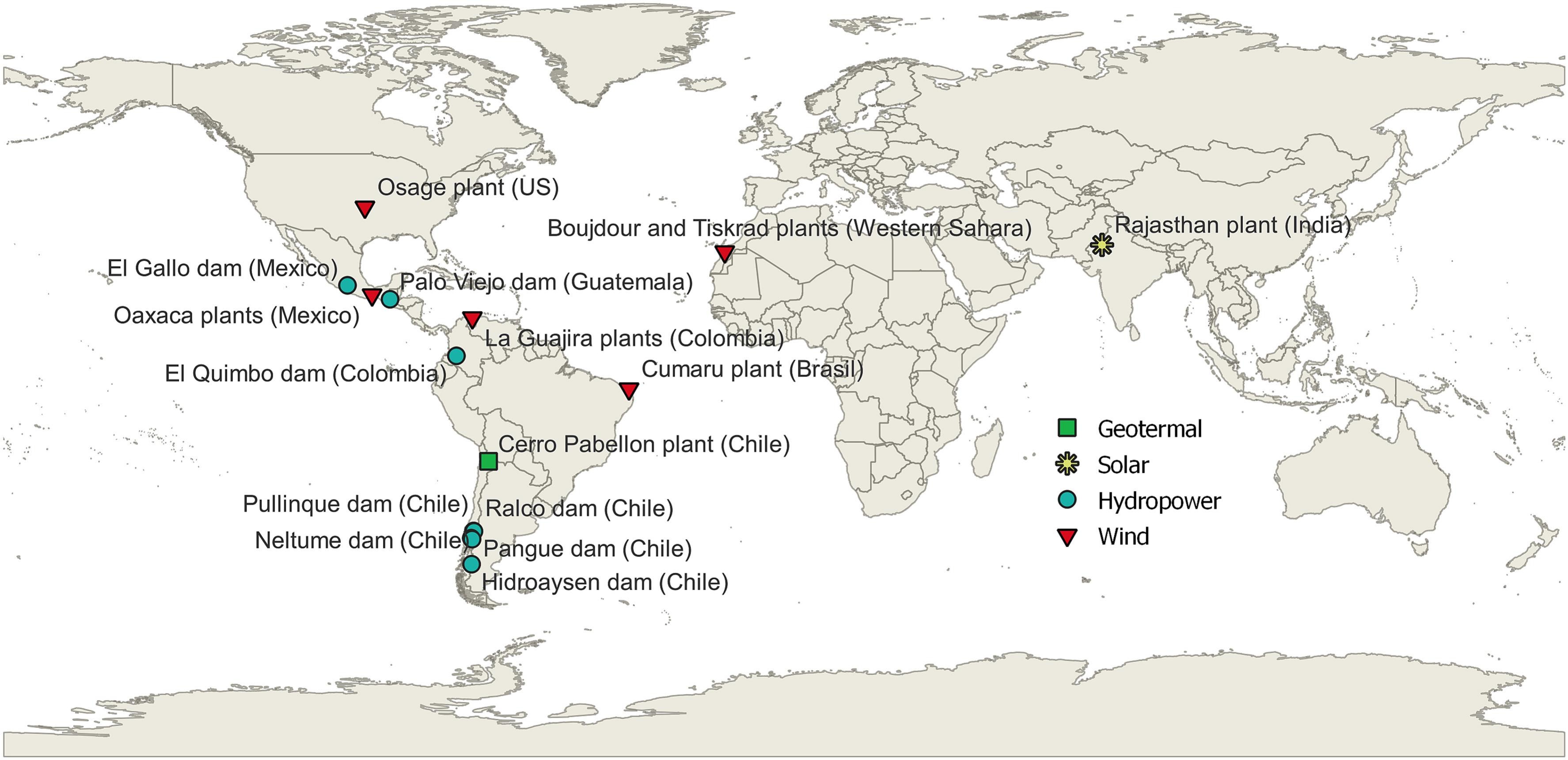
An exhaustive international study with the involvement of ICTA-UAB reveals that large energy corporations use corporate sustainability discourses to legitimise wind, solar, and hydropower projects that, in practice, exclude communities from just economic and financial returns and ignore their social and environmental impacts.
Focusing on the major Italian group Enel, one of the largest electricity utilities globally and majority owner of the Spanish energy company ENDESA, the research analyses 15 cases of social conflicts around renewable energy projects, including solar, hydro, wind and geothermal power, in the United States, Mexico, Guatemala, Colombia, Chile, Brazil, India, and Western Sahara. The study, recently published in the scientific journal Ecological Economics, also involves researchers from the Università Ca Foscari of Venice, the Universitat Ramon Llull and Universitat Oberta de Catalunya in Barcelona, and The School of Oriental and African Studies (SOAS) of London.
Despite following the supposedly novel corporate concept of "Creating Shared Value" and presenting it as a way to benefit both companies and local populations, the company is still being confronted by local communities for infringing their rights. The authors argue that the corporate narrative works as a moral upgrade of corporate social responsibility, as corporations unilaterally define what counts as "value" in the energy transition, leaving out the fundamental values of affected communities, such as cultural ties to land, food sovereignty, health, and autonomy over their natural resources.
The authors also warn that ENEL's green and social washing is not an isolated case, but a global pattern transferable to the renewable megaproject model worldwide, where climate urgency is used to accelerate energy infrastructure building that reproduces profit-making logics over territorial well-being. Consequently, the results cast doubt on the willingness of large corporations to really meet due diligence and human rights benchmarks.
"The energy transition is urgent, but it cannot be built on the suffering of communities whose values are left out of the equation. Understanding what 'values' are meaningful locally is a precondition for a transition that is truly just and sustainable over time. For example, it is contradictory to provide hydropower to the mining industry and claim you are using green energy, when the affected communities have been cheated, forced to move, and have lost their means of livelihood and community bonds, as happened in Chile," says Daniela Del Bene, researcher at ICTA-UAB and Ca' Foscari University of Venice.
Treaty violations
Social movements, organised communities, journalists, and international NGOs have long exposed violations of agreements and of basic human rights principles. Through a counter-reporting exercise and interviews, the research discusses five dimensions of impacts: environmental, socio-economic, health-related, ontological, and political. Among them, grievances highlight the flooding of protected reserves, loss of biodiversity, and incomplete environmental impact assessments. Added to these are the forced displacement of populations, disruption of traditional economies, and noise-related health issues in wind energy areas. Likewise, communities face growing stress, inadequate economic compensation, lack of transparent information, and the systematic dismissal of spiritual or relational values in non-self-governing territories and conflict areas.
Impacts on flora and fauna appear in every case, often alongside grievances over incomplete or fragmented environmental impact assessments. For instance, at the El Quimbo hydropower dam in Colombia, sources report that more than 8,000 hectares flooded, largely within a protected area, and that over 30,000 people were affected. In Brazil's Cumaru region, where company wind energy parks are located, residents have denounced noise-related illnesses and even cases of depression, alcoholism, migration, and suicide, effects linked by community members to the loss of land and community ties. A similar situation can be found in the Thar Desert in the Indian state of Rajasthan, where large solar farms are being built; while in Western Sahara, serious issues linked to that territory's non-self-governing status have also emerged.
"Our cases show that the form of harm changes between dams, wind farms and geothermal or solar parks, but the underlying logic does not: community relationships to the territory are subordinated to the logics of profit-making," notes Roberto Cantoni from Ramon Llull University.
"The discourse of corporate responsibility changes over time to accommodate pressing concerns around the social sustainability of large-scale development projects. The problematic modus operandi of transnational corporations does not. And the idea of 'creating shared value' is an example of this contradiction," indicates Antonio Bontempi, researcher at ICTA-UAB.
The publication calls on governments and institutions to build energy governance on plural values. To achieve this, the authors propose shifting from consultation only to real co-decision power for affected communities. Likewise, they call for impact assessments that recognise relational and spiritual values, also in relation to non-human species; collectively decided benefit-sharing; and strong support for community-run energy systems.
Reference article: Del Bene D., Cantoni R., Bontempi A., Di Felice L.J., Siciliano G. (2027). Shared Value vs Plural Values. Contesting Renewable Energy Projects of the Enel Group. Ecological Economics. 10.1016/j.ecolecon.2026.109268


