Eastern Canada has seen a rise in the number of hurricane- and near-hurricane strength events battering its maritime areas, with particularly violent storms in 2003 (Hurricane Juan), 2019 (Dorian) and 2022 (Fiona). While these seem to be recent phenomenon, the region has experienced this kind of surge in activity before, according to a new Concordia study.
The research, which looked at core samples taken from peat bogs in the Magdalen Islands in the Gulf of Saint Lawrence, provides a deeper understanding of 4,000 years of storm activity in the northwestern Atlantic. Published in the journal Climate of the Past, the study is the first to use geochemical analysis of peatland samples to research and reconstruct the histories of paleo-storms in eastern North America.
Peatlands build up layers of organic material over time, creating a natural record of the past. Because these layers form steadily and relatively quickly, they can trap wind-blown particles from storms, allowing scientists to study past storms in much finer detail than most coastal sediments can provide.
"The Magdalen Islands have been plagued with high levels of erosion due in part to increasing storm frequency, but studies have not been made on the long-term impacts of these storms on the region," says lead author Antoine Lachance, a PhD candidate at the Climatology, Hydrology and Paleo-Environmental Lab in the Department of Geography, Planning and Environment.
"We do not have very much information about the highest latitudes where hurricanes travel and why, but eastern Canada seems to be at the limit of where they remain active. We wanted to see if the area had always had hurricane activity, how the climate may have been connected, and what possible impacts climate change will bring."
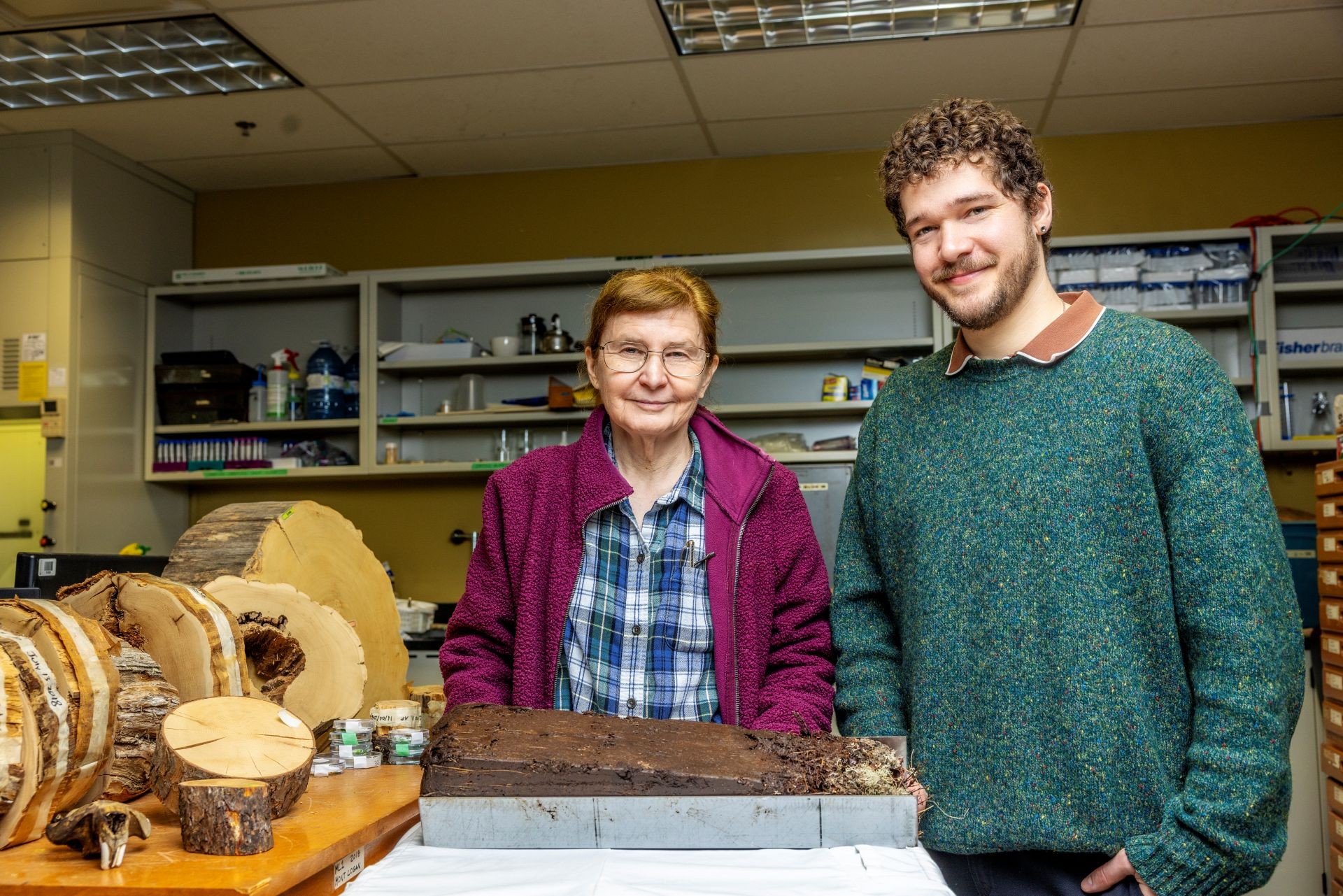 Antoine Lachance with Jeannine-Marie St-Jacques: "We wanted to see if the area had always had hurricane activity, how the climate may have been connected, and what possible impacts climate change will bring."
Storm effects inland
The team studied two peatlands on Havre-Aubert Island and measured tiny changes in sand content and chemical elements carried by strong winds during storms. Because these bogs are fed almost entirely by rain and airborne material, sudden spikes in the soil's mineral composition are strong indicators of intense storm winds. This approach captures storm wind strength rather than just coastal flooding, filling an important gap in existing hurricane research.
The results show that storm activity and intensity around the Magdalen Islands have increased and decreased over the centuries. The records identified three major periods of heightened storminess: roughly 800 to 550 BCE; 500 to 750 CE; and 1300 to1700 CE, the so-called Little Ice Age. The researchers noted decreased storm activity during the warmer Medieval Climate Anomaly, circa 900 to 1300 CE.
The periods align closely with storm records from eastern Canada, the northeastern United States and the Bahamas. The findings also strengthen confidence that the Magdalen Islands records reflect large-scale North Atlantic storm patterns rather than local events.
However, storm activity in the higher latitudes did not always mirror tropical hurricane formation further south, the researchers say. Instead, hurricane activity appeared to be strongly influenced by regional climate conditions such as sea-surface temperature and atmospheric pressure. These factors can increase a storm's intensity as it moves north and transitions into a post-tropical system.
"We think colder climates create a strong temperature gradient which pulls storms north, away from the tropics," says Lachance. This helps explain why some periods, like the Little Ice Age, saw increased storm impacts in Atlantic Canada even when hurricane activity in more tropical areas was lower.
Warming effects unknown
The researchers suggest that clearly linking storm activity over multiple millennia to climate conditions helps explain regional storm dynamics and could be used to anticipate future storm risks. However, wide-spread warming brought on by anthropogenic climate change creates more uncertainty, Lachance says.
"The consequences of a storm are going to be much more severe with even a 10-centimetre rise in sea levels," he says. "With less sea ice in the Gulf of Saint Lawrence leading to higher winds and higher waves, we expect even smaller storms will have a bigger impact."
Associate professor Jeannine-Marie St-Jacques co-wrote this study, along with Matthew Peros at Bishop's University, Pierre Francus at l'Institut National de la Recherche Scientifique and Nicole Sanderson at UQAM. All are members of Geotop - the Research Centre in Earth System Dynamics.
Funding for this research was provided by the Natural Sciences and Engineering Research Council of Canada and the Fonds de recherche du Québec.
Read the cited paper: "High-resolution paleo-storm reconstruction from Eastern Canada align with late Holocene northwestern Atlantic hurricane records"