In medicine, security, nuclear safety and scientific research, X-rays are essential tools for seeing what remains hidden.
The materials used to create X-ray detectors can be rigid, expensive and laborious to produce. But new research led by FSU Department of Chemistry and Biochemistry Professor Biwu Ma is creating lower-cost, adaptable materials that could revolutionize X-ray detection technologies.

In two separate research studies, Ma's group offers solutions to long-standing challenges in X-ray imaging. In the first study, published in Small, the team developed a new material that generates electric signals when exposed to X-rays, enabling direct X-ray detection. In the second study, published in Angewandte Chemie, the researchers used a related material to produce low-cost scintillators, which are materials that emit visible light when exposed to X-rays or other high-energy radiation.
"We have traditionally relied on inorganic materials for X-ray detection, but they are often rigid, expensive to manufacture and energy-intensive to produce, and they have many limitations," Ma said. "What we have been trying to develop is a new class of materials that can address the issues and challenges faced by existing materials."
In these studies, researchers created new hybrid materials composed of both organic and inorganic components, known as organic metal halide complexes (OMHCs) and organic metal halide hybrids (OMHHs). By tailoring the structures of these materials at the molecular level, the team enabled different forms of X-ray detection. This research represents a major step toward developing lower-cost, scalable and flexible X-ray detector technologies capable of overcoming key limitations of conventional inorganic systems.
Commercially available direct X-ray detectors are constructed using inorganic semiconductors, made from non-carbon materials, such as cadmium telluride (CdTe) and cadmium zinc telluride (CdZnTe). These materials contain toxic elements and require energy-intensive processing, making them expensive.
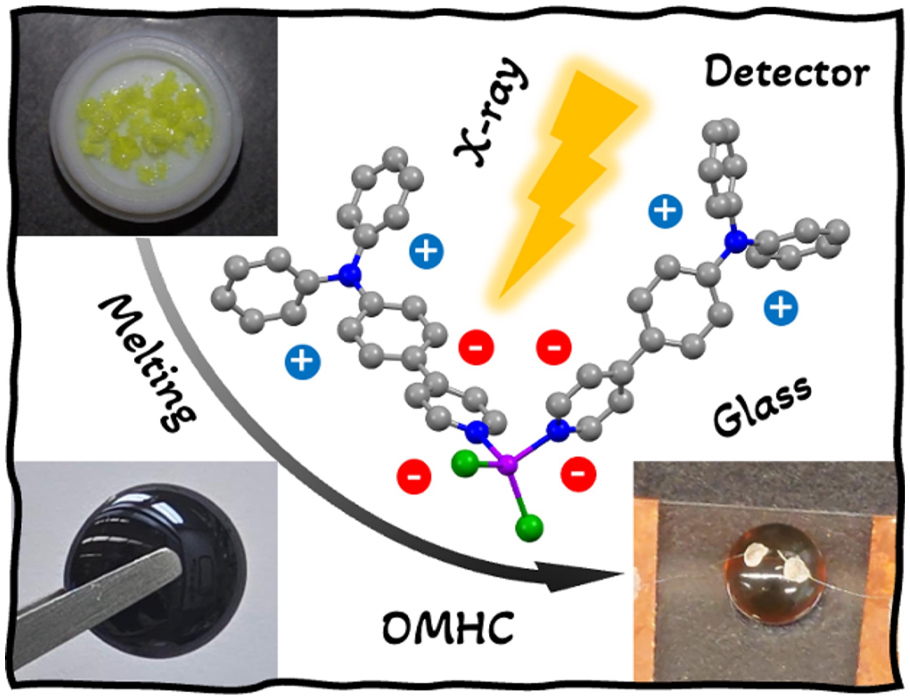
In the first study, the team demonstrated, for the first time, the use of OMHCs as a material for making direct X-ray detectors. These are materials composed of carbon-based semiconducting molecules that are bonded to metal halides, which are compounds made of metal and a halogen element. The specific OMHC compound developed by the team was created out of zinc, bromine, and a carbon-based molecule, enabling efficient X-ray absorption and electron transport within a single material.
Using a melt-processing approach, similar to melting plastics and allowing them to cool into a desired shape, the researchers transformed OMHC molecular crystals into amorphous, glass-like materials that can be molded into ready-to-use forms. They used these materials to make direct X-ray detectors that convert incoming X-rays into electrical signals.
The resulting detectors produced strong electrical responses even at low X-ray exposure levels, making them more effective than detectors made from traditional materials. The team also evaluated the long-term stability of detectors made with the new material. After storing the detectors for four months under ambient conditions, testing showed they retained 98% of their initial performance.
OMHCs offer additional practical advantages. They are less expensive to produce than materials currently used in commercially available X-ray detectors because they can be synthesized from abundant and non-toxic raw materials. Moreover, the simple melt-processing method also makes device fabrication easier and more scalable than existing approaches.
"This is actually the first time these OMHC materials have been used to fabricate direct X-ray detectors," said Ma. "They can be prepared in a low-cost way while delivering high performance. From a sustainability perspective, this new class of materials offer tremendous advantages over conventional materials."
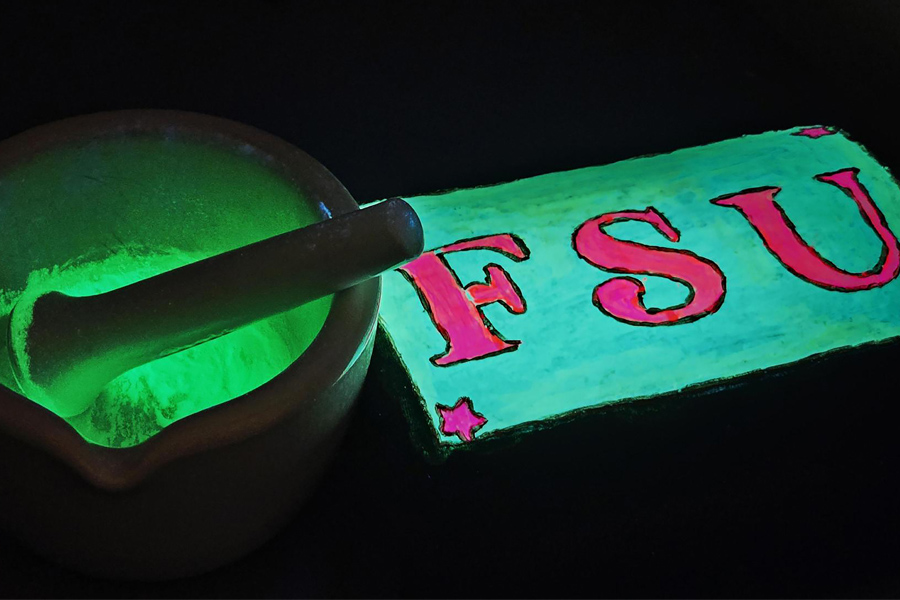
In the second study, the team developed a new version of OMHH-based scintillators that exhibit high light yield and fast response, meaning they emit strong visible light and respond almost instantly when exposed to X-rays. OMHHs are similar to OMHCs, but a different type of chemical bond brings together organic components and metal halides into a single material.
The work builds on the team's years of effort in the area since 2020, when they demonstrated the first ecofriendly OMHH scintillators. Earlier versions of OMHH scintillators relied on slow crystal growth processes that limited their size and flexibility, and their light emission faded relatively slowly. This latest generation of OMHH scintillators overcomes both challenges by eliminating the need for crystal growth and by dramatically speeding up the light response.

By carefully designing the molecular structure, the team created a new amorphous OMHH material that shows fast response in nanoseconds. Unlike earlier versions of OMHH scintillators, in which light emission comes from metal halide centers and lingers for longer periods, the new material emits from the organic components of the material, exhibiting a faster response while maintaining excellent X-ray absorption and high light output.
Fast-response scintillators are especially important for advanced radiation detection and imaging. Their rapid light emission allows for clearer images, improved timing accuracy and reduced signal overlap, which are critical for applications such as medical imaging, security screening and real-time radiation monitoring.
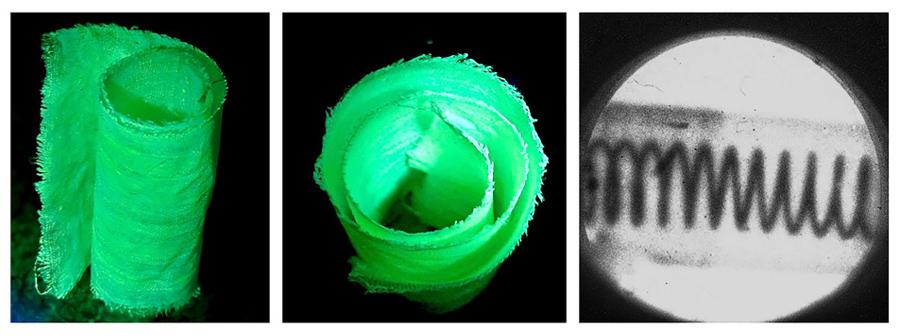
The amorphous nature of the material also allows it to be easily processed into thin films and coatings. Using this approach, the team created fabric-based X-ray scintillators that can be integrated into clothing, enabling wearable and portable radiation detectors. These flexible scintillating fabrics represent a significant departure from traditional rigid detectors and open new possibilities for comfortable, adaptable and low-cost X-ray detection technologies.
While the two studies focused on different X-ray detection approaches, both used similar material design strategies to address major challenges in developing next-generation X-ray detection technologies.
FSU has begun filing patents to commercialize the technologies developed in Ma's group and test them in real-world conditions. These advancements offer exciting and cost-effective solutions for next-generation X-ray detection technologies. Commercialization of these materials could benefit many fields, including medical imaging, security scanning, nuclear safety and more.
In addition to the team's internal efforts, the group has collaborated with research institutions and industrial partners to explore diverse applications of these materials. These collaborations include Delft University of Technology (TU Delft) for photon-counting computed tomography, the University of Antwerp for luminescent dosimeters for radiotherapy, the University at Buffalo for pixelated X-ray imagers, and Qrona Technologies for X-ray microscopy technologies.
"The materials are very unique and were developed here at FSU," Ma said. "We believe our materials and devices have tremendous potential to outperform existing technologies and address key challenges in the field."
The research has been supported by federal funding from the National Science Foundation Division of Materials Research and Innovation and Technology Ecosystems. The lead authors of the two publications are Oluwadara Joshua Olasupo, who recently graduated with a Ph.D., and Tarannuma Ferdous Manny, a fourth-year graduate student. Collaborators from TU Delft and the University at Buffalo also contributed to the work. The research additionally involved high school students through the FSU Young Scholars Program.