
To see the latest advance in sustainability on Cornell's campus, facilities engineer Sam Fairchild will tell you to look up to the roof of Olin Hall.
Perched along nearly the entire length of the building's west wing, a brand new heat recovery system - "a beautiful assembly of sheet metal," Fairchild said - is a small cityscape, with fans 30 feet high, metal shed-like structures and a long chute for the flow of air.
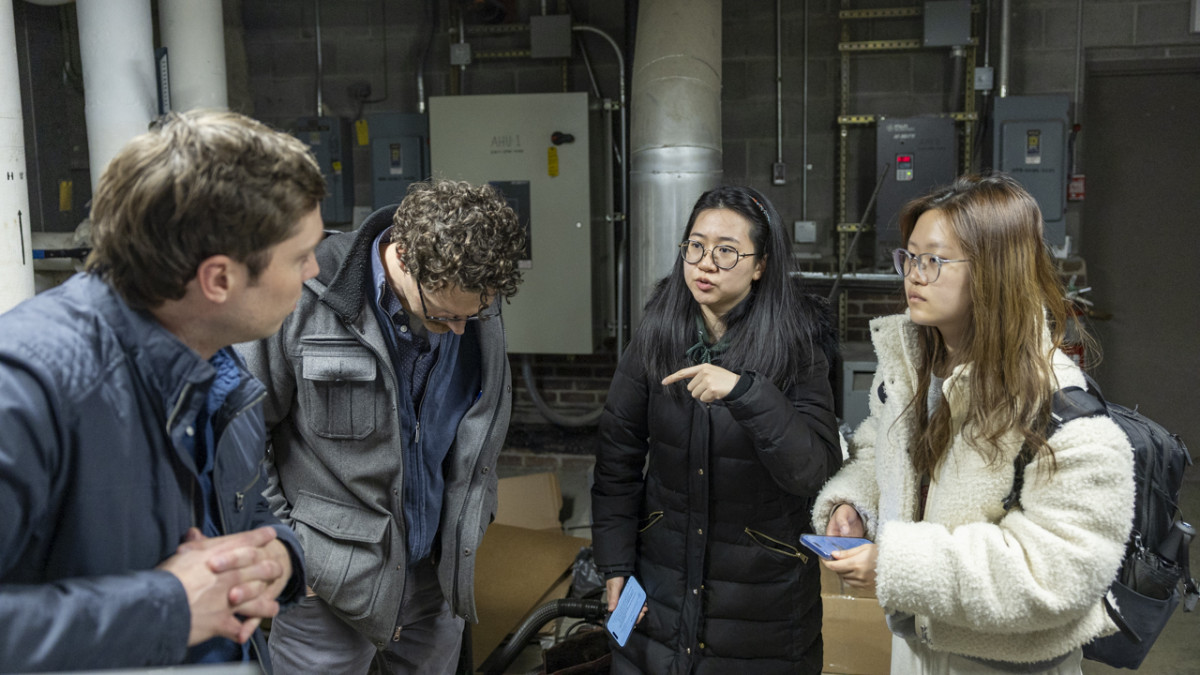
From left to right, Cornell facilities staff Sam Fairchild and Jason Collins answer questions from students Gina Chen '28 and Eunice Son '28 in a tour of Olin Hall's mechanical room.
The system is one of three installed on campus and is part of a larger portfolio of improvements, across 23 campus buildings, that have massively overperformed on initial targets for cost and carbon savings. The renovations, part of Cornell's Energy Conservation Initiative (ECI) save the university $2.29 million and 9,000 metric tons of carbon annually, and will pay for themselves in six years, rather than the 10 the team originally estimated.
"We just blew the goals away," said Fairchild, an energy engineer in Facilities and Campus Services' (FCS) Department of Energy and Sustainability. "In the context of our campus decarbonization mission, this is directly pushing us towards that goal by reducing demand. It also follows our rule of thumb when choosing projects - of having that simple payback."
The effort fits into Cornell's larger, long-standing approach of using campus facilities and its operations as a Living Lab, where staff, researchers and students innovate, experiment and learn while advancing sustainability goals. From pioneering campus hydropower more than a century ago to the 21st-century innovation of Lake Source Cooling and the exploration of geothermal, the university has repeatedly pursued cutting-edge technologies to decarbonize, provide proof of concept and lead in sustainability.
"We do some pretty amazing things," said Cole Tucker, associate vice president of energy and sustainability in FCS. "It's not only about the problems we solve for Cornell, it's about how our solutions can be maximized globally."
Tucker said ECI - which has saved the university more than $75 million since 2011 and enough carbon to take Cornell's Combined Heat and Power Plant offline for an entire year - lowers the university's overall energy load, so that future systems have less to decarbonize.
"Since 2000, through really diligent efforts across many generations and energy management practices, we've reduced our projected load by 50% - that's 50% fewer holes we have to drill on campus, 50% fewer heat pumps," Tucker said. "What different problems are we going to be able to solve with this unique mix of operational experts and faculty leadership? That to me is really exciting."
Chemicals, crickets, coordination
Ventilating a single fume hood in a Central New York lab can use as much energy annually as three small homes, Fairchild said. Multiply that by thousands of fume hoods in labs across Cornell's campus, and the energy needs become extreme.
Driving those energy costs is the need to warm or cool the outdoor air used to ventilate. The new heat recovery units - on the rooftops of Olin Hall, Duffield Hall and the Biotechnology Building - can take heat from air that's already cycled through the building and apply it to air coming from outside. On a peak winter day, the system can heat -5 degree air to around 35 degrees.
"That's saving a bunch of heating energy," Fairchild said. "And in Olin, it's passive heating, there's no energy input into the type of coil we're using, no maintenance, no moving pumps or fans or belts. It's really pretty incredible."

The latest renovations in 23 buildings on campus included adding occupancy sensors to labs, so that ventilation could be adjusted according to use.
The renovations also included digitizing HVAC controls and installing occupancy sensors, so that, rather than running continuously, the air flow to the labs and hoods can be adjusted based on use.
Carrying out the installations, which took place between 2019 and 2024, required massive coordination to minimize disruption to research. Each building had its own considerations: chemicals in Olin; the mass spectrometer in Duffield. For Biotech, it was all about crickets.
"I had a lot of meetings about crickets," Fairchild said.
In Olin Hall's west wing, they removed 38 old exhaust fans, one by one, lab by lab, so that contractors could do their work, often in a two- or three-day window per lab. Then they connected the labs to the new heat recovery unit one at a time as well.
"This has been a collaboration with the researchers, the building owners and operators, the facility directors, project managers," Fairchild said. "I mean, to make a project like this happen requires everyone at the table."
Fairchild's team is already building the next portfolio of projects. Every year, with support from the state's FlexTech program - out of the New York State Energy Research and Development Authority (NYSERDA) - facilities engineers conduct energy studies on between 10 and 20 campus buildings and file the findings in a "library of opportunities," Fairchild said.
NYSERDA's Commercial Industrial Carbon Challenge awarded Cornell $1.2 million to help implement renovations from its more recent portfolio; Fairchild said it's one of various incentive programs Cornell is leveraging to advance decarbonization goals.
"There are no shortage of things to investigate and efficiencies to expand on - and nothing has boundaries around it," Fairchild said. "If you can conceptualize the way a system will operate more efficiently, you can study and find out if that's an opportunity."
'It doesn't happen by magic'
On a rare sunny day in March, Fairchild opened the door to a dark, cavernous mechanical room on the fourth floor of Olin Hall, inviting students to see and understand the maze of large tubes and fans that power the building.

On a peak winter day, the recovery system can use heat that's already cycled through the building to warm -5 degree air to around 35 degrees.
The students, from the Cornell Duffield College of Engineering project team Engineers for a Sustainable World, have been taking advantage of the Living Lab on top of Olin Hall for the last semester by tracking the energy savings and performance of the heat recovery system. They analyze data provided by FCS and produce reports that they then send to Fairchild, who provides feedback and answers questions. On March 24, they witnessed the building's inner workings for the first time.
"Our HVAC systems, these are things hidden behind walls, but it's really important for people to know what it takes to operate this place," Fairchild said. "It doesn't happen by magic."
Gina Chen '28, an environmental engineering student in the College of Agriculture and Life Sciences and a member of the project team, said that access to a large-scale, real-world sustainability project is invaluable to her education.
"I want to see those applications because that's what I want to work on when I graduate," Chen said. "I see Cornell as a great, leading institution in sustainability, and all of these projects, from Earth Source Heat and Lake Source Cooling, all of these innovations are really inspiring to me personally. It makes me really proud as a student to be a part of this community."


