
Injectable dermal products have become some of the most sought after cosmetic treatments. But behind every injection lies a complex combination of materials that determines how these products behave during injection and use.
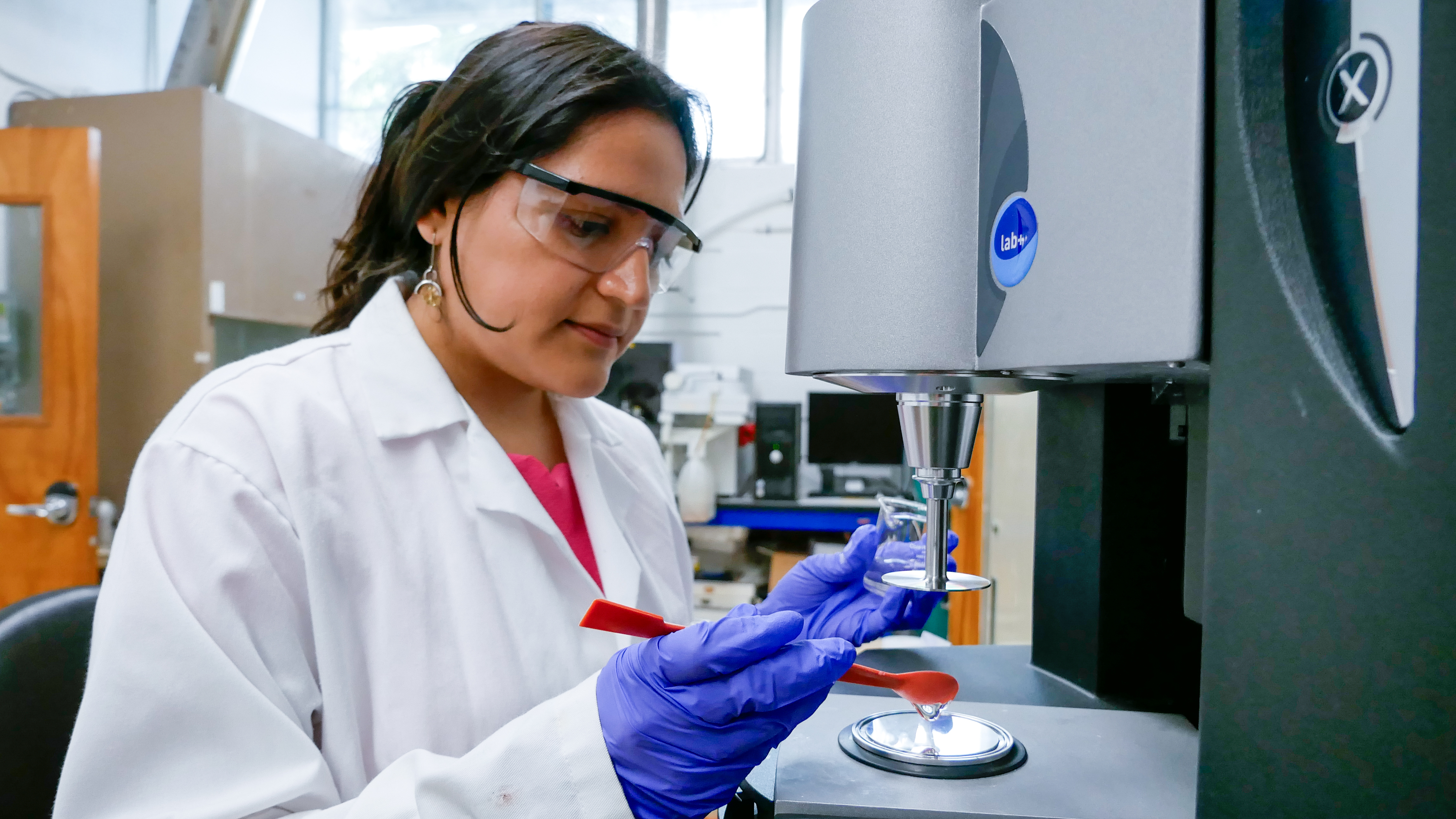
At the University of Miami College of Engineering, doctoral student Maria Calderon Vaca works in the Soft Matter Product Design Group, led by Samiul Amin, professor of practice in the Department of Chemical, Environmental, and Materials Engineering. She studies how the microscopic structure of hydrogels influences how they flow and recover when used as injectable dermal products.
"One of the most common hydrogels is hyaluronic acid, which is naturally compatible with the body because we already produce it," Calderon Vaca said. "To make it more effective, particles can be added for different purposes."
The group's latest study, published in ACS Omega, was conducted in collaboration with Allergan Aesthetics, an AbbVie company. Allergan Aesthetics is a leader in injectable aesthetic treatments, with market leading products including Botox Cosmetic and Juvederm.
The research focuses on calcium hydroxyapatite, or CaHA, a particle commonly used in injectable dermal formulations, and examines how the material behaves depending on when the particle is added to the hyaluronic acid gel.
"It was truly exciting to discover how the interaction between these particles and the hyaluronic acid hydrogel matrix brings about a significant shift in material structure and behavior and how those changes may support future biomedical and cosmetic applications," said Hai Xin, a postdoctoral fellow in the Soft Matter Product Design Group and first author of the publication.
In the first method, calcium particles were built into the gel as it formed, becoming part of its internal structure. This created a firmer formula that holds its shape and is less likely to spread. However, the thicker structure can also make the material harder to inject or mold.
In the second method, calcium particles were mixed in after the gel was already formed, allowing them to move more freely. This produced a more flexible formula that injects easily and settles softly into tissue. Because the particles are not locked into the structure, this type of gel may spread more within the tissue.
By directly comparing these two approaches, the researchers demonstrated how small changes in formulation can dramatically influence how a filler feels and flows, knowledge that is helping guide the design of next generation injectables.
Calderon Vaca said one approach is not necessarily better than the other. Firmer hydrogels are typically used in areas of the face with less movement, while formulas that flow more easily are often used in areas with more movement, such as around the eyes.
"Our research is helping industry develop better products for specific uses," she said.
Beyond beauty
While the research has cosmetic implications, its potential goes beyond aesthetics. Injectable hydrogels like the hyaluronic acid and calcium hydroxyapatite composites studied are also being explored for medical applications. Whether injected or used topically, hydrogels hold promise for wound healing and drug delivery.
The project highlights how industry partnerships with the College of Engineering are driving global biotech innovation.
"Allergan Aesthetics is dedicated to advancing the science behind aesthetic medicine," said Prithwiraj Maitra, vice president of global skincare research and development at Allergan Aesthetics. "In partnership with academia and external scientists, we can identify new technologies and properties that will help elevate treatment experiences and outcomes for patients."
"We are very excited about this publication and our continued collaboration with AbbVie and Allergan Aesthetics," Amin said. "This partnership exemplifies the core strength of the Soft Matter Product Design Group in applying deep scientific expertise to solve technically challenging, industry driven problems."
Allergan Aesthetics provided the cross linked hyaluronic acid gels used in the study and supported the research, helping students and researchers apply engineering principles to real world product challenges.
"It is fascinating to see how each ingredient contributes to a whole product," Calderon Vaca said. "By focusing on the behavior of core materials and processes, we can support the development of tomorrow's medical treatments."


