
Key points
- Dr Thomas Jones doesn't teach microbes new tricks - he finds ones already doing the jobs he needs and helps them work faster.
- His research pairs microbes with crushed basalt rock on farms, speeding up a natural process that pulls carbon from the air and simultaneously enriches soil.
- A geologist by training, he sees microbes as valuable teammates and his science as a creative, almost artistic, pursuit.
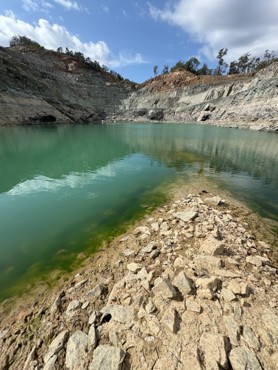
A working quarry isn't a pretty sight. Dust and bare rock, deep cuts into a hillside that appear like steps made for a giant. Nothing grows here, or so you would assume.
Dr Thomas Jones, a geomicrobiologist and Early Research Career Fellow at CSIRO, Australia's national science agency, knows appearances are deceiving. Hidden in plain sight among the bare rocks are millions of living microbes, each brilliantly suited to their niche habitat, some thriving in spaces that would be toxic to other life.
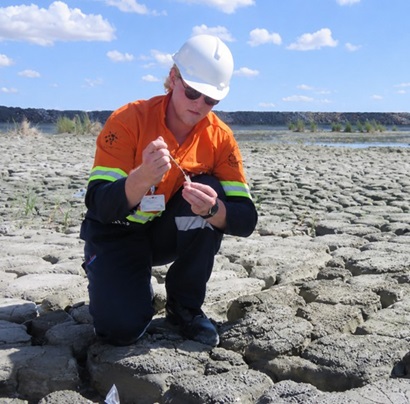
"We are looking for microbes that are already present here," Dr Jones said. "Then we take them back to the lab, where they become starter cultures for our experiments."
To anyone else, it might look like Dr Jones is very carefully collecting a smear on a rock, but to him that 'smear' could hold the secrets to cleaning up impacted landscapes and even capturing carbon from the atmosphere.
"We're talking about climate change, about removing gigatonnes of carbon dioxide. What does that even mean?" he said. "Then on the other side, we're talking about microbes that are only 1 micron. You could fit 100 of them across the thickness of a hair."
It's activity on a scale that stretches from the microscopic to the planetary.
Glimpses of a hidden world
As a geomicrobiologist, Dr Jones has dedicated his career to studying how microbes interact with minerals – and how we might turn those relationships to our advantage.
Many of these processes are very old and have been pivotal to creating our planet as we know it.
"Microbes have been pulling carbon dioxide out of the atmosphere for three and a half billion years – as long as life has existed," Dr Jones said.
Stromatolites are a great example – the layered mounds are created by communities of photosynthetic microbes drawing on carbon dioxide from the air and locking it into calcium carbonate mineral layers. They're so ancient, they helped create Earth's early atmospheric oxygen. Needless to say, Dr Jones is fascinated by them.
To watch these microbes at work, he uses scanning electron microscopes, revealing surfaces in extraordinary detail. When he wants to know which element sits where, he turns to X-ray Fluorescence (XRF) Mapping at ANSTO's Australian Synchrotron.
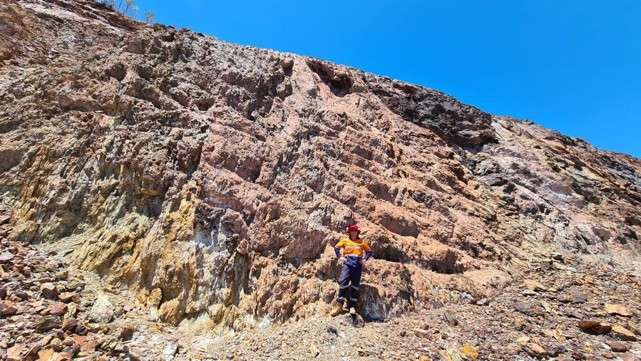
"At its core, geomicrobiology is a creative pursuit," Dr Jones reflected. "It's like painting a picture. You look at it and ask, what colours do we need to add? You're filling in gaps that may not exist here but exist somewhere else. It's artistic, in a weird way."
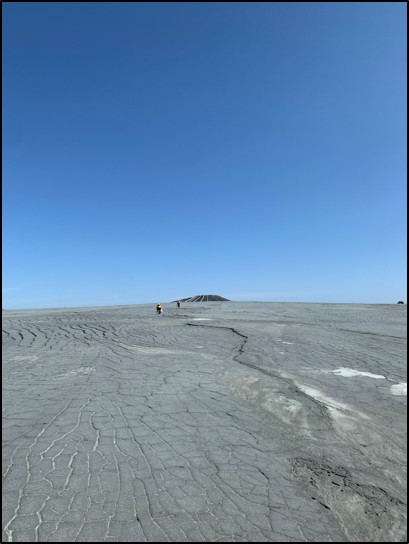
And he never has to look very hard to find his subject matter – microbes are everywhere. Even in neglected mine tailings dams, where the water is incredibly acidic, these miniscule life forms have found a way to survive.
Acidity is measured on a pH scale. On this scale, pure water, which is neutral, sits at around 7. Lemon juice would be a 2, while your stomach acid is closer to 1. While the numbers are modest, each step down the scale is 10 times more acidic than the last, which makes the survival of these microbes mind boggling.
"You can get a pH of 2, 1, even negative – and there are microbes living there," Dr Jones said.
"They can make their home in the most impossible places, and it blows my mind just how much work they're actually doing."
It's no wonder they're proving to be powerful allies in the fight against climate change.
Microbes against climate change
Dr Jones's current focus is a process called enhanced rock weathering. Basalt, that grey rock that is a staple of road gravel and building sites, is crushed up and spread across farmlands. As it breaks down it serves a dual purpose – releasing calcium and magnesium that helps lock carbon dioxide from the air into a more stable form, while simultaneously neutralising soil acidity and freeing up vital nutrients for crops.
"Every process we're experimenting with already exists in nature. Weathering happens everywhere water meets rock," he said. "We just take little bits and try to accelerate it."
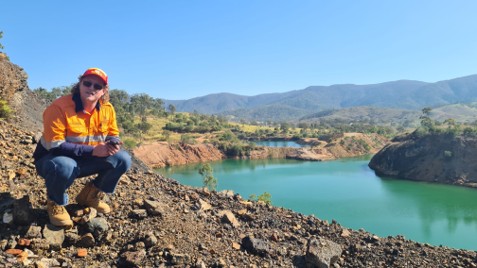
Microbes can speed up that natural process, but unfortunately, they're not always great at taking orders.
Rather than relying on a single lab-grown strain, Dr Jones starts with broad communities collected during his field trips. He plays around with the cultures, adjusting nutrients or acidity, carefully watching how the microbes respond – once the group he is interested in starts to flourish, he has his mix. Dr Jones has dubbed this 'gold' in microbe form his "Daddy consortium". His intrepid recruits are now ready for the field – but things don't always go according to plan.
"It's easy for pure cultures that have lived in a lab to be really good at their job," he said. "But then you throw them into the playground with the other microbes, and they often get bullied out."
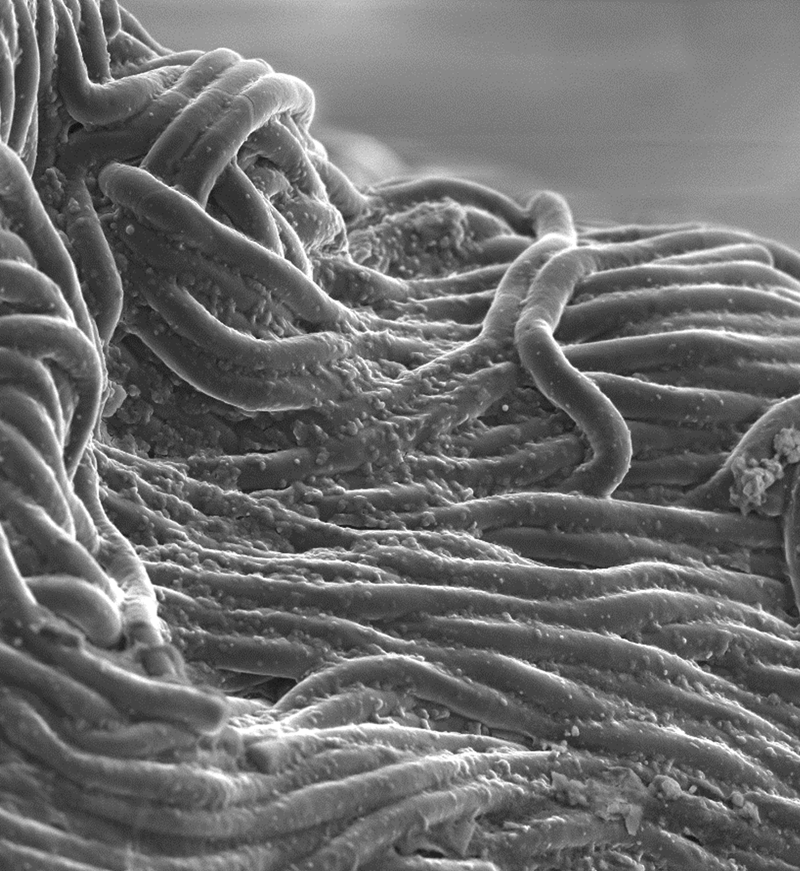
"Soil is really complex. Every microbe in it is there for a reason. There's not a lot of room for newcomers."
Working on a farm introduces an additional layer of complexity. For instance, changing soil chemistry is off the table.
"A farm is a finely tuned machine, and a lot of work has gone into that," he said. "The most important thing is not to mess with all that effort, or change what's already there."
Instead, Dr Jones said his main lever is timing. Spreading rock dust and microbes just after rain allows them to settle or laying them out just before the onset of the wet season means they can be carried into the soil. Throughout he's keenly aware he's working with living matter.
"Unless the microbes are happy, they won't do what they do," he said, "You've got to push them a little bit, but not too much, or they get upset. It's a balance."


