Rutgers research opens new doors for offshore aquaculture in New Jersey
Rutgers researchers have made a discovery that could change the future of seafood farming in New Jersey.
A study led by marine scientist Daphne Munroe has shown that Atlantic surfclams can be successfully farmed in the open ocean.
Her research, published in the North American Journal of Aquaculture, proves that offshore aquaculture is not only possible but promising. This method could help meet the increasing demand for seafood while protecting wild clam populations.
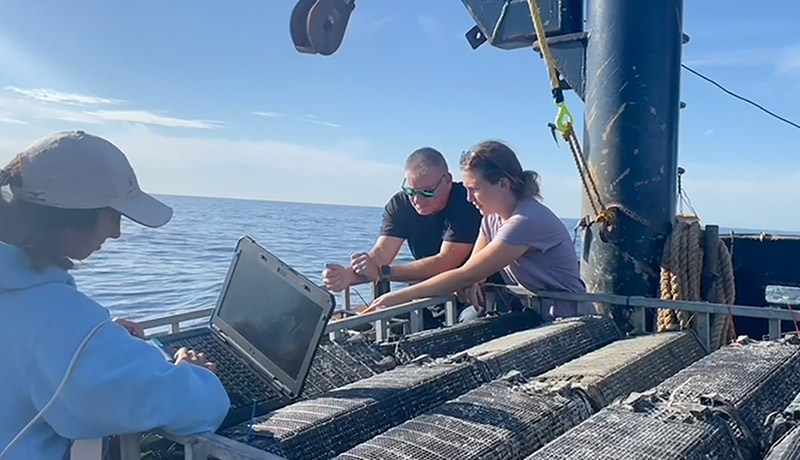
We didn't do this in a lab. We did it in the real world, with real fishermen. That's what makes the results so meaningful.
Daphne Munroe
Associate Professor, Department of Marine and Coastal Sciences
"We're among the first to show that offshore clam farming can really work," said Munroe, an associate professor in the Department of Marine and Coastal Sciences in the Rutgers School of Environmental and Biological Sciences. "It's exciting because it opens the door to a new kind of business for New Jersey's farming and fishing industries."
The study was funded by a grant from the National Oceanic and Atmospheric Administration and was done in partnership with commercial fishing companies.
"We didn't do this in a lab," Munroe said, emphasizing the importance of working with industry partners. "We did it in the real world, with real fishermen. That's what makes the results so meaningful."
Aquaculture is the practice of farming fish, shellfish and other aquatic organisms. It's similar to agriculture, but instead of growing crops on land, farmers raise seafood in water. Most aquaculture takes place near the shore in protected bays or in artificial ponds and lakes.
These areas are easier to manage and safer from storms, but they are crowded with other user groups like homeowners and boaters and can be subject to poor water quality which can hinder farm operations. Offshore aquaculture avoids these challenges, Munroe said, by using the vast, cleaner waters of the open ocean, where there is more room and less potential for pollution.
Members of Munroe's team wanted to test whether surfclams, which are large, hard-shelled shellfish that live buried in sandy ocean bottoms, could be raised offshore, where space is more available. The clams, commonly used in chowders and fried clam strips, are an important part of New Jersey's commercial fishing industry.
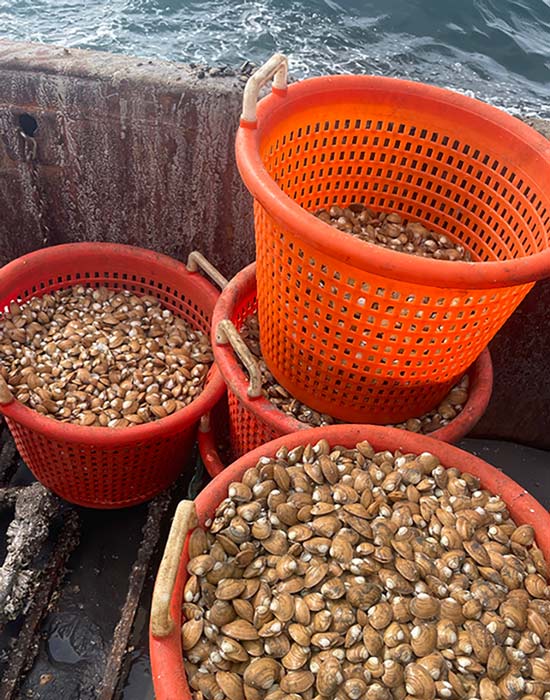
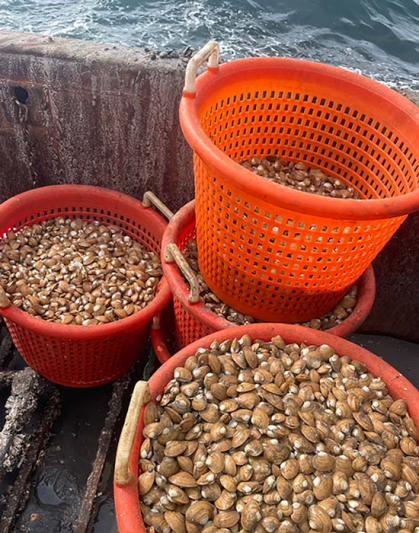
Researchers placed more than 300,000 young surfclams into cages in ocean waters miles off the coast of New Jersey. They tested the clams in both spring and fall to see how the seasons affected their growth and survival.
The cages used in the study were specially designed to protect the clams in several ways. They kept the shellfish safe from predators such as crabs and fish, which are common threats in the wild. The cages also helped reduce the buildup of sand and sediment, which can make their meat gritty.
By keeping the clams elevated off the ocean floor, the cages allowed cleaner water to flow through, resulting in clams with very little sand in their meat, making them ideal for eating steamed or on the half shell. In addition, the cages were built to withstand strong waves and rough ocean conditions, making them reliable even during storms.
The researchers found that clams put out in spring grew faster and had higher survival than those put out in fall. Spring conditions were calmer, with fewer storms and less sediment, making it easier to retrieve the cages and check on the clams. Another important finding was that clams in less crowded cages were healthier and grew better, showing that space matters when farming shellfish.

Munroe said that the results were especially encouraging because they showed that offshore aquaculture could be both productive and environmentally responsible. "We saw that the clams were not only surviving, but they were also thriving," she said. "And the meat quality was excellent, with very little grit. That's a big deal for consumers and for the industry."
She said there are still hurdles to surmount, such as making sure the gear lasts in challenging weather and properly navigating and following governmental regulations. But Munroe said the potential is huge.
"This could be a win-win," she said. "We can grow more seafood in a sustainable way and support local jobs."
Rutgers scientists who contributed to the study included: Laura Steeves, a former postdoctoral researcher at the Rutgers Haskin Shellfish Research Laboratory and now at the Flødevigen Research Station in Norway; Sarah Borsetti, a fisheries researcher at the Haskin Shellfish Research Laboratory; and Rachel Davitt, a doctoral student in the Department of Marine and Coastal Sciences.
Explore more of the ways Rutgers research is shaping the future.