
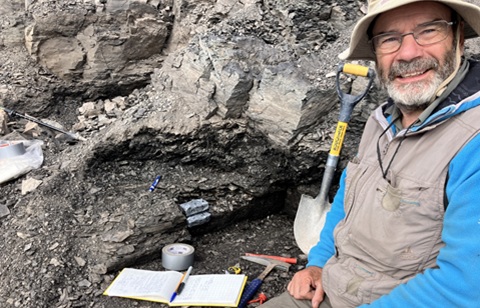
A Southampton paleontologist has been awarded a royal honour for his decades of research in the polar regions.
Professor John Marshall has amassed over a year's worth of time spent in remote camps in extreme conditions to better UK scientific knowledge of the polar regions.
He has been awarded a Polar Medal by His Majesty King Charles III in the 2026 New Year's Honours. Previous recipients have included famed explorers Sir Ernest Shackleton and Sir Edmund Hillary.
The Polar Medal is awarded to individuals who have made outstanding achievements in polar research, and particularly those who have worked over extended periods in harsh climates. It was instituted in 1857 as the Arctic Medal and renamed the Polar Medal in 1904.
Professor Marshall, from the University of Southampton, is an expert on the Devonian Old Red Sandstone Continent which existed 380 million years ago and included parts of Scotland, East Greenland and Norway's Spitsbergen.
"The Old Red Sandstone Continent is particularly important as it contains fossils of the first four legged animals, which evolved from fish with fins, and some of the world's first forests," said Professor Marshall.
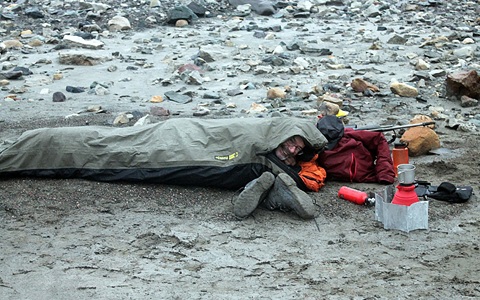
Over 30 years, he has taken part in 10 expeditions to East Greenland and nine expeditions to Spitsbergen, travelling via inflatable boats, helicopters and light planes capable of landing on the Arctic tundra. Expeditions involve camping in the great outdoors, frequently at altitude with the challenges of snow, ice, rain and storms.
He said: "It has always been a great privilege to work in these remote areas. There is dramatic scenery of glaciers with snowcapped mountains and wonderfully exposed geological sections. We can literally acquire entire mountains of data in a way we can't do in the UK.
"You can visit places nobody has ever been so there is always a great sense of adventure and discovery. It can be very challenging with significant manual effort and endless climbing, often in extreme conditions with blizzards and storms. On the way we have encountered many of the fabulous arctic animals such as narwhal, muskoxen and of course polar bears."
In East Greenland, Professor Marshall studied microscopic pollen and spores and discovered the earliest known seed plant, as well as the geological ages of the earliest four-legged animals.
His research demonstrated that the End Devonian mass extinction 360 million years ago was caused by an ultraviolet burst in the Earth's atmosphere. He also resolved the debate over the cause of the late Devonian mass extinction, proving it was caused by volcanic eruptions.
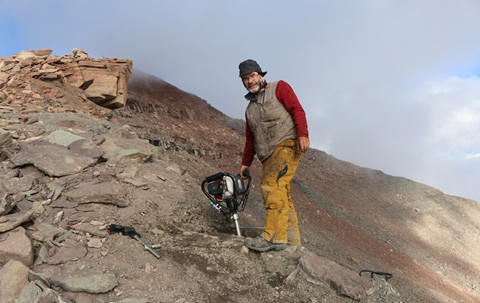
In Spitsbergen he identified a new type of palaeo-equatorial forest from 384 million years ago. And, from studying rocks, he discovered that a 55-million-year-old warming event reached from the equator to the Arctic.
Professor Marshall said: "It is fantastic to receive this honour and royal recognition for my Arctic research. None of this has been achieved alone as scientific expeditions are always collaborative with many British and international colleagues, and I have benefitted from working with many talented geologists and palaeontologists.
"I have also received the vital support from family at home with ice free conditions in East Greenland - the ideal time to conduct research - always appearing to coincide with school summer holidays. I particularly value this medal as my great uncle John Warnock was awarded one as an officer on the RRS William Scoresby, and a forerunner of the National Oceanography Centre Southampton, where I am now based."


