
In Brief
• Spielman brings decades of global food policy and economics expertise to WashU.
• His research strengthens FARM's focus on food systems, innovation and rural health.
• Spielman calls for economic and policy reforms to improve access to healthy food.
Economist David J. Spielman has spent decades working with farmers, researchers and policymakers across Africa and Asia, studying how policies, markets and innovations shape livelihoods, food systems and human health.
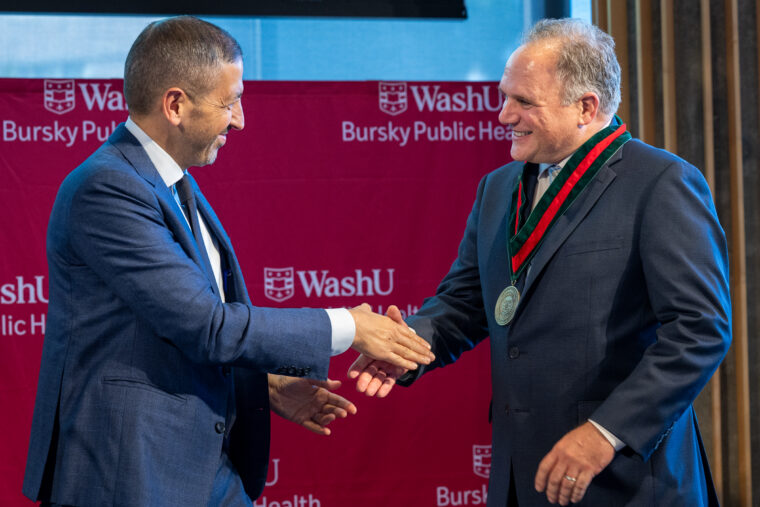
Spielman now brings that distinctive global perspective to Washington University in St. Louis, where he was installed as the Lauren and Lee Fixel Distinguished Professor during an Oct. 12 ceremony in Hillman Hall.
Spielman joined the Bursky School of Public Health in July. His expertise strengthens Food and Agriculture Research Mission (FARM), a research network within the school's Office of Innovation that unites academic, public- and private-sector partners to develop scalable solutions that improve access to healthy, sustainable foods.
Through FARM, Spielman will extend his research to the Midwest, exploring the agricultural and rural health challenges of America's heartland.
Morven McLean, associate dean for innovation, professor of practice and co-director of FARM, emphasized Spielman's ability to bridge the gap between agricultural innovation and meaningful benefits for people.
An improved crop variety, she explained, may hold enormous promise. But that promise means little if farmers cannot obtain the seeds, afford them or successfully grow the crop. Overcoming those barriers requires an understanding of markets, public policy, local institutions and the decisions farmers make under difficult and uncertain circumstances.
It also means asking who benefits from innovation - and who may be left behind.
"David brings these questions together," McLean said. "He connects economics with agricultural science, nutrition and public health, and connects researchers with governments, businesses and communities capable of putting this evidence into action."
Spielman's path to WashU began when he served as a panelist at the inaugural FARM Food Futures Forum last October.
Impressed by the school's interdisciplinary approach, he later wrote to McLean: "This is something I want to be a part of."
Rethinking food policy
During his installation address, "What's on Our Table, and How Did It Get There? Rethinking Food Policy for a Healthier Future," Spielman described the pressures on global food systems. He pointed out that an estimated 645 million people throughout the world currently face hunger, while obesity and other diet-related problems are also on the rise. For many, a healthy diet remains financially out of reach.
Armed conflict, displacement, economic shocks, extreme weather and climate change further compound those challenges, he said.
But Spielman sees opportunities for change. He argued that improving health requires more than developing new technologies to increase food production. Public policy also shapes our food system by influencing the choices people make about food and the prices they pay.
While markets are fundamental to the food system, Spielman questioned whether they are sufficiently competitive. He warned that industry concentration and imperfect markets can give companies excessive influence over food choices, undermining the agency of farmers, workers and consumers and limiting their opportunities and well-being.
Rather than relying on markets or technological breakthroughs alone, Spielman called for researchers to design, test and implement new economic and policy approaches that make socially beneficial innovations more attractive to investors and more accessible to communities.
Before joining WashU, Spielman spent more than two decades at the International Food Policy Research Institute (IFPRI), most recently as director of its Innovation Policy and Scaling Unit. He led more than 90 researchers, program managers and staff who worked across more than 25 low- and middle-income countries and spent part of his IFPRI career in Ethiopia and Rwanda.
Earlier in his career, he worked with the Aga Khan Development Network in Pakistan, and he had short stints at the World Bank and the U.S. Department of Agriculture's Economic Research Service.
A farmer's perspective
Reflecting on his career, Spielman said some of his most influential teachers were the farmers he met during fieldwork and the drivers who often accompanied him in the field. Their perspectives helped shape his understanding of small-scale agriculture and the people whose lives depend on them.
"I've built my career on thinking about the food we produce - the fields, gardens and farmers that feed us," he said. "But I'm keenly aware that it is a long and circuitous road between our farms and our health. And we still need evidence that goes beyond the argument that 'simply producing more food at a lower cost is going to improve diet quality, nutritional status or health outcomes.' Whether it is today or tomorrow - in Missouri, in the U.S. or in the global south - something has to change."
Sandro Galea, MD, DrPH, the Margaret C. Ryan Dean and the Eugene S. and Constance Kahn Distinguished Professor in Public Health, presided over the ceremony and presented Spielman with a medallion recognizing his appointment.
Galea also acknowledged Lauren and Lee Fixel, whose philanthropy established FARM and supports interdisciplinary research connecting food, agriculture and human health.
"Food and agriculture science does not often live in schools of public health, but it makes sense here, and Lee and Lauren saw this," Galea said. "There are so many dimensions to food and agriculture that impact the health of our population."
Spielman's installation came one day before the second annual FARM Food Futures Forum, held Oct. 13-14. The gathering brought together farmers, producers and leaders in rural health, nutrition, agriculture and business to examine challenges facing farming communities and their implications for the nation's food system.
About Lauren and Lee Fixel
Lauren and Lee Fixel founded the Lauren and Lee Fixel Family Foundation in 2014 to support various educational and nonprofit initiatives.
Lee earned a bachelor's degree in business administration, with concentrations in finance and accounting, from WashU Olin Business School in 2002. He serves as a board member of the Washington University Investment Management Company, a member of the Olin National Council, and a campaign cabinet member for With You: The WashU Campaign. He also served as a WashU trustee from 2015 to 2023 and received an Olin Alumni Award in 2017.
Lee is the founder and managing partner of Addition, an investment firm that supports founder-led, technology-enabled companies.
In 2017, Lee, along with his wife, Lauren, founded the Norman Fixel Institute for Neurological Diseases at the University of Florida Health. The clinical care and research institute focuses on advancing diagnosis and treatment for Parkinson's disease and other neurological disorders.
Lauren earned a bachelor's degree in journalism from the University of Florida in 2007. Lauren also serves as a campaign cabinet member for the With You campaign.
Lauren and Lee reside in New York City with their two children, Livia and Logan.


