
February is American Heart Month and the Preventive Cardiology services at UConn Health is providing ways for patients to focus on identifying cardiovascular risk early, often years or even decades before symptoms appear.
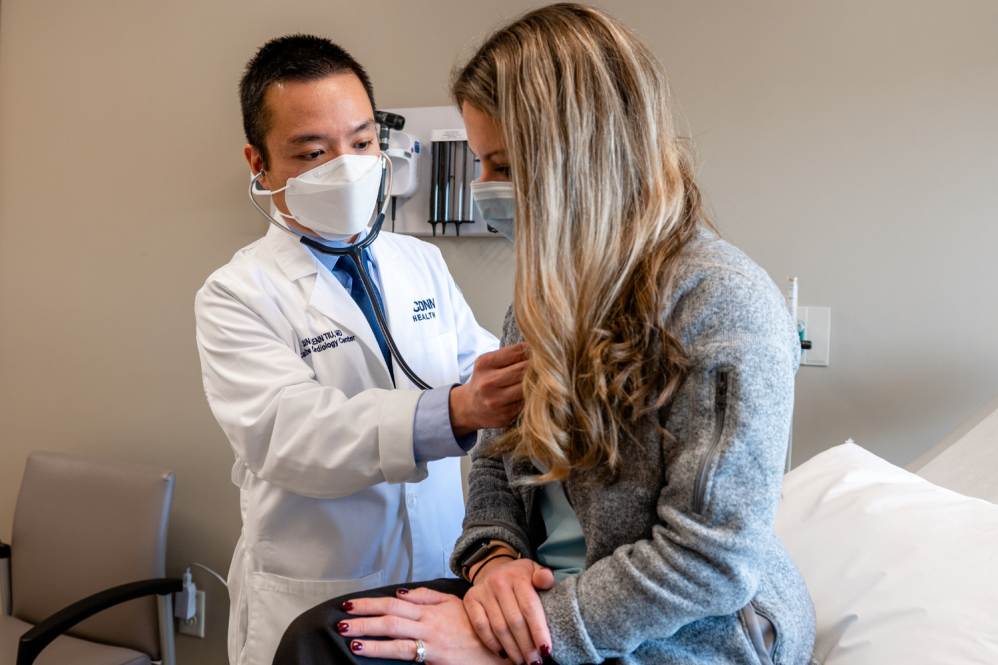
Dr. John Glenn Tiu is checking the heart of a patient.
 Heart disease remains the leading cause of death in the United States, but for many patients, the first warning sign doesn't have to be a heart attack.
At UConn Health, preventive cardiology is redefining what heart care looks like - shifting the focus away from emergency interventions and toward identifying cardiovascular risk early, often years or even decades before symptoms appear. Leading that effort is Dr. John Glenn Tiu, director of UConn Health's Preventive Cardiology Program, whose work centers on helping patients understand their risk and take action before irreversible damage occurs.
"Most people think of cardiology as something you need after there's a problem," Tiu says. "Preventive cardiology is about asking the question earlier: What is your risk, and what can we do now to lower it?"
The patients Tiu sees every day don't fit the traditional image of someone with heart disease. Many are active and otherwise healthy. Some exercise regularly. Others have never been hospitalized. What brings them in is concern that is often sparked by family history, borderline lab results, or a growing awareness that heart disease can be silent for years.
"Patients are much more proactive than they used to be," Tiu says. "They want to understand their risk before something happens, not after."
While traditional cardiovascular risk calculators use age, sex, cholesterol, and blood pressure to estimate risk, Tiu says those tools don't always capture the full picture. "They're helpful, but they're not personalized enough," he says. "Heart disease doesn't develop the same way in everyone."
To close that gap, UConn Health's Preventive Cardiology Program uses advanced testing to reveal risk that standard evaluations can miss.
One of the most frequently used tools in preventive cardiology is the coronary artery calcium score. The test is a low-dose CT scan that requires no IV contrast and takes only minutes to complete.
Rather than identifying blockages, the scan measures calcified plaque buildup in the coronary arteries and assigns a numerical score.
"This test is designed for people who don't have symptoms," Tiu explains. "It tells us how much plaque has already formed in the heart arteries."
The results can be transformative. A calcium score of zero may reassure patients and allow clinicians to take a more conservative approach when no other major risk factors are present. On the other hand, a high score can uncover significant cardiovascular risk even in patients whose cholesterol levels appear only mildly elevated.
"I've had patients with 'okay' cholesterol numbers but very high calcium scores," Tiu says. "That changes how aggressive we need to be with prevention."
The calcium score becomes a guide no a diagnosis, helping patients and physicians make informed decisions about long-term treatment.
Another cornerstone of preventive cardiology at UConn Health is testing for lipoprotein(a), known as Lp(a). Lp(a) is a genetically determined form of LDL, or "bad," cholesterol that is particularly likely to promote plaque formation in arteries. About one in five people have elevated levels, often without any outward signs.
"This is something you inherit," Tiu says. "You can have a healthy lifestyle and still carry a higher risk because of your genetics."
Elevated Lp(a) significantly increases the risk of heart attack, stroke, and aortic valve stenosis. Because levels remain stable over a lifetime, a single blood test can provide critical insight. Lp(a) testing can be ordered on its own or as part of an advanced lipid panel, which may also measure markers of inflammation that contribute to cardiovascular disease.
"When we combine genetic information with calcium scoring, we get a much clearer picture of who truly needs aggressive prevention," Tiu says.
Some patients face elevated cardiovascular risk regardless of lifestyle. Familial hypercholesterolemia (FH), a genetic condition affecting roughly one in 250 people, causes very high LDL cholesterol from birth. At UConn Health, Tiu collaborates closely with the genetics team to identify and manage these patients early.
"If someone has FH, their risk is significantly higher, even at the same cholesterol level," he says. "They need earlier and more aggressive prevention."
Age and sex also influence risk. Men tend to develop heart disease earlier than women, while estrogen offers some protection before menopause making early menopause itself a cardiovascular risk factor.
Chronic conditions such as diabetes, kidney disease, autoimmune disorders, obesity, smoking, and high blood pressure can further accelerate cardiovascular risk through ongoing inflammation.
For many patients, the first step after testing is reassurance. For others, it's a call to action.
Regardless of risk level, Tiu emphasizes that lifestyle is the foundation of prevention.
"Healthy eating, regular exercise, weight management, and not smoking are critical for everyone," he says. "No test replaces those basics."
When medication is needed, statins remain the first-line therapy.
"They've been around the longest, and they're extremely effective," Tiu says. "They don't just lower cholesterol, they reduce inflammation and stabilize plaque as well."
For patients who need additional cholesterol lowering or who cannot tolerate statins, newer injectable medications offer powerful alternatives.
Some of these therapies are self-administered every two weeks. Others available through UConn Health's Preventive Cardiology Program require just two in-office injections per year.
"It's a twice-a-year treatment," Tiu says. "For many patients, that makes a huge difference in adherence, and the cholesterol reduction can be dramatic."
This option is especially helpful for older adults, patients who cannot self-inject, or those who struggle with taking daily medications.
One of the most common questions patients ask is whether plaque can be removed from the arteries.
"We can't erase plaque completely," Tiu says. "And stents aren't a cure they treat narrowing, but not the disease itself."
What preventive therapies can do is stabilize existing plaque, reduce inflammation, and when cholesterol is lowered to very low levels sometimes lead to modest plaque regression.
"The real success is preventing events," he says. "Heart attacks and strokes that never happen."
Preventive cardiology reflects a broader shift in medicine from reacting to disease to preventing it. Primary care physicians increasingly refer patients to UConn Health's Preventive Cardiology Program when calcium scores are elevated, family history is concerning, or traditional assessments leave uncertainty.
As more patients seek answers before symptoms appear, preventive cardiology offers a roadmap for protecting heart health grounded in early detection, collaboration, and the belief that the most powerful cardiac care is the care that prevents disease altogether.


