
UConn professor's research pit narrative versus nonnarrative pictorial warning labels against one another and measured their emotive effects

(Adobe photo)
Getting someone to curb or stop harmful behaviors takes not just a convincing argument, but one that evokes sympathy, says one UConn researcher whose recent study of cancer warning labels shows the benefits of using the emotion as an influencer.
Part of a larger look at the effectiveness of two types of pictorial warning labels on alcohol, the latest paper from Zexin "Marsha" Ma, an assistant professor in UConn's Department of Communication, considers what emotions those pictures should draw out to move someone to reduce or stop drinking because of the risk of cancer.

Ma says her research pit narrative versus nonnarrative pictorial warning labels against one another: pictures like an emaciated person with a feeding tube versus an endoscopy image to warn of the esophageal cancer dangers of alcohol.
In theory, Ma explains, narrative labels should win out, because they depict what living with a disease is like – in this case that of a person with a feeding tube.
"For a warning label to be perceived as a story, it needs to have a character," Ma says. "The character has to be discernible and believable and one who projects an emotion like sadness through their facial expression. Also, the image and text have to match for consumers to infer the link between alcohol use and cancer risk, and it has to reveal some contextual information, like taking place in a hospital or other medical setting."
In the latest paper, "The role of sympathy in motivating behaviour change: a discrete emotions approach to examining responses to cancer warning labels for alcohol," which was published recently in the journal Health Education Research, Ma and her colleagues challenged existing research that says effective warning labels should evoke negative emotions like anger, disgust, and fear.
First, she says, existing research lumps together these negative emotions, when they're strikingly different from one other - anger isn't the same as fear, for instance. Second, prior studies never looked at "self-oriented" emotions like sympathy, in which a viewer feels sympathy or empathy toward a character, and how that might motivate a person.
The study, funded by a grant from the National Cancer Institute of the National Institutes of Health, surveyed two sample groups, an online panel of moderate to heavy drinkers aged 21 to 84 and UConn undergraduates between 21 and 28 years old.
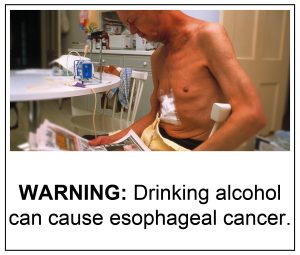
Participants were randomly shown either three narrative or three nonnarrative pictorial warning labels communicating oral, esophageal, and larynx cancers, then asked various questions about them, including how moved they were and whether they'd consider abstaining from alcohol.
Ma says she found that narrative labels, the ones showing lived experiences, evoked less disgust and anger and more sympathy than nonnarrative ones. The nonnarrative labels, like the endoscopy, caused more fear than the narrative ones in the online sample, but not among the college students.
When it came to convincing alcohol abstention, "Fear consistently related to intentions, meaning the greater the fear, the greater the intention to reduce or stop drinking, but the college students weren't moved by fear-based warnings," she says. "Anger was found to be a counterproductive emotion and decreased the intention to reduce drinking. Disgust didn't persuade anyone to do anything.
"Sympathy was the only significant mediator across the two sample groups," she continues. "Sympathy was positively related to intentions to reduce or stop drinking, so the takeaway is that we want to evoke sympathy when communicating the cancer risk of alcohol. Fear is still a useful emotion, so narrative labels should also be designed to elicit fear."
Therefore, a pictorial warning label that shows an oral cancer patient with their jaw removed sitting on a medical exam table with a look of fear in their eyes could be enough of a narrative to convince someone not to drink, she says.
Images like this could be put on individual liquor bottles or posters, or in social media posts or television commercials, she says.
"We know that's going to take a long time because of various challenges," Ma admits. "But that doesn't mean we shouldn't do this type of research. We want to conduct research to develop effective messages before implementing them and before encountering any political or economic barriers."

It's also a campaign that might need to cycle through stories to bypass consumer fatigue or the so-called wear-out effect.
"Besides, sometimes we might not want to focus just on the health effects of cancer. We might also want to focus on the financial burden that cancer can bring to people, the emotional burden that cancer can bring to your loved ones," she says. "There are different ways to talk about and convey the same risk information. Some might resonate differently among different groups of people."
Beyond alcohol, Ma says she could envision this type of narrative pictorial warning label on bottles of soda, packages of processed and red meat, and tobacco products, all known carcinogens.
Although she concedes, "It's hard to imagine that people would accept a cancer warning label like this on a $400 bottle of champagne, right? But it can be just as difficult to accept them on a $1 bottle of soda because it causes defensive reactions in people. We know that people tend to get defensive when a health message threatens or challenges their current knowledge, beliefs, or behaviors."


