
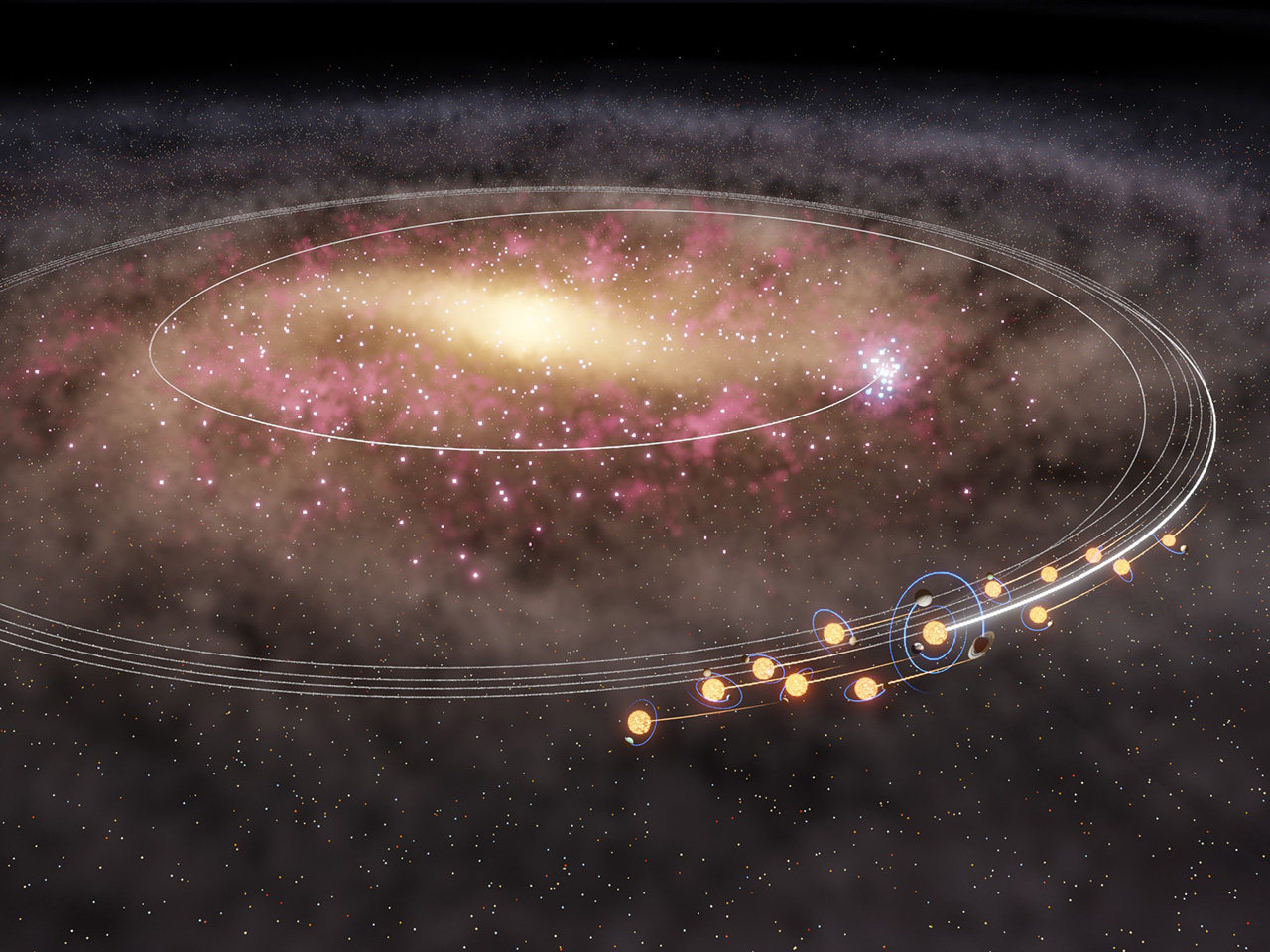
Researchers have uncovered evidence that our Sun was part of a mass migration of similar "twins" leaving the core regions of our Galaxy, 4 to 6 billion years ago. The team created and studied an unprecedentedly accurate catalogue of stars and their properties using data from the European Space Agency's Gaia satellite. This discovery sheds light on the evolution of our Galaxy, particularly the development of the rotating bar-like structure at its center.
While archaeology on Earth studies the human past, galactic archaeology traces the vast journeys of stars and galaxies. For example, scientists know that our Sun was born around 4.6 billion years ago, more than 10,000 light-years closer to the center of the Milky Way than we are today. While studies of the composition of stars support this theory, this has long proven a conundrum to scientists. Observations reveal an enormous bar-like structure at our galactic center which creates a "corotation barrier," which makes it difficult for stars to escape so far from the center.
So how did we get here? To answer this question, a team led by Assistant Professors Daisuke Taniguchi from Tokyo Metropolitan University and Takuji Tsujimoto from the National Astronomical Observatory of Japan undertook an unprecedentedly large study of solar "twins," stars which have very similar temperature, surface gravity, and composition to our Sun. They used data taken by the European Space Agency's Gaia satellite mission, a daunting trove of observations covering two billion stars and other objects. They created a catalogue of 6,594 stellar "twins," a collection around 30 times larger than previous surveys.
From this immense list, they were able to obtain the most accurate picture to date of the ages of these stars, carefully correcting for the selection bias of stars which are easier to see. Looking at the distribution of ages, they noticed a broad peak for stars around 4 to 6 billion years old: this includes our Sun, and is evidence for similar stars of similar age, positioned around the same distance from the center of the Galaxy. This means that our Sun is not at its current position by accident, but as part of a much larger stellar migration.
This discovery sheds light not only on the nature of our Solar System, but also the evolution of the Galaxy itself. The corotation barrier created by the bar structure at the galactic center would not allow for such a mass egress. However, the story changes if the bar was still being formed at the time. The ages of our stellar "twins" reveal not only when the mass escape occurred, but also the time range over which the bar was formed.
The center of the Galaxy is a far less hospitable environment for the evolution of life than the outer regions. The team's findings thus illuminate a key factor in how our Solar System, and in turn our planet, found itself in a region of the Galaxy where organisms could develop and evolve.
In the future the team hopes to use precise observations of the stars similar in age to the Sun to look for stars born near the same time and place as the Sun to determine the point of origin and travel route of the mass migration. It is expected that the Japanese JASMINE astrometry satellite mission being developed by the National Astronomical Observatory of Japan will contribute to this research.
Detailed Article(s)
We are Not Alone: Our Sun Escaped From Galactic Center Together with Stellar "Twins"
JASMINE Project
Release Information
Researcher(s) Involved in this Release
- Daisuke Taniguchi (Tokyo Metropolitan University)
- Takuji Tsujimoto (National Astronomical Observatory of Japan)
Coordinated Release Organization(s)
- Tokyo Metropolitan University
- National Astronomical Observatory of Japan, NINS
Paper(s)
- Daisuke Taniguchi et al. "Solar twins in Gaia DR3 GSP-Spec I. Building a large catalog of Solar twins with ages", in Astronomy and Astrophysics, DOI:10.1051/0004-6361/202658913
- Takuji Tsujimoto et al. "Solar twins in Gaia DR3 GSP-Spec II. Age distribution and its implications for the Sun's migration", in Astronomy and Astrophysics (Letter to the Editor) DOI: 10.1051/0004-6361/202658914


