
Key points
- Methane in mine ventilation air is a major source of emissions from underground coal mining which is tricky to tackle.
- CSIRO's CataVAM™ technology is designed to destroy methane in these large, dilute exhaust air streams without extra fuel.
- Field trials have shown the technology can destroy more than 98 per cent of methane in real mine ventilation air, helping pave the way for lower-emissions mining.
A problem hiding in plain air
Every underground coal mine has one thing in common: coal seams leak methane gas into the tunnel network, presenting a serious safety hazard.
The control is the same the world over: continuously pump fresh air through the workings, diluting and pushing out the methane. High-volume mechanical ventilation systems are a cornerstone of mine safety, but they create a stubborn environmental problem.

Exhaust air from coal mining, called ventilation air methane (VAM), carries methane at safe concentrations – typically well below one per cent ensuring a safety margin below the five per cent explosive range. Dusty and damp, the VAM is often pumped at hundreds of cubic metres per second.
Methane is roughly 28 times more potent as a greenhouse gas than CO2. VAM accounts for more than 60 per cent of all fugitive emissions from Australian coal mines and around 15 per cent of the nation's total methane output. That makes methane a material liability. One that regulators, investors and mine operators are increasingly required to address.
Thermal oxidisers – essentially high-temperature burners – have been used since the 1990s to destroy industrial methane.
But they are often bulky, and generally operate above 900°C, using the methane they treat to sustain that temperature. A conventional thermal system requires concentrations of 0.3 per cent and above to work well. Once methane in the VAM drops below this threshold, they typically need supplemental fuel to keep running efficiently, adding cost, complexity and their own emissions.
Too dilute to burn, too voluminous to concentrate easily, low and highly variable levels of VAM have presented an engineering paradox that has defeated every straightforward approach to effective abatement - until now.
Why the problem is getting harder
The VAM challenge has sharpened considerably over the past decade, driven by two converging forces.
Australia's Safeguard Mechanism , established in 2016 and significantly expanded in 2023, now unequivocally requires large emitters, including underground coal mines, to keep net emissions within defined baselines.
Australia is also a signatory to the Global Methane Pledge , which commits more than 120 countries to collectively cut methane emissions by 30 per cent below 2020 levels by 2030. That deadline is approaching fast, and global progress has been disappointing.
At the same time, mine safety practice has tightened risk management. Operators usually pre-drain methane from coal seams removing the majority of the explosive gas. Further government regulatory pressure has driven even lower methane concentration limits through improved gas management and reporting to better protect workers underground.
This means more dilution, with lower average methane concentrations in the VAM stream and higher volumetric flow rates.
Over the past decade, methane concentrations in Australian mine ventilation air streams have declined significantly and now typically range from 0.2-0.4 per cent, with levels below 0.2 per cent occurring for substantial periods.
Older abatement systems that were marginal at these concentrations will inevitably become unfit for purpose.
Two decades of groundwork
CSIRO has been working on the science of VAM abatement for close to two decades. That sustained investment produced a suite of technologies spanning three broad approaches: converting VAM to electricity (VAMCAT), concentrating it for downstream use (VAMCAP), and destroying it via thermal (VAMMIT) or catalytic oxidation (CataVAM™).
Dr Yonggang Jin , CSIRO Senior Principal Research Scientist and Team Leader, Environment and Sustainability, leads CSIRO's R&D in VAM abatement and is the principal inventor of CataVAM™.
"The success of CataVAMTM is underpinned by strong science and engineering foundations in catalytic materials and reaction engineering, fluid dynamics, heat transfer and system control, built on CSIRO's two decades of R&D in methane emissions abatement," said Dr Jin.
"That accumulated expertise is what has made CataVAM™ possible, underpinning CSIRO's position as the leading research organisation in this space."

This diagram shows a cross-sectional view of a coal mining operation, illustrating both surface infrastructure and underground workings, and how ventilation air methane (VAM) is captured and treated using CaTaVAM technology.
At the top of the image is the land surface, drawn as a flat to gently sloping landscape. Surface infrastructure includes a mine site with buildings, access roads, and ventilation equipment. Several large ventilation fans sit at the surface, connected to vertical shafts that extend down into the underground mine. These fans are used to move large volumes of air through the mine to keep it safe for workers. Arrows indicate airflow direction, showing fresh air being drawn into the mine and methane-containing air being pushed out through return air shafts.
Below the surface, the diagram reveals the underground mine network. This consists of horizontal tunnels (roadways) extending through coal seams. The coal seam is shown as a dark horizontal layer within lighter-coloured surrounding rock. Mining equipment, such as longwall machinery, operates along the coal seam, extracting coal. Workers and vehicles may be depicted within the tunnels to show scale.
Airflow is clearly marked throughout the underground workings. Fresh air enters through intake shafts and tunnels, flowing across active mining areas. As it passes through, it mixes with methane released from the coal seam. This creates ventilation air methane (VAM), which is low in concentration but present in very large volumes. The air, now containing diluted methane, is directed toward return airways and exits the mine through return shafts.
At the surface, the return air is captured and channelled toward a CataVAM system. This system is represented as a treatment unit connected to the ventilation exhaust. Arrows show the methane-containing air moving from the mine into the CataVAM reactor.
Inside the CataVAM unit, the diagram may depict a reactor chamber or catalytic oxidation system. This is where methane in the ventilation air is converted into carbon dioxide and water vapour. Labels or icons may indicate heat generation, oxidation, or catalytic processes, emphasising that the methane is safely destroyed rather than released into the atmosphere.
In some versions of the diagram, heat generated by the oxidation process is shown being recovered and reused. This may be illustrated with arrows leading from the CataVAM unit to energy recovery or reuse applications, such as power generation or heating systems.
The overall flow of the system is presented as a clear sequence:
- Methane is released from the coal seam during mining.
- Ventilation air dilutes and carries the methane through underground tunnels.
- Air is extracted via return shafts using surface fans.
- Methane-containing air is directed into the CataVAM system.
- Methane is oxidised, reducing greenhouse gas emissions.
Colour and arrows are used throughout the diagram to distinguish between fresh air (often shown in blue or green tones) and methane-containing air (often shown in warmer colours such as orange or red). Labels identify key components, including intake shafts, return shafts, coal seam, mining equipment, ventilation fans, and the CataVAM treatment unit.
Overall, the diagram communicates how underground coal mining generates ventilation air methane and how CataVAM technology captures and treats this dilute methane stream at the surface to reduce emissions
CataVAM™: a technology built for where the industry is heading
CataVAM™ uses high-performance catalysts on a purpose-designed honeycomb regenerative bed to destroy methane.
Like the catalytic converters found in modern cars, it scrubs out methane at concentrations from 0.5 per cent down to as little as 0.1 per cent, without supplemental fuel.
It operates in full autothermal mode at temperatures between 450°C to 650°C depending on VAM concentrations - well below the temperatures required by other thermal systems.
Self-sustaining once running and energy-efficient by design, the system uses heat generated by catalytic methane oxidation to preheat incoming gas.
Central to the technology's performance is a proprietary honeycomb-shaped catalytic regenerative bed, designed to optimise the coupling of catalytic performance, heat transfer and flow dynamics.
"We have engineered the honeycomb bed to destroy methane efficiently while maintaining efficient cross-bed heat transfer for stable autothermal operation and keeping bed flow resistance very low to reduce energy consumption," said Dr Jin.
"The lower operating temperature avoids catalyst degradation and prevents issues such as stone dust sintering, supporting long-term bed durability."
Similarly, moisture in the gas stream – a persistent complication in real mine conditions – has not presented problems in trials.
Critically, the innovative honeycomb bed design delivers more than four times the VAM throughput of comparable conventional thermal systems of the same physical unit size.
That significantly improves the commercial and logistical case. For the same airflow capacity, a CataVAM™ module is much smaller than older technology units making it suited to space-constrained mine sites and practical to relocate between ventilation shafts.
Dr Gareth Kennedy , CSIRO's Research Director, Sustainable Mining Technologies, said this would make modules genuinely transportable.
"Older thermal-based systems are larger, heavy and generally not relocatable in any practical sense," said Dr Kennedy.
"A CataVAM™ set-up will be able to be deployed at one shaft, and when that seam is exhausted, packed up and trucked to the next."
The economics are shifting too. Catalytic systems have traditionally cost more, but falling VAM concentrations are making thermal technologies less efficient and harder to scale. At lower methane levels, thermal systems need to be much larger to remain self-sustaining.
At the same time, advances in catalyst performance and durability, combined with much higher throughput, are making catalytic mitigation a more practical and cost-effective option.
A world-first demonstration
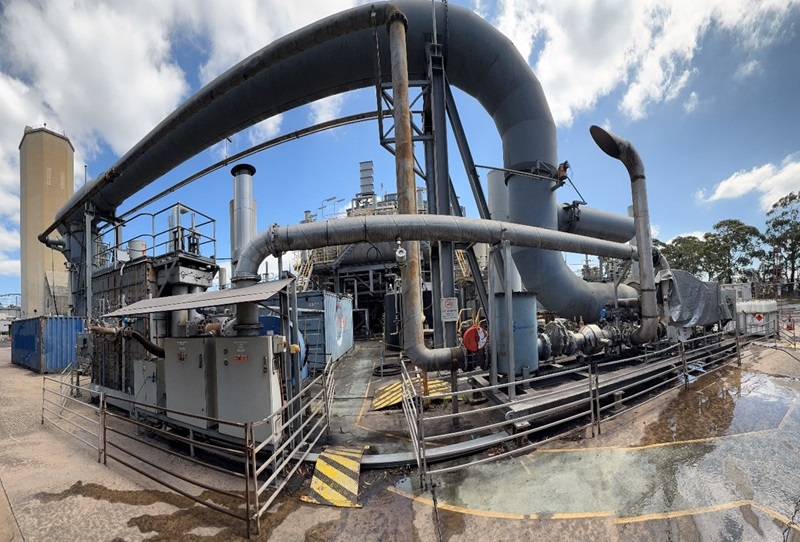
A large-scale pilot CataVAM™ has been field-trialled at GM3 Appin mine in southern New South Wales using real VAM.
The CataVAMTM technology reached Technology Readiness Level (TRL) 7 following its successful demonstration, processing substantially high ventilation airflows up to 1.38 cubic metre per second in extensive trials completed in April 2026.
This represents a world-first demonstration of high-efficiency catalytic VAM abatement at this scale under real mining conditions. The successful field validation marks a significant milestone in de-risking the technology for industry adoption and establishes clear pathways toward further scale up and commercial deployment.
"We achieved a world first from trials of the new prototype, demonstrating greater than 98 per cent methane destruction efficiency using real VAM at methane concentrations around 0.2 per cent or less," said Dr Kennedy.
Mining company GM3 have been an industry collaborator in CSIRO's VAM abatement research and development since 2014.
"GM3 is committed to exploring practical and innovative opportunities to reduce greenhouse gas emissions from our operations," said Russell Thomas, GM3 Technical Services Manager.
"Projects such as this provide an opportunity to test emerging technologies under real-world conditions and generate valuable operational data that may help inform future methane abatement solutions for Appin Mine and the mining industry."
The next step is a trial of a unit designed for approximately 5 cubic metres per second and is underway with a commercialisation partner.
"This is the final proof-of-technology phase before moving to full-scale modular development, for which we are actively collaborating with industry partners to achieve," said Dr Kennedy.
The target commercial module is designed to treat around 20 cubic metres per second, with mine deployments using multiple modules in parallel to match the full ventilation flows at a given shaft.

The infographic presents six stages in the development of CataVAM™ methane mitigation technology. It begins with prototype testing at Appin mine, NSW, followed by catalyst and system optimisation, small-scale prototype validation, and a successful field demonstration achieving about 98% methane destruction efficiency at scale. The current phase is a scale-up demonstration to a 5 m³/s unit with industry partners. The next step is full-scale deployment using 20 m³/s modules at mine shafts.
A future-facing technology
CataVAM™ is not designed for the VAM concentrations of a decade ago. It is designed for the concentrations coal mines produce today, and the even lower concentrations they will have to move towards as safety standards continue tightening.
"The mines that currently need this technology are already at or approaching the CataVAMTM design window, and every new mine developed in Australia to modern safety standards will likely operate there from day one," said Dr Kennedy.
"The science is done. The field performance is documented. The next stage is an engineering up-scale and commercial challenge, and CSIRO is not looking to solve it alone."
With VAM abatement a priority in Australia's Net Zero Plan for the Resource Sector, further investment in scale-up could support Safeguard Mechanism baselines and Australia's Global Methane Pledge commitments.


