
Researchers at the University of Würzburg have succeeded in detecting exceptionally robust electrical transport in a topological insulator. This could lead to new metrological applications.
Metrology is the science of measurement. Its aim is to ensure that measurement results are comparable and reliable worldwide, for example in industry or in scientific experiments. So-called fundamental constants, or unchanging physical quantities such as the speed of light or Planck's constant, play an increasingly important role in this context. As their values are universal, i.e. independent of place and time, they enable the definition of highly stable units and ensure highly reproducible measurement results. Since 2019, the International System of Units SI (short for: Système international d'unités) has been based entirely on these constants.
The precise measurement of electrical resistance turns out to play an important role here. "It turns out, that under certain conditions, electrical resistance of a two-dimensional material can have a universal value, defined by a ratio of Planck's constant h and square of elementary charge e", explains Kajetan Fijalkowski, a physicist at the Institute for Topological Insulators at the University of Würzburg (JMU) and the main author of the study. "Such characteristic is independent of any material property, making it excellent for reproducibility - precisely what one wants from a standard". A new class of materials emerged in 2007, called Topological Insulators, which possess certain electrical properties that turn out to be extraordinarily useful for metrology. The new work explores that.
How quantized electrical transport works
Many people will probably still remember the classical Hall effect from their physics lessons: when a current flows through a conductor exposed to a magnetic field, a voltage is generated, known as the Hall voltage. Hall resistance, obtained by dividing this voltage by the current, increases as the magnetic field strength increases.
However, in thin layers (around 10,000 times thinner than a human hair) and in sufficiently strong magnetic fields (around 100,000 times stronger than the Earth's), this resistance develops discrete steps. These steps have values that are exactly h/ne², where h is Planck's constant, e is the elementary charge, and n is an integer. This phenomenon is known as the quantum Hall effect. The resistance depends solely on fundamental physical constants (h and e), making it the most accurate standard of resistance to date.
In fact, modern, state-of-the-art metrological experiments make it possible to measure h/e² with a relative error of just a few parts per 10⁻¹¹. "It's like measuring the circumference of the Earth to an accuracy of a few millimetres", Fijalkowski explains.
What makes topological insulators special for metrology
A particular type of topological insulator known as a 'magnetic topological insulator' can exhibit a unique kind of Hall effect known as the quantum anomalous Hall effect (QAHE). This is special because the Hall resistance takes on a precisely defined value (also given by h and e) even when no external magnetic field is applied. "Operating without an external magnetic field makes it possible to combine electrical resistance and voltage standards, or high-precision references, in a single universal electrical reference device", explains Fijalkowski. "This is also significant for building a standard determining the 'kilogram', which partially relies on electrical standards to operate." This is because a voltage reference can only operate without an external magnetic field. The conventional quantum Hall effect, which requires strong magnetic fields, is therefore not suitable for this combination.
Technical obstacles to measurement
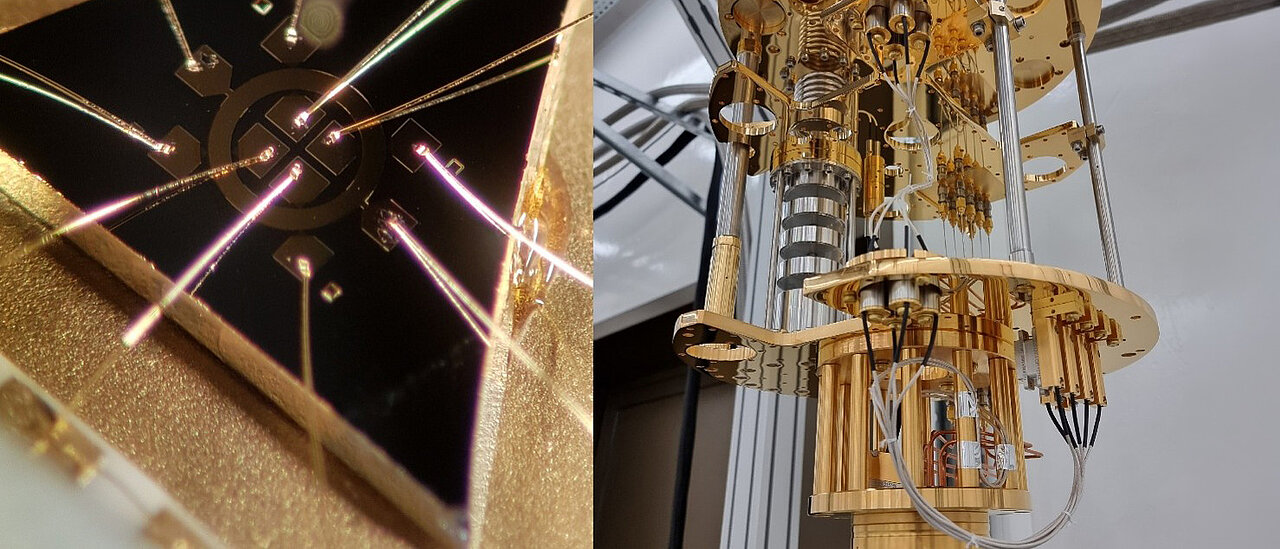
Using the QAHE as a resistance standard necessitates extremely demanding experimental conditions in terms of both the need for extremely low temperatures and the extremely low currents involved. The required temperature for the QAHE is below 100 millikelvin (just 0.1 degrees above absolute zero), necessitating the use of expensive cryogenic systems known as dilution refrigerators. By contrast, the quantum Hall effect can be operated with ease at a temperature of 4.2 Kelvin, which is relatively straightforward to achieve using liquid helium. Furthermore, it operates at significantly higher electric currents than the QAHE. These two factors currently limit the practical applications of the QAHE in resistance measurement technology.
The research team at the University of Würzburg has now demonstrated that the quantized edge transport in a magnetic topological insulator can withstand significantly higher measurement currents than was previously thought, while operating at a temperature of 4.2 K (and above), which is important for the prospects of future applications in metrology. To achieve this, the researchers used a method they had developed themselves called electrochemical potential balancing.
Normally, the measurement current creates a strong electric field between the conductive edges of the sample. If this field exceeds a certain strength, however, electrons can travel through the interior of the material from one edge to the other. Consequently, the Hall resistance loses its precisely defined value. "Using a relatively simple electrical circuit, we can compensate for the voltage difference between the edges and thus eliminate this electric field", explains Fijalkowski. This means that the Hall resistance remains stable even at significantly higher measurement currents. "This circuit also turns out to significantly simplify the way in which current flows inside of the sample at higher temperatures, making it possible for us to conclude that electronic topological properties in fact remain quantized and robust."
Further research is planned
The results show that, on a fundamental level, the QAHE is just as robust as the conventional quantum Hall effect. However, there is still a major hurdle to overcome before it can be used in measurement technology: Under the conditions studied, the universal resistance value (h/e²) cannot yet be measured directly with the required accuracy at 4.2 K.
"Even a slight increase in temperature causes additional conductive pathways to form in the material alongside the desired topological current transport", explains Fijalkowski. These unwanted currents affect the measurement, causing the resistance to deviate from the precisely defined value.
"Our method shows that the topological contribution is fundamentally robust enough for practical applications", says Fijalkowski. "Now we need to find a way to reduce the additional conductivity in the material." The search for potential new material systems that may allow for QAHE operating at elevated temperatures continues.
The research was funded by the German Council of Science and Humanities (Wissenschaftsrat) and the Bavarian State Ministry for Science and the Arts via the Institute for Topological Insulators, the German Research Foundation DFG (project SFB 1170), the Cluster of Excellence ctd.qmat and the European Commission under the Grant TOCHA and the Project QuAHMET.
About the Study
Kajetan M. Fijalkowski, Martin Klement, Nan Liu, Karl Brunner, Charles Gould, and Laurens W. Molenkamp "Quantum adiabatic transport in a quantum anomalous Hall insulator". Nature Communications, 21 July 2026. DOI: 10.1038/s41467-026-75851-7 .


