
Significant energy savings highlight gains since last Earth Day, while the UConn School of Medicine makes the grade on the 2026 Planetary Health Report Card
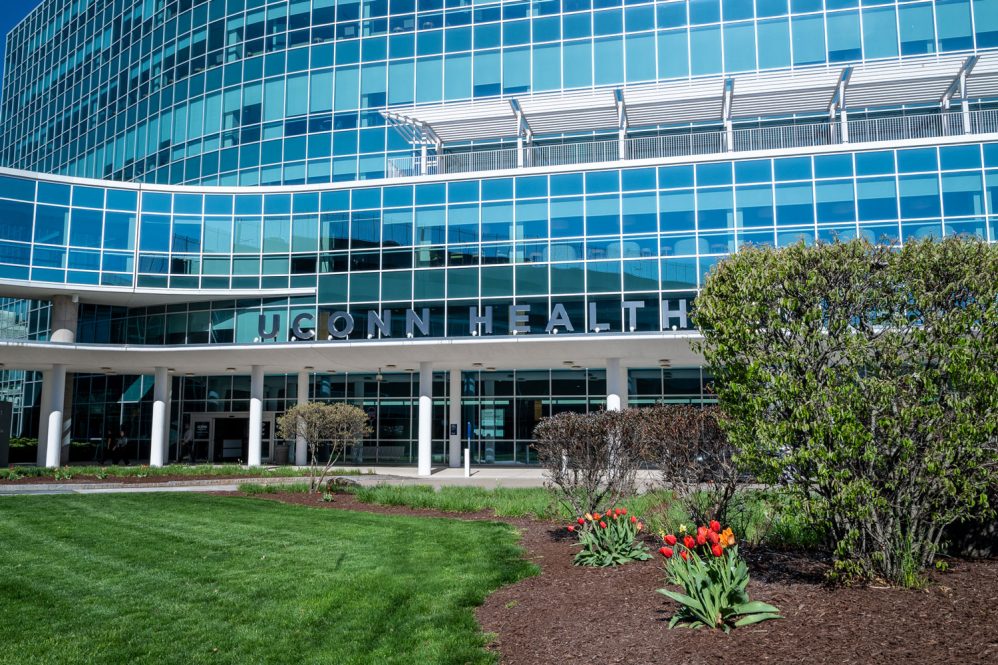
UConn Health lower campus early spring 2026 (Tina Encarnacion/ UConn Health photo)
The UConn School of Medicine has the highest mark among the 54 U.S. medical schools graded by the 2026 Planetary Health Report Card, released annually on Earth Day.
UConn's is one of seven U.S. medical schools with an overall grade of 'A,' up from an 'A-' last year and representing a new high. The report card takes into account curriculum, interdisciplinary outreach, community outreach, support for student-led initiatives, and campus sustainability.
Sustainability is in the curricula in both the medical and dental schools and in the internal medicine residency program.
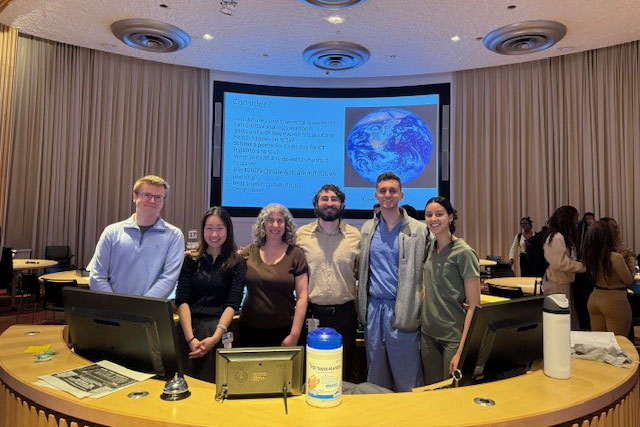
"We discuss the importance of clean water and air, and a livable climate, as fundamental to human health in a series as part of the Health Systems Science course," says Dr. Kirsten Ek, assistant professor of medicine and member of UConn Health's sustainability working group..
In late January, students took part in a zero-waste event as part of a community health panel in North Hartford, bringing reusable food containers and utensils to a community historically overburdened by landfills and incinerator waste. Two months later, first-year medical and dental students heard from two local community members sharing their experiences with health harms related to pollution.
"In part this served as a reminder of the critical importance of considering environmental determinants of health when taking care of patients," Ek says.
The topic of the April 7 Health System Sciences class was climate and health, including how sustainable practices in health care can reduce its carbon footprint.
"And from the graduate medical side, for the first time ever this year, internal medicine residents had an educational half-day session on climate and environmental health, which included ways health care can reduce carbon emissions," Ek says.
The UConn John Dempsey Hospital operating room is one particular area at UConn Health that has been focusing on sustainability for several years now.
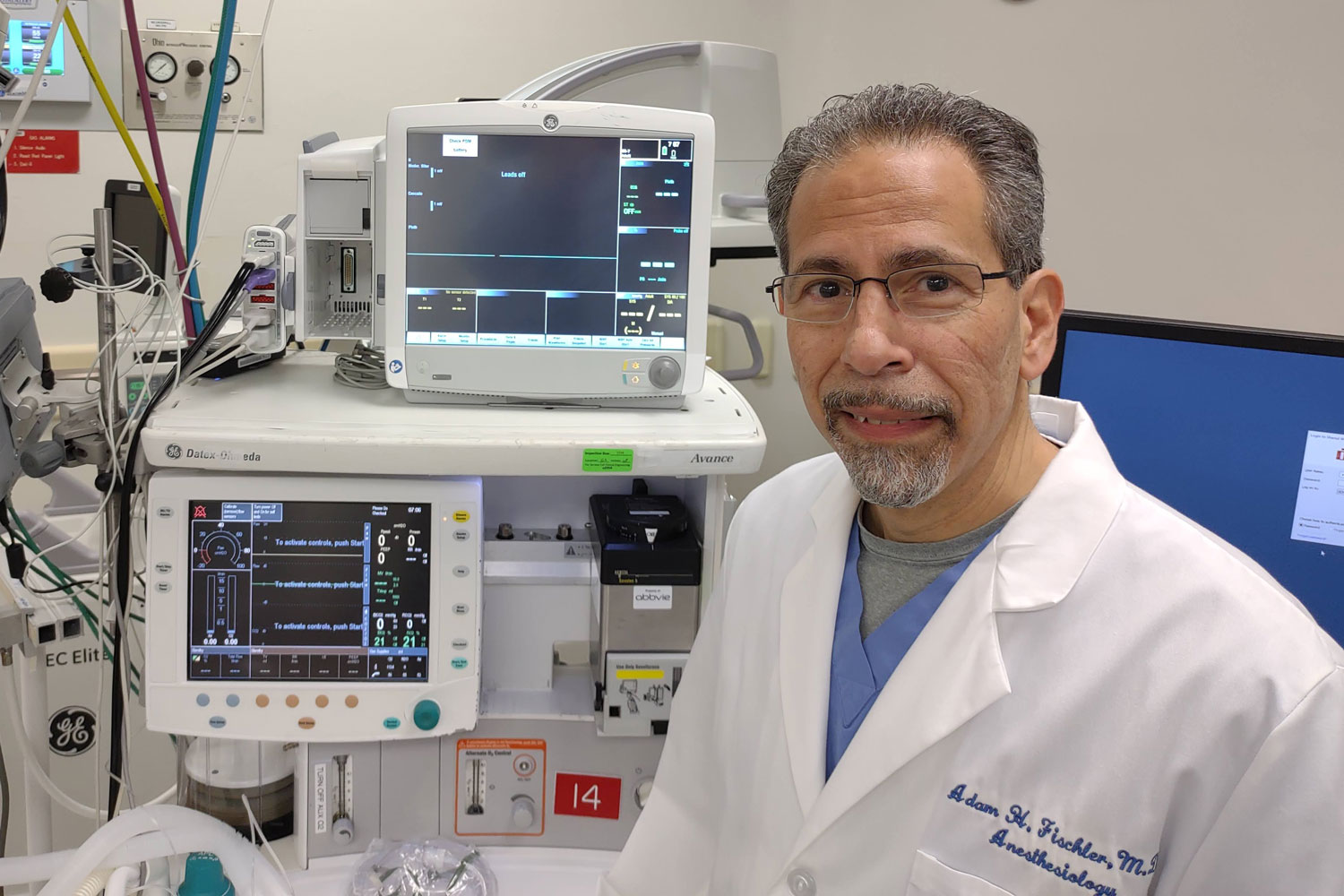
"Sustainability initiatives in the OR are making a tremendous impact on the OR's carbon footprint at UConn Health," says Dr. Adam Fischler, OR medical director. "Reduction of anesthetic gas usage, minimization of material waste, and better HVAC management are making a difference."
Fischler reports UConn Health installed 14 new anesthesia machines, equipped with sustainability features, in the operating rooms and electrophysiology lab. Volatile anesthetic gas usage is down more than 50%. New machines can safely lower fresh gas flows to as low as 0.3 liters per minute. The potential for reduction of greenhouse gas emissions is 75% or greater. The OR also has reduced is hourly air exchanges, which saves energy.
Perhaps the most significant, measurable sustainability success since Earth Day 2025 is at the Creative Child Center on UConn Health's lower campus. In the nine months since energy efficiency improvements were completed, the building is using half the energy.

The improvements were part of a state pilot program to reduce the building's carbon footprint using new technology known as ultra-high performance heating, ventilation and air conditioning (UHP HVAC).
Connecticut Innovations, the strategic venture capital arm of the state's Office of Manufacturing, fully funded the project, in which the Shelton-based firm Budderfly installed the UHP HVAC at the child center on UConn Health's lower campus to demonstrate the potential benefits by way of a 12-month pilot. The new system, combined with a changeover to LED lighting throughout the building, saved nearly 46,000 kilowatt hours from June through February, a 51% reduction in energy use compared to average usage over those same months. At 18 cents per kilowatt hour, it's a savings of more than $8,600.

It's one of several sustainability successes UConn Health reports for Earth Day 2026.
"More important than us reporting on our ongoing sustainability efforts is using them to illustrate how we all can take steps to make a difference and contribute to the collective effort," says John Lombardi, UConn Health's director of facilities engineering and sustainability and chair of the sustainability working group. "We also use the opportunity to learn how one area contributed and others can engage with similar efforts. This way smaller things add up."
Other sustainability highlights and initiatives at UConn Health include:
Connecticut GreenerGov Awards
- Trailblazer Award for OR sustainability team and anesthetic gas minimization/reduction
- Honorable mention for Fischler and Karen Curley, senior director of nursing in the OR, as "Eco Champions"
- Honorable mention for Natural Gas Savings.
- Honorable mention for All Fuels Savings.
Recycling
An upward trend going back to 2022 continues, with nearly 319 tons of recyclable materials diverted from UConn Health's waste stream in 2025, up 2.7 % from 2024, and more than 17% over four years.
Composting
UConn Health implemented a food composting program with the vendor Blue Earth in August 2024. Since then, Blue Earth has converted nearly 30 tons of food waste from UConn Health into compost soil.
Lighting system upgrades
UConn Health has replaced old fluorescent lighting with LED lighting in mechanical rooms and stairwells in the L Building (lab portion of the main building) and the University Tower, resulting in an estimated savings of 200,000 kilowatt hours per year, or approximately $36,000.
"Our achievements are significant and noteworthy, especially considering the additional challenges as our medical center grows and much more energy and waste is generated to accommodate growing patient volumes," Lombardi says. "For example, adding an additional operating room or linear accelerator increases our greenhouse gas footprint while simultaneously we are trying to drive down to meet goals."

At the UConn School of Medicine's Department of Public Health Sciences, pollution is both an academic and research focus.
Assistant professor Misti Levy Zamora studies environmental health and engineering, notably, how transportation-related pollution from fossil fuels directly impacts morning commuters in their own cars, highlighting the importance of cleaning up our transportation in the state for our health.
Department Chair Doug Brugge has more than 50 published papers on health impacts of traffic-related pollution.
"Public health, I think, frequently does not get the attention it deserves, because the benefits are more invisible to people," Brugge tells Dr. Anthony Alessi on his "Healthy Rounds" podcast. "If you don't get cancer or don't have a heart attack because someone… regulated toxins in the drinking water, or in my field, the pollution in the air, it's invisible. You just don't know that it happens."
Looking ahead
Projects now or soon to be underway at UConn Health include heating distribution piping insulation, which will improve efficiency in maintaining water temperature. It's a $1 million initiative, with utility company incentives covering nearly $900,000 of that. Lombardi estimates it should only take two years for UConn Health to recover its portion of that expense through enhanced energy savings.
Starting this year, UConn Health is using technology known as Electrocell to treat the water for its cooling system without the need for sand filters, which require hundreds of additional gallons of water daily to rinse.
"It breaks down the particles in the water by electrolysis and it works like a magnet that pulls all the particles out, so it makes the water really clean," Lombardi says.
The cleaner water cleaner will minimize the buildup of film on the cooling system's coils and tube, optimizing efficiency and capacity.
Additionally, facilities crews are conducting periodic inspections of mechanical systems, known as "retro commissioning."
"Through time, things wear out," Lombardi says. "We also have a lot of projects going on where we're tapping into existing systems and there simply is not enough capacity to serve the new expanded areas. So what we're doing is, we're going back to each area and making sure it's working the way it was supposed to when it was new, and then if there are more demands on it than when it was new, making sure you're running it at a capacity that is efficient."
One example of this is the recalibration of sensors to optimize HVAC system ventilation and use outside air when temperatures are ideal for free cooling and heating of spaces.
Some student and resident outreach events planned in the near future include the sustainability interest group's sustainable thrifting event in the student lounge April 26 to May 2, inviting students and staff to donate or thrift.
Additionally, the Internal Medicine Community Health Alliance Track is collecting donations of gently used clothes, which will go to the UConn John Dempsey Hospital social work teams for patients in need.


