
The Center for Pharmaceutical Manufacturing Modernization will support work to modernize pharmaceutical production and build a more efficient, sustainable, and resilient pharmaceutical ecosystem
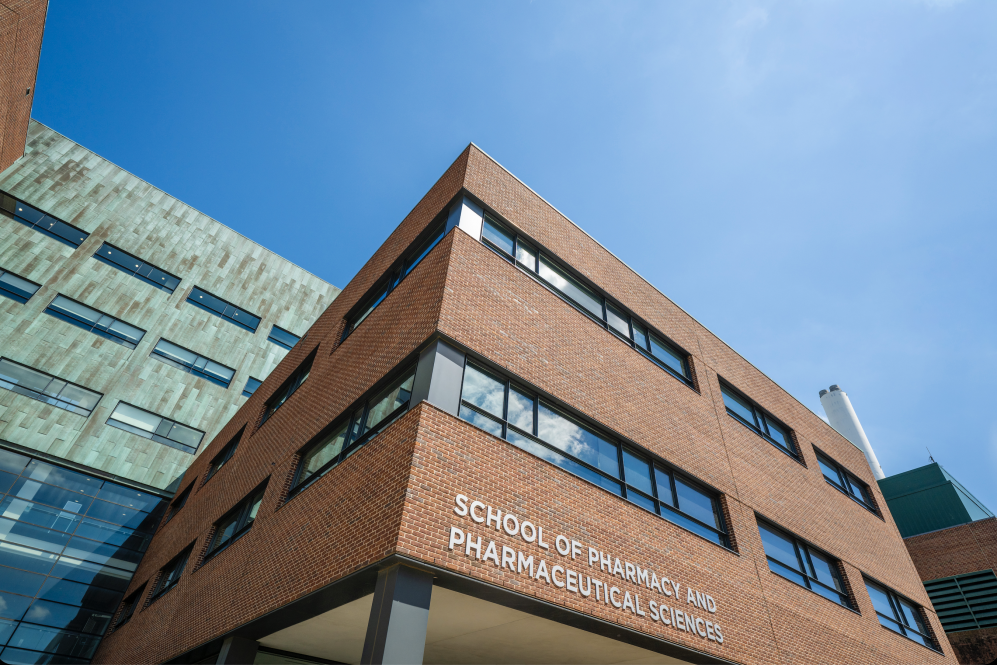
Exterior view of the School of Pharmacy and Pharmaceutical Sciences on Aug. 19, 2026. (Sean Flynn/UConn Photo)
The UConn School of Pharmacy and Pharmaceutical Sciences has launched the Center for Pharmaceutical Manufacturing Modernization (CPMM), a new initiative designed to accelerate innovation in pharmaceutical manufacturing, strengthen domestic supply chains, and expand access to high-quality medicines.
The Center will serve as a hub for collaboration among industry leaders, researchers, and regulatory agencies to modernize pharmaceutical production and build a more efficient, sustainable, and resilient pharmaceutical ecosystem.
The center is directed by Xiuling Lu, professor of pharmaceutical sciences and director of research and graduate education in the School of Pharmacy and Pharmaceutical Sciences.
"UConn has a rich history, a strong collaborative network, and established technologies that position us to make significant impact in this area," Lu says. "We see a clear need, especially in the Northeast, where many biotechnology and pharmaceutical companies are seeking expertise in pharmaceutical technology and manufacturing."
By leveraging cutting-edge pharmaceutical technology, automation, artificial intelligence, and sustainable manufacturing, CPMM aims to improve efficiency, enhance drug quality, and improve global access to medicines.
"This center can help transform pharmaceutical manufacturing from traditional approaches into systems that are more secure from a supply chain perspective and more effective in delivering affordable medications to patients," says Howard Stamato, an advisory board member for the center and a consultant with decades of pharmaceutical industry experience.
The new center builds on UConn faculty expertise to address urgent challenges in cost-effective pharmaceutical manufacturing. Its work aligns with national priorities to expand domestic manufacturing capacity and strengthen the pharmaceutical workforce.
UConn pharmacy researchers have established leadership in key areas of pharmaceutical development, including drug delivery, advanced manufacturing, formulation stabilization, and automation.
Our vision is for the center to serve as a one-stop resource-from technology development to talent training, and workforce support. — Xiuling Lu
CPMM also draws on expertise across UConn, including chemistry, engineering, computer science, and business, as well as infrastructure at UConn Tech Park. The Center's work is supported by industry partners and regulatory collaborators, including the FDA.
Initial areas of focus include injectable medicines and oral pharmaceutical products, building on existing UConn faculty expertise and the needs of industry partners.
In Connecticut, CPMM has established a partnership with the Mashantucket Pequot Tribal Nation (MPTN). MPTN is one of the first tribal nations exploring the pharmaceutical manufacturing plant on tribal land as part of broader efforts to address nationwide medication shortages.
In collaboration with Connecticut Center for Economic Analysis at the UConn School of Business, the team is supporting MPTN's Project REMIND. This US Economic Development Administration grant funded study is led by MPTN. The project explores the feasibility of a tribal pharmaceutical manufacturing facility.
"We are excited about this collaboration, and we are exploring how might a Tribal Nation, with public and private partners, help strengthen national health security by producing essential medicines which are often generic and often in critical shortage," says Dr. Setu Vora, MPTN Chief Medical Officer.
At its core, CPMM is designed to bridge academic discovery with real-world manufacturing needs.
"Technology advances most quickly when academia and industry collaborate," Stamato says. "That partnership helps ensure academic solutions are connected to the practical problems identified by industrial partners. There is valuable cross-pollination of ideas between communities with very different perspectives."
The Center's long-term goal is to provide integrated, end-to-end support for pharmaceutical manufacturing. Working directly with partners, CPMM will help develop rapid and cost-effective manufacturing strategies while offering educational workshops, consulting services, and workforce-development opportunities.
"Our vision is for the center to serve as a one-stop resource-from technology development to talent training, and workforce support," Lu says. "Long term, CPMM will be a versatile platform that can work with multiple partners in a sustained and meaningful way."


