
A growing body of research suggests that sleep may be more than a symptom of Alzheimer's disease - it may also play a role in how the disease develops and progresses. Now, new research from the University of Kentucky's Sanders-Brown Center on Aging is shedding light on how everyday environmental factors and inflammation in the brain could influence sleep, circadian rhythms and Alzheimer's-related changes.
In two recently published studies, UK researchers explored how dim light exposure at night and neuroinflammation affect sleep and biological rhythms in Alzheimer's disease models. Together, the findings point to potentially modifiable factors that may influence brain health during aging.
The first study, published in the journal SLEEP, examined how dim light at night - similar to light exposure from televisions, phones, hallway lighting or streetlights - affects circadian rhythms and Alzheimer's-related brain changes.
The team found that nighttime light exposure disrupted daily activity rhythms, reducing rhythm stability and increasing fragmentation. In Alzheimer's disease models, dim light exposure also modestly worsened amyloid buildup and altered microglial activity toward a more immune-activated state.
"These studies examine why sleep and daily biological rhythms become disrupted in Alzheimer's disease, and whether those disruptions are influenced by both the outside environment and inflammation inside the brain," said Adam Bachstetter, Ph.D., lead author of the study, associate professor of neuroscience in the UK College of Medicine.
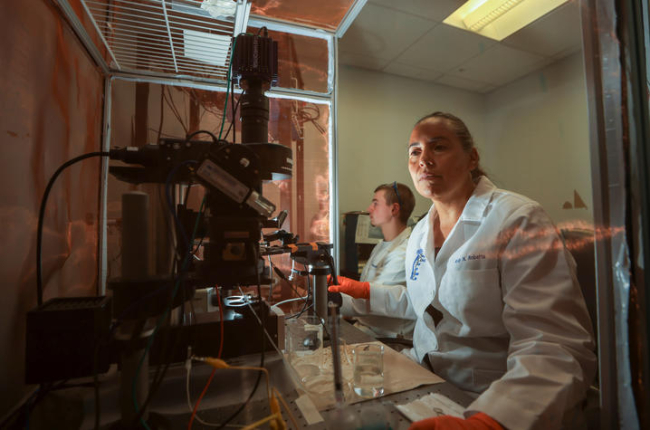
An accompanying editorial in SLEEP highlighted the broader significance of the findings, describing artificial light at night as a potentially modifiable environmental factor that could influence Alzheimer's disease risk or progression through circadian and neuroimmune pathways.
The second study, published in Alzheimer's & Dementia, focused on what may drive poor sleep once Alzheimer's-related pathology is already present. Researchers monitored sleep patterns, activity rhythms, cognition and inflammatory signaling over time in Alzheimer's disease models.
The study found that disrupted sleep and more fragmented circadian rhythms emerged in midlife - before major memory deficits appeared. Researchers then tested MW151, a compound developed by Sanders-Brown Director Linda Van Eldik, Ph.D., that targets excessive inflammatory signaling from glial cells in the brain.
Treatment with MW151 improved sleep patterns and restored more typical daily rhythms without reducing amyloid buildup, suggesting that inflammation - rather than amyloid alone - may be driving sleep disruption in Alzheimer's disease.
"We now know that sleep can be improved without reducing amyloid," said Bachstetter. "This finding separates sleep disruption from amyloid load and points to neuroinflammatory signaling as a modifiable driver of poor sleep in Alzheimer's-related pathology."
The findings are especially significant because poor sleep and disrupted circadian rhythms are common in Alzheimer's disease and often emerge years before severe cognitive symptoms develop. Researchers say the studies add to growing evidence that sleep and circadian health may be important factors in brain aging.
"Poor sleep is not just a symptom that appears late in disease," said Bachstetter. "It may interact with amyloid pathology, microglial function and inflammation in ways that influence disease progression."
Although the research is still in the preclinical stage and does not yet translate directly into clinical recommendations for people, researchers say the findings reinforce current sleep health guidance and point toward future therapeutic possibilities.
"Practical steps such as reducing unnecessary light exposure at night, keeping a consistent sleep schedule and supporting healthy circadian rhythms are low-risk strategies that align with current sleep health guidance," said coauthor Marilyn Duncan, Ph.D., professor of neuroscience in the UK College of Arts and Sciences.
The studies also highlight the collaborative nature of research at Sanders-Brown, involving investigators and trainees across multiple units, including neuroscience, biology, biomedical engineering, molecular and cellular biochemistry, and the Spinal Cord and Brain Injury Research Center.
Both studies were supported by the National Institutes of Health. The dim light study also received equipment support from UK's Office of the Vice President for Research.

Research reported in this publication was supported by the National Institute on Aging of the National Institutes of Health under Award Number R01AG068215. The content is solely the responsibility of the authors and does not necessarily represent the official views of the National Institutes of Health.


