
An ultrathin ferroelectric capacitor, designed by researchers from Japan, demonstrates strong electric polarization despite being just 30 nm thick including top and bottom electrodes-making it suitable for high-density electronics. Using a scandium-doped aluminum nitride film as the ferroelectric layer, they achieved high remanent polarization even at reduced thicknesses. This breakthrough demonstrates good compatibility with semiconductor devices combining logic circuits and memories, paving the way for compact and efficient on-chip memory for future technologies.
Ultrathin (Al,Sc)N Ferroelectric Capacitors for Next-Generation Memory Devices
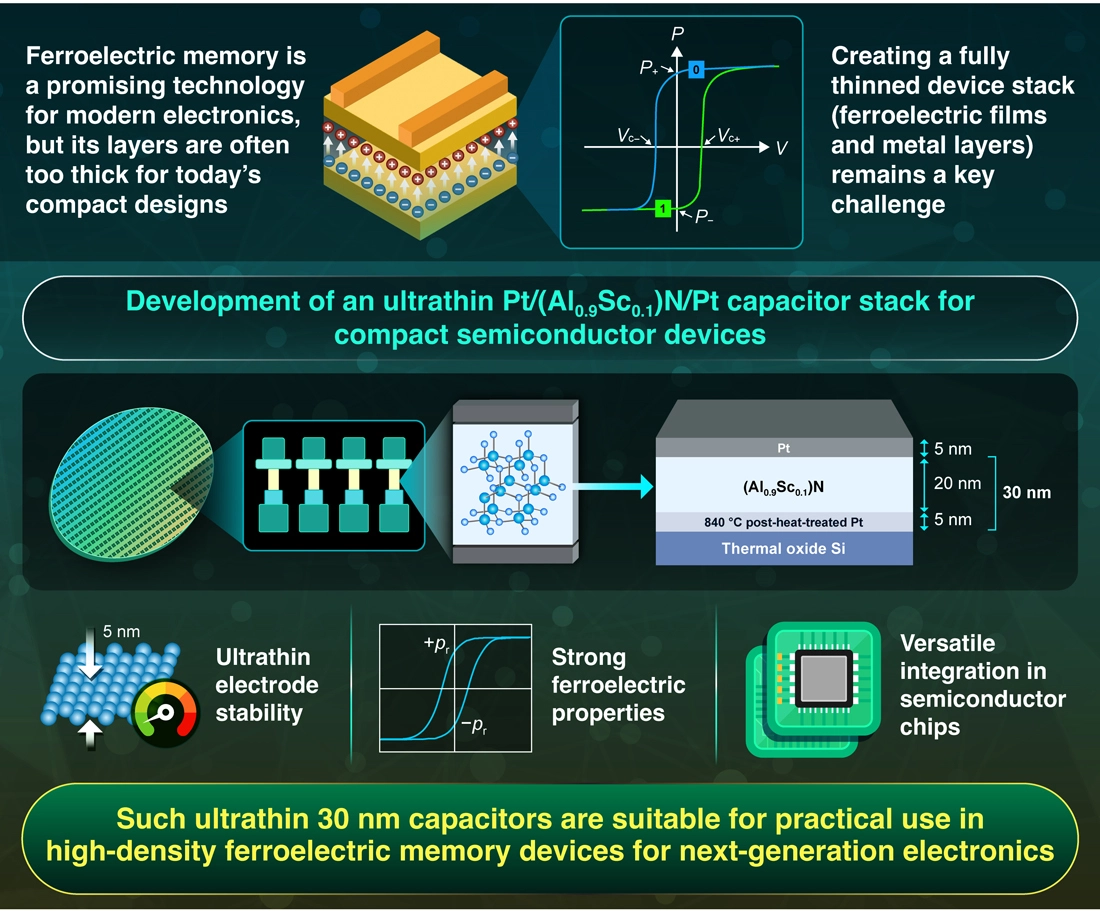
Modern electronic technology is rapidly advancing towards miniaturization, creating devices that are increasingly compact yet high-performing. As the devices continue to shrink in size, there is an increasing demand for ultra-small memory materials that can efficiently store data, even in smaller dimensions. Ferroelectric memory devices are promising options for future mobile and compact electronics, as they store information using switchable electric polarization, allowing data retention even without power. However, very few initiatives have reported progress in downscaling of these ferroelectric devices.
Bridging this gap, a research team led by Professor Hiroshi Funakubo from the School of Materials and Chemical Technology, Institute of Science Tokyo (Science Tokyo), Japan, in collaboration with Canon ANELVA Corporation (Canon ANELVA), successfully downscaled a total ferroelectric memory capacitor stack using scandium-substituted aluminum nitride ((Al,Sc)N) thin films with platinum electrodes, reducing the total thickness to just 30 nm including top and bottom electrodes. The research team included Mr. Soshun Doko, a doctoral student jointly affiliated with Science Tokyo and Canon ANELVA, Assistant Professor Kazuki Okamoto from Science Tokyo, along with Dr. Naoko Matsui, Dr. Toshikazu Irisawa, and Dr. Koji Tsunekawa from Canon ANELVA, Japan. The details of the breakthrough were published online in the journal Advanced Electronic Materials on November 07, 2025.
Typically, ferroelectric memory devices use a simple stack design consisting of a ferroelectric material layer enclosed between two metal electrodes. The ferroelectric layer is responsible for storing information through switchable polarization, while the electrodes ensure electrical connection and enable voltage-driven switching.
"Previous research on downscaling ferroelectric memory has only focused on thinning the ferroelectric layers," notes Funakubo. "What makes our research stand out is that we focused on downscaling the complete device stack, not just the ferroelectric film."
To achieve the same, the researchers developed a three-layer capacitor structure consisting of a (Al0.9Sc0.1)N film as the ferroelectric layer enclosed between platinum electrodes. By carefully balancing layer thickness with functional performance, the team successfully built an optimized full capacitor stack with a thickness of just 30 nm. The resultant Pt/(Al0.9Sc0.1)N/Pt capacitor stack consisted of a 5 nm platinum bottom electrode, a 20 nm (Al0.9Sc0.1)N ferroelectric layer, and a 5 nm platinum top electrode.
The impressive performance was attributed to the inherent ferroelectricity of (Al,Sc)N, which stems from its high remanent polarization (polarization that remains even after the removal of electric field). Moreover, the downscaling of the entire stack also indicates a device-ready capacitor that is suitable for direct embedding in semiconductors and logic systems (the decision-making units in electronic devices).
"The results demonstrated that high ferroelectric performance can be sustained even when the entire capacitor stack thickness is drastically reduced, and this brings us one step closer to the practical implementation of ultrathin memory devices," says Funakubo.
Additionally, the team also discovered that post-heat treatment of the bottom platinum electrode at 840 °C enhanced its crystal orientation and improved the polarization switching in thinner films. This highlights a critical step for preserving ferroelectric performance during aggressive thickness scaling.
Overall, the study lays a strong foundation for compact ferroelectric memories and could inspire downscaling of other ferroelectric architectures such as FeRAM and FTJ, which heavily rely on stable polarization switching and retention. In future, the researchers aim to explore alternative electrode materials with more suitable crystal orientations, which may reduce the thermal processing requirement while strengthening the device's durability. These improvements could accelerate the development of on-chip memory for Internet-of-Thing devices, leading to smaller, faster, and more energy-efficient electronics.
Reference
- Authors:
- Soshun Doko1,2, Naoko Matsui1, Toshikazu Irisawa1, Koji Tsunekawa1, Nana Sun2, Yoshiko Nakamura2, Kazuki Okamoto2, and Hiroshi Funakubo2,3*
- Title:
- Thickness Scaling of Integrated Pt/(Al0.9Sc0.1)N/Pt Capacitor Stacks to 30 nm
- Journal:
- Advanced Electronic Materials
- Affiliations:
- 1Canon ANELVA Corporation, Japan
2Department of Material Science and Engineering, Institute of Science Tokyo, Japan
3MDXResearchCenter for Element Strategy, Institute of Science Tokyo, Japan


