
The United Nations Institute for Training and Research (UNITAR) has been named the new administering organization of the Inter-Organization Programme for the Sound Management of Chemicals (IOMC) and host of its Secretariat, marking a new chapter for the global partnership after three decades of coordinated action on chemicals and hazardous waste management and continuing the role played by the World Health Organization (WHO) since 1995.
A 30-year legacy of global cooperation
Established in 1995 after the Rio Earth Summit , the IOMC was created to enhance international coordination on chemical safety and address the growing risks posed by hazardous substances to human health and the environment. The initiative currently brings together ten leading international organizations: FAO, ILO, UNDP, UNEP, UNIDO, UNITAR, WHO, the Organisation for Economic Co-operation and Development (OECD), the World Bank Group, and the Basel, Rotterdam and Stockholm Conventions (BRS). Under its new motto - Working Together to End Chemical Pollution - the IOMC helps its member organizations provide countries with coordinated scientific, technical, legislative, and financial support. This reflects multi-sectoral collaboration in action, across the health, environment, workplace, agriculture, development, industry, and finance fields.
Over its first decade, the IOMC focused on advancing global chemical safety priorities outlined in Chapter 19 of Agenda 21 . Over its second decade , the IOMC shifted focus toward supporting the priorities of the Strategic Approach to International Chemicals Management (SAICM) framework. The IOMC later moved toward supporting international frameworks for chemicals management and, in recent years, has played a central role in advancing global efforts to address pollution and hazardous waste.
Major achievements and global impact
Since its inception, the IOMC has supported the implementation of major international agreements regulating hazardous chemicals and waste, helped harmonize global safety standards, and promoted stronger national regulatory systems, particularly in developing countries. The IOMC was instrumental in preparing for the adoption of the Global Framework on Chemicals - For a Planet Free of Harm from Chemicals and Waste (GFC) in September 2023.
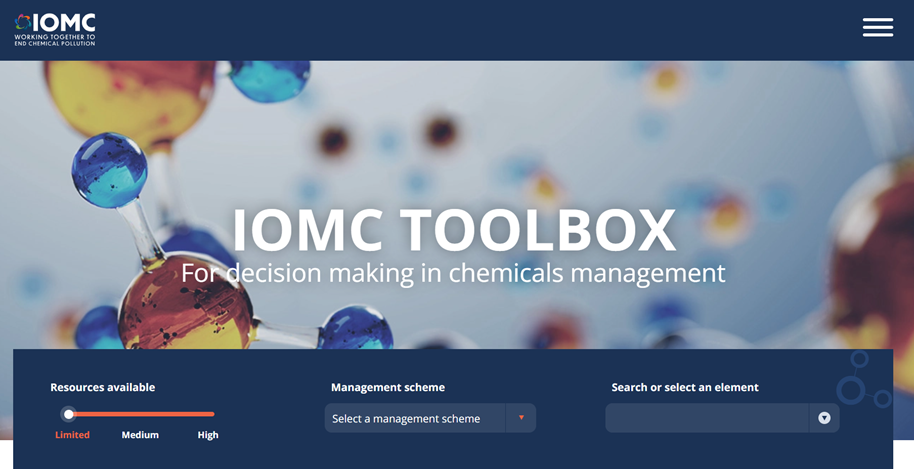
Among its flagship contributions is the IOMC Toolbox for Decision Making in Chemicals Management , widely used by governments to strengthen national policies, improve chemical safety, and enhance enforcement mechanisms.
The IOMC has further contributed to international dialogue on sustainability, supported global efforts to phase out highly hazardous pesticides, and promoted innovation in emerging areas such as nanotechnology, pollution monitoring, and environmentally sound waste management. Its work has also strengthened global data systems and indicators, improving transparency and accountability in chemicals governance.
Since 2024, the IOMC is leading international efforts to develop " implementation programmes " under the Global Framework on Chemicals (GFC). Together with industry and civil society partners, in working groups and webinars , the IOMC is developing the design of two GFC implementation programs: one for "strengthening legal frameworks and institutional capacities for chemicals management" (IP1) and one for "sstrengthening economic and industry sector engagement and action for the sound management of chemicals along value chains" (IP2) - both for consideration by the GFC's first International Conference (IC-1) in November 2026.
UNITAR's role from 2026
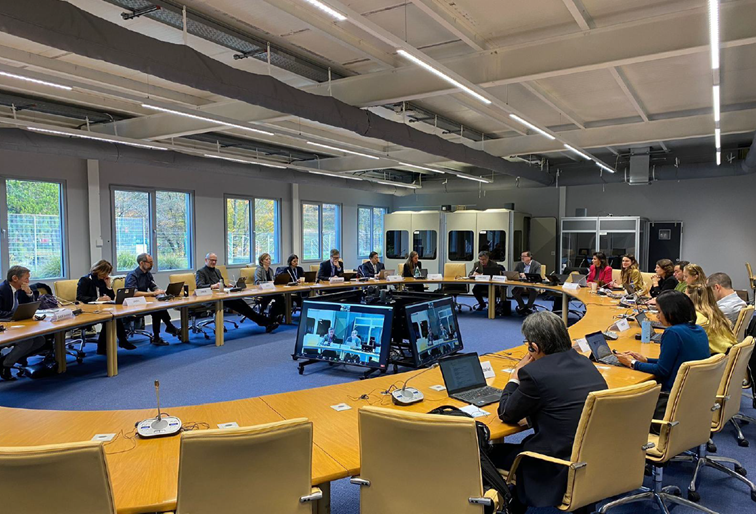
As the new host of the IOMC, UNITAR is determined to build on this legacy, further supporting effective collaboration among participating organizations and efforts to provide training and technical assistance for countries. The Institute already plays a key role in supporting the IOMC and global chemicals management activities through its capacity-building initiatives, such as the IOMC webinars . Strategically based in Geneva, UNITAR will liaise directly with the many international organizations and entities working on Chemicals and Waste Management and other relevant areas of international cooperation.
This transition and a greater role for UNITAR comes at a critical moment, as governments seek stronger, more effective global coordinated action to address pollution - a global environmental and public health challenge and, along with climate change and biodiversity loss, an element of the triple planetary crisis. With renewed leadership and resources, the IOMC aims to deepen its role in implementing the Global Framework on Chemicals, supporting national action, and advancing sustainable development goals.
For 30 years, the IOMC has served as a cornerstone of international cooperation on chemicals and waste. It reinforces the value of a formalised structure for UN organizations and agencies to work together in an increasingly challenging time for multilateralism. This new chapter, hosted by UNITAR, seeks to reinforce that mission by promoting sustainable chemicals management worldwide and continuing to shape a safer, healthier, and more sustainable future.


