
The death knell for the rainforests of the sea, rising ocean temperatures know no boundaries. From the South Atlantic to the Red Sea and from the Hawaiian Islands to the Chagos Archipelago, record-high warm waters continue to decimate coral reefs across the world's oceans, prompting some scientists to issue a stern warning: Corals will disappear altogether in just a few decades if more effective measures aren't taken to save them.
University of Miami marine microbial ecologist Cynthia Silveira could be the scientist whose work helps provide the lifeline corals need to survive.
Silveira, who studies the interactions between viruses and bacteria, will soon spend a month aboard a research schooner in the waters of the "Coral Triangle" to investigate why corals in that region of the Indo-Pacific have an amazing ability to withstand heat-induced bleaching events.
"A coral sanctuary is as good way to describe it," Silveira said of the Coral Triangle, a wide swath of tropical waters in the Pacific and Indian oceans that is home to nearly 600 species of reef-building corals, representing about 75 percent of the world's coral species.
"What specifically is fascinating," Silveira continued, "is that the corals there are being exposed to the same level of heat stress as other reefs globally, but they're not responding the same way—they've shown an extraordinary ability to cope with higher water temperatures, while corals that are of the same species but located in other parts of the Pacific are suffering. So, the question we hope to answer on this expedition is not only why those corals are so resistant, but also how we might be able to help corals elsewhere."
Volcanic islands, mangrove forests, and a vast array of other habitats that may have forced corals in the region to adapt to the geographically complex reef system could be one reason for the corals' ability to withstand bleaching events, in which corals expel the symbiotic algae that live in their tissues, causing them to lose color and turn white.
But the complex role viruses and bacteria play in determining coral health—one of the tenets of Silveira's lab—shouldn't be overlooked, she noted. "While viruses are infamous for causing deadly epidemics, not all are harmful," said Silveira, assistant professor in the College of Arts and Sciences' Department of Biology. "Many are advantageous, playing key roles in maintaining the health of ecosystems by ensuring that harmful bacteria don't take over."
In a previous study of a reef system in the Pacific, Silveira and her team proved that point beyond a doubt, showing through careful experimentation how viral predation of bacteria is associated with high coral cover and resilience in reefs of the Phoenix Islands, located just below the equator in the central Pacific Ocean.
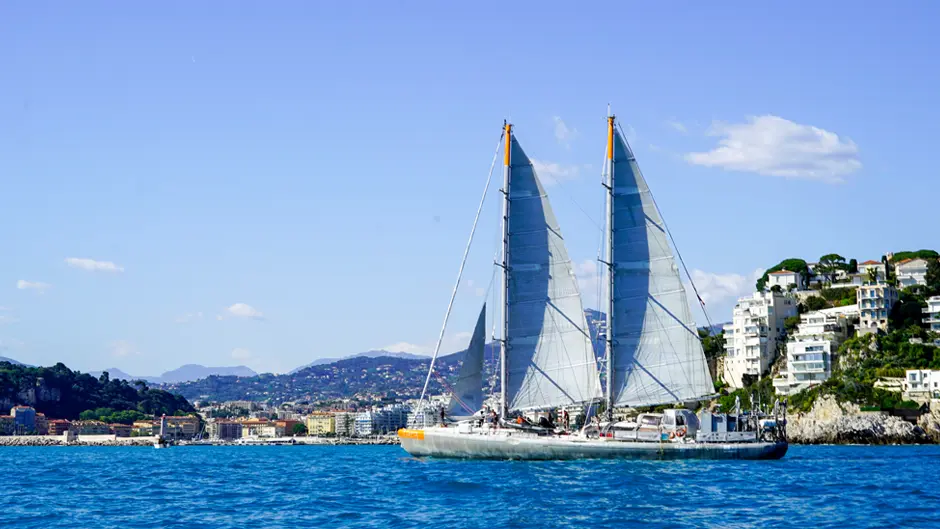
The research schooner Tara will accommodate dozens of scientists during its 18-month voyage of the Coral Triangle.Photo: Courtesy of Ariane Michel
During her monthlong expedition to the Coral Triangle, which begins in September, she and a group of other scientists will ply the waters of the Pacific archipelago nation of Palau aboard the schooner Tara, diving to reef sites, extracting corals, then bringing the samples aboard ship to expose them to short-term high-temperature stress tests that simulate marine heat waves.
They will also take water samples for chemical, plankton, and microbial analysis. "We'll even collect aerosol samples and look at how the land itself might influence the reefs," Silveira said.
Her Palau deployment is just one leg of an 18-month scientific expedition organized by the Tara Ocean Foundation to investigate coral resilience and adaptation across multiple sites in the heart of the Coral Triangle. Officially called Tara Coral, the research voyage will also stop in Indonesia, Malaysia, Papua New Guinea, the Philippines, and India.
Nearly 50 scientists from around the world are involved in the endeavor—from oceanographers and marine biologists to genomicists, microbiologists, paleoclimatologists, and microplastics specialists. Teams of six to seven researchers will rotate on and off the schooner for each of the monthlong segments of the journey.
"All the methods for sampling and experimentation are standardized," Silveira said. "So, regardless of who is on the boat, samples and datasets will be collected and compiled the same way, which will allow scientific communities to benefit from the research even several years later."
Though the Tara schooner, a French sailing ship that had its maiden voyage in 2004 with an expedition to Greenland, departed from France on Dec. 14, the Tara Coral mission officially runs from May through the end of 2027.
The expedition comes not long after the National Oceanic and Atmospheric Administration announced that the world experienced its fourth and most devastating coral bleaching event on record, with about 84 percent of the planet's coral reefs being affected by bleaching level heat stress between 2023 and late 2025.
While Silveira's weekslong stint on the vessel will not begin for seven months, her graduate assistant, Bailey Wallace, will deploy to the schooner in July to conduct coral research near the remote Indonesian archipelago of Raja Ampat.
Tara Coral will serve as a reminder of just how important coral reefs are to the planet, said Wallace, whose Ph.D. studies concentrate on the ecology of microbes and viruses.
"A world without them would be tragic," she said. "Our coastlines would change, beaches would disappear, and marine life that are highly dependent on coral reefs would perish because of the loss of their habitat. Beyond that, so many of our coastal communities depend on coral reefs for food and for their economies. So, coral reefs have immense economic value. Even though the struggle to save them seems daunting at times, they're worth fighting for."


