Scientists at the University of New Mexico have played a key role in identifying a rare, 4.1-billion-year-old Martian meteorite that provides new evidence that the Red Planet may have once had a wetter, Earth-like environment.
The discovery, titled "A Martian meteorite that formed ≳4.1 billion years ago samples Mars' early crust and mantle" and published today in the Journal Science, provides an unprecedented look at Mars' earliest geological history that could help guide future exploration of the planet.
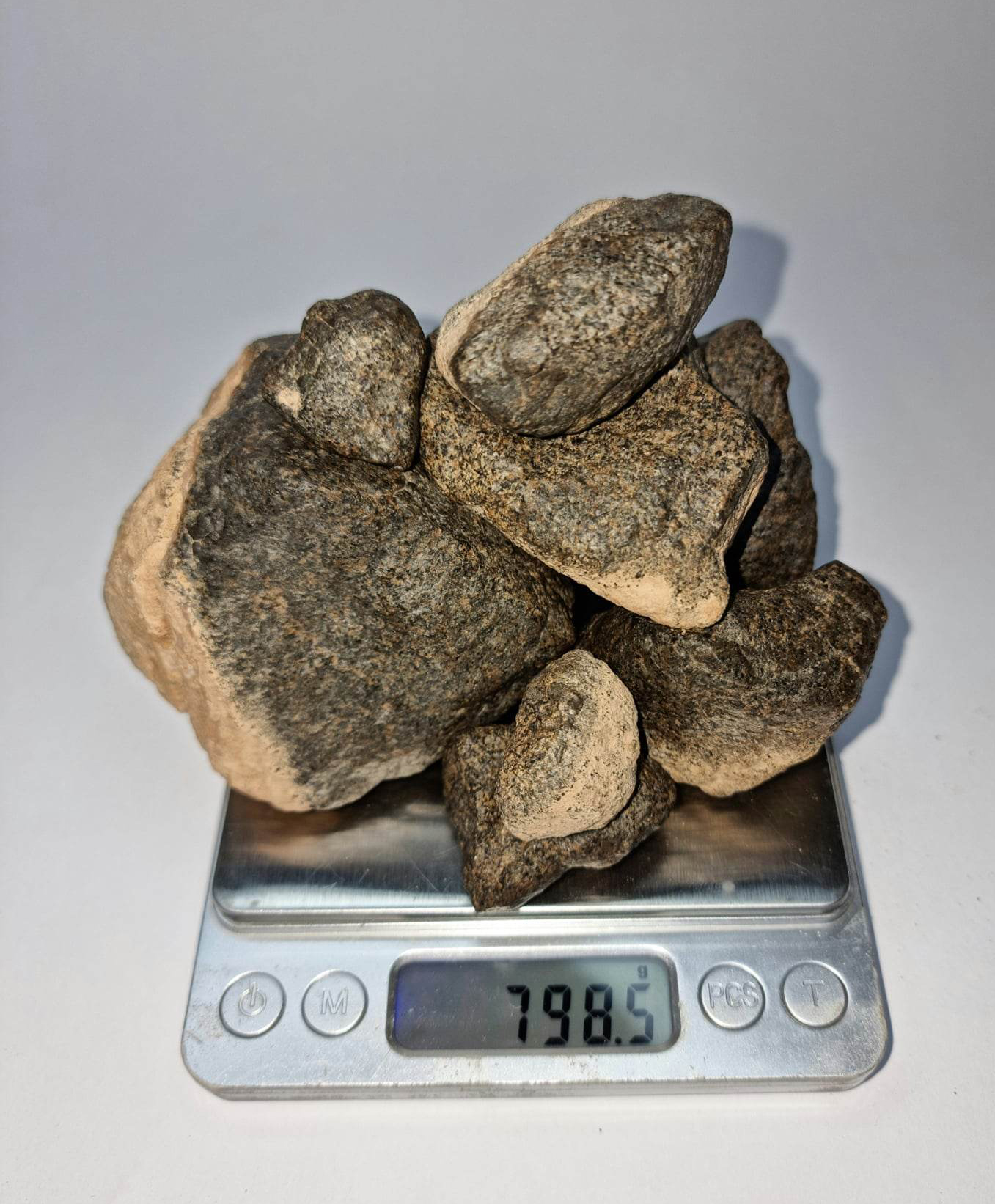
Scientist Carl Agee, director and curator at UNM's Institute of Meteoritics (IOM), has long studied the origin and evolution of planetary interiors and their differentiation. After receiving meteorite samples recovered from the Sahara Desert, he began examining one of them, now known as Teghaza 001 (Teg 001), and recognized unusual textural, mineralogical, and compositional features not typically seen in Martian meteorites. These characteristics were somewhat similar to another famous Martian rock Agee studied, Black Beauty, a water-rich meteorite linked to the Martian crust.
Agee's experience analyzing and noting something unusual in this sample led to further scientific detective work to pursue the mystery. Using UNM's electron microprobe and oxygen isotope analysis capabilities at UNM's Center for Stable Isotopes, Agee and colleague Karen Ziegler, a scientist in the IOM and research professor in the Department of Earth and Planetary Sciences, examined the meteorite more closely and identified characteristics that distinguished it from previously studied specimens, including high levels of manganese oxide, a common byproduct of microbial life.
"I realized that this one was a little bit like Black Beauty, not exactly, but it resembled it in the oxygen isotope values," said Agee, who thought this meteorite might be something special. I looked at it microscopically and found domains within it that had high levels of manganese oxide, a compound being looked for on Mars by the rovers as an indicator of environments conducive to life."
UNM's expertise in meteorite identification and analysis helped initiate a research effort that produced a significant planetary science discovery. The findings led to a collaboration with scientists at NASA's Jet Propulsion Laboratory, Caltech's Division of Geological and Planetary Science Analytical Facility, UCLA's Department of Earth, Planetary, and Space Sciences, and the University of Maine's School of Earth and Climate Sciences.
"This is just one single meteorite. It's like going out back in time and chipping off a hunk of an outcrop, 4 billion years ago on Mars, and then we have this example of what was actually happening. That is why it's such a valuable sample. We've never found one like this before."
– Carl Agee, director and curator at UNM's Institute of Meteoritics
Scientists, including NASA JPL's Yang Liu, whose research focuses on extraterrestrial rocks and soils using microbeam methods, along with scientists at Caltech, conducted additional testing and discovered tiny zircon crystals that allow age-dating of igneous rocks. Using uranium-lead age analyses to date the tiny zircon crystals, Liu dated the meteorite to an extraordinary 4.1 billion years old, making it the oldest known Martian lava rock identified to date, according to Agee.
"There are a few parts to Black Beauty that are around that age, but that whole meteorite itself is a conglomeration of many different rock types. Teghaza 001 is just one unadulterated rock type, and it's 4.1 billion years or older, so that was a big surprise," said Agee. "It's the oldest Martian igneous rock ever found by a huge margin, but in addition to that, it seemed to have these clues in its composition that suggested it had been in an environment that had fluids and water coursing through it."
Unlike most Martian meteorites, which formed hundreds of millions of years ago, Teg 001 dates to the earliest stages of the planet's formation. Its composition consists of a single rock type, unlike other known Martian meteorites such as Black Beauty, offering a unique glimpse into Mars and a rare opportunity to study the planet's ancient crust and geological evolution.

One of the discovery's most significant findings is evidence that the meteorite interacted with fluids on Mars' surface billions of years ago. The unusual oxygen isotope composition and altered minerals suggest that early in the planet's life, Mars experienced environmental conditions dramatically different from today's cold, dry planet. The findings support theories developed over the decades that Mars once had a warmer, wetter and more geologically dynamic environment.
"We also had these anomalous oxygen isotopes, and these domains that had high manganese levels. All of that was consistent with it being from a time on Mars, from the very, very beginning when the Martian environment was different from the time in which most of the Martian meteorites that we see were formed and erupted a few 100 million years ago when Mars was a dry desert, just like it is now. This sample probably came from an environment on Mars that was more Earth-like."
The period of time on Mars when it was more like Earth is called the Pre-Noachian period, the oldest geological epoch, approximately 4.5 to 4.1 billion years ago. If life ever existed on the Red Planet, this would be the era when it could have been possible. Combined with evidence of water, the discovery offers scientists another opportunity to investigate environments that may once have supported life.
"If there was ever abundant life on Mars, on the surface, not sequestered away in some subsurface, that would be the time that you would be looking at, the Pre-Noachian period," said Agee. "It's the very earliest time, and that was when maybe Mars still had a magnetic field, and it was shielded from radiation, and there were surface waters. There was a denser atmosphere. If primitive life was abundant in Mars. That is the time that is most likely for it to have happened."
Because Teg 001 is chemically and geologically distinct from other Martian meteorites, most of which are roughly 200 million years old, scientists believe it may have originated from a previously underrepresented region of Mars, an area where a rover has yet to explore. In their Science paper, Agee and co-authors also used orbital remote-sensing data to identify possible locations on Mars that match the meteorite's composition, several of which place Teg 001's origin in Mars's ancient southern highlands.
"This is just one single meteorite. It's like going out, going back in time and chipping off a hunk of an outcrop, 4 billion years ago on Mars, and then we have this example of what was actually happening," said Agee. "That is why it's such a valuable sample. We've never found one like this before. The most exciting part about this find is its age, plus the alteration in the meteorite that indicates it has been in what I would call an Earth-like environment, with fluids coursing over the surface and volcanoes creating hydrothermal systems. There are surface waters and so on. And that's all reflected in the way that the meteorite has been sort of altered from its original state."
Identifying its potential source could help scientists determine where future landers, rovers or sample-return missions should investigate the planet's ancient crust. The discovery also reinforces how much remains unknown about Mars' geological diversity.
"It's not like this is very common so not only is it ancient and samples a different type of environment in a different time on Mars, but we don't have any other samples like it," said Agee. "Chances are very slim or next to impossible, that we'll get another one, like this anytime soon."