
At a time of geopolitical instability, economic uncertainty and growing competition for strategic resources, gold has re-emerged as a symbol of a secure investment. Investors buy it. Central banks stockpile it. Luxury brands sell it.
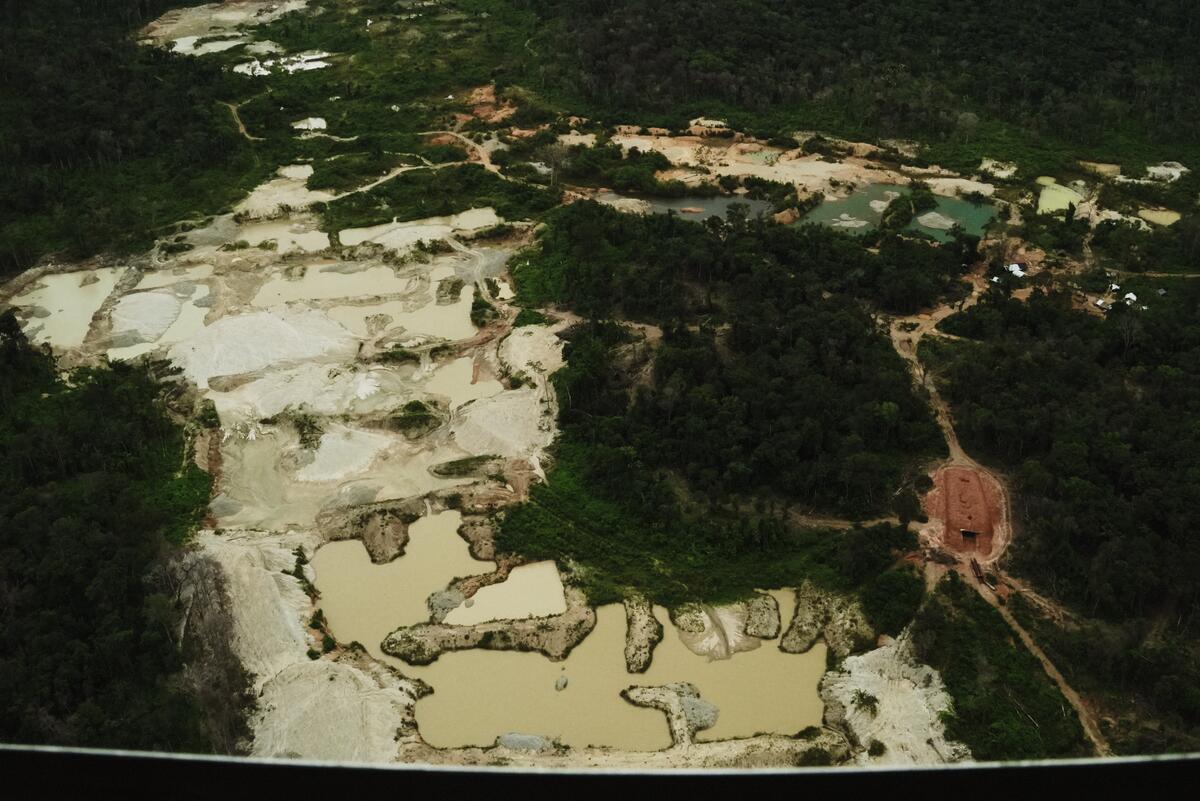
But behind part of this global trade lies a hidden cost: one measured in destroyed forests, contaminated rivers and Indigenous territories under attack.
A new Greenpeace Brazil investigation, Gold Laundering in the Amazon: Anatomy of a Fraud, reveals how illegally mined gold from the Brazilian Amazon can be laundered into legal supply chains and reach markets around the world.
How gold laundering happens in Brazil
At the centre of the scheme, revealed by the report, are the permits provided by the Brazilian Mining Agency, a licensing system originally created to regulate artisanal mining. Because the permits can be granted without prior geological surveys and rely on self-declared estimates of a site's productive potential, there are no reliable technical parameters to verify whether reported production volumes are realistic. According to the report, this loophole allows gold extracted illegally from Indigenous Territories and conservation areas to be laundered into legal supply chains.
What the investigation found
Greenpeace Brazil analysed 187 mining permits between 2018 and March 2026, and identified 98 with signs of irregularities. Together, they accounted for 25.3 tonnes of declared gold worth approximately US$3,66 billion at current market prices.
The Greenpeace Brazil investigation shows a gold laundering scheme that, for decades, has used a legal instrument to insert gold stolen from Indigenous Territories and other protected areas in the Amazon into national and international markets.
The impacts of illegal gold mining in the Amazon
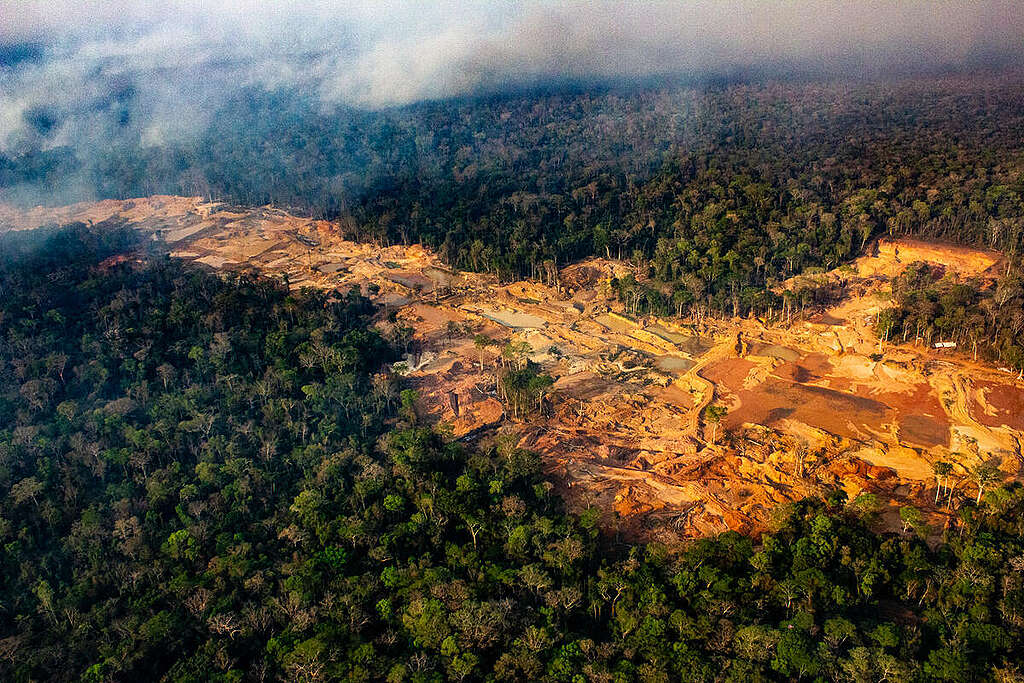
The consequences of this system reach far beyond the mining sites themselves. Between 2023 and 2025 alone, more than 5,249 hectares of rainforest were destroyed by gold mining inside Indigenous Territories in the Brazilian Amazon, an area equivalent to around 7,500 football fields. Illegal mining contaminates rivers with mercury, destroys biodiversity, fuels violence and accelerates invasions into protected areas.
The impacts are particularly severe for Indigenous communities. Mercury contamination threatens food systems and water sources, while violence associated with illegal mining disrupts community life and undermines territorial security. Indigenous women often face some of the harshest consequences, including increased harassment, exploitation and violence. In the Munduruku Indigenous Territory, a recent study found that 98.5% of pregnant Indigenous women examined had mercury levels above safe thresholds in their bodies.
We want to live in a standing and living Amazon, with our rights protected, with clean rivers, with fish free from contamination, and without the constant threat of invasions.
– Alessandra Korap Munduruku, Indigenous Leader
How Indigenous Peoples are resisting and taking action
For generations, Indigenous Peoples and local communities have stood on the frontline of forest protection. Through ways of life deeply connected to and respectful of nature, they have safeguarded the most important ecosystems on Earth long before the world began discussing climate negotiations, biodiversity frameworks or rights-based solutions. Despite representing only 6% of the global population, Indigenous Peoples manage or hold tenure rights over 25% of the earth's surface and at least 37% of the remaining natural lands worldwide.
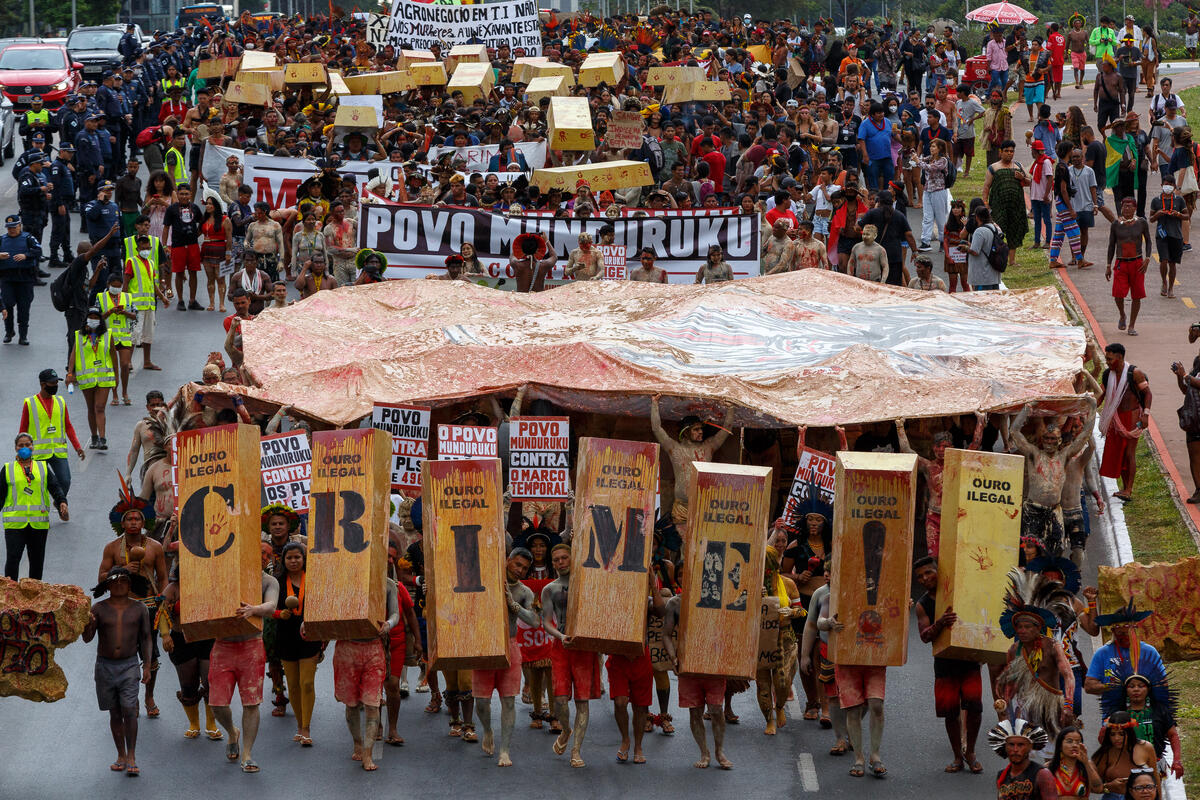
As illegal gold mining advances across the Amazon, Indigenous Peoples are once again leading the response. This June, prominent Indigenous leaders are traveling across France, Belgium, the Netherlands and Italy as part of "The True Cost of Gold" tour.
The group includes:
- Alessandra Korap Munduruku, winner of the Goldman Prize Award in 2023 for her fight against a mining company in her territory
- Juma Xipaia, founder of the Juma Institute, an organisation dedicated to environmental conservation, Indigenous self-determination and women's empowerment, and the first woman leader of the Xipaya Tukamã village
- Megaron Txucarramãe, a key figure in the modern Indigenous rights movement and the official successor of Chief Raoni
- Beptuk Metuktire, Indigenous Youth leader and coordinator of the Raoni Institute
Together with Greenpeace, they are meeting political leaders, journalists, decision-makers and other influential actors to demand stronger accountability in global gold supply chains, greater protection for Indigenous territories and increased support for Indigenous-led forest protection.
Their message is simple: protecting Indigenous rights is not only about justice for Indigenous Peoples. It is about protecting some of the most important ecosystems left on Earth, preserving climate stability, safeguarding water systems and defending the conditions that make life possible for everyone.
Because in the end, what is truly priceless is not gold. It is the possibility of a livable planet for all of us.
Ask political leaders to act on their promises to stop Amazon destruction.
Jaqueline Sordi is the Communications and Engagement Lead for the Tropical Forests campaign at Greenpeace International.


