
'Our group will be unraveling this rich dataset for years'
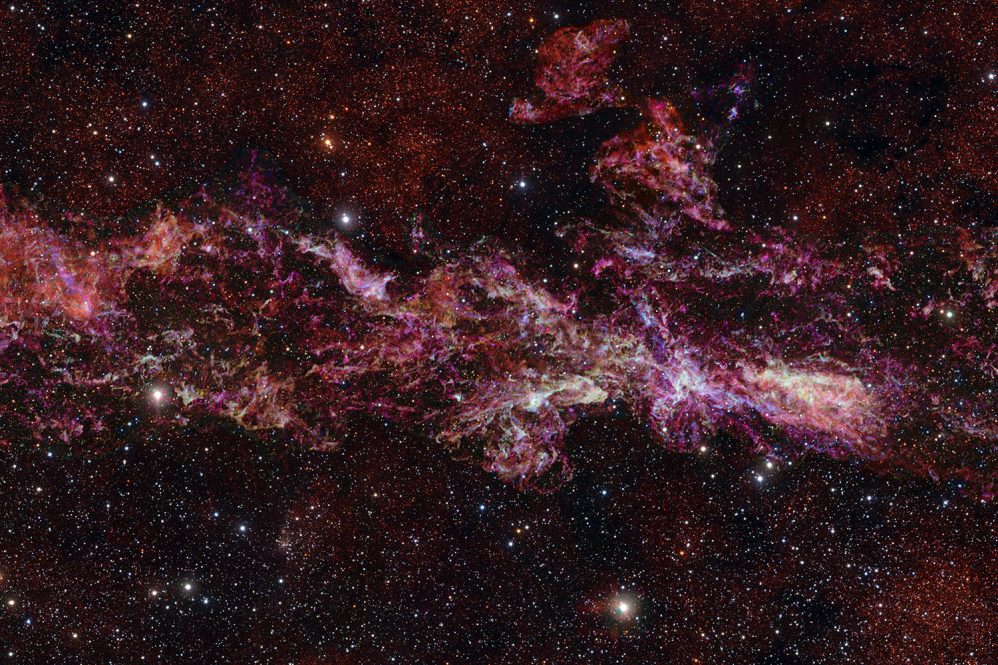
This image shows the complex distribution of molecular gas in the Central Molecular Zone (CMZ) of the Milky Way. It was obtained with the Atacama Large Millimeter/submillimeter Array (ALMA), in which ESO is a partner. This map is as long as three full Moons side-by-side in the sky, and it is in fact the largest ALMA image ever obtained. (Image courtesy of ALMA(ESO/NAOJ/NRAO)/S. Longmore et al. Background: ESO/D. Minniti et al.)
An international collaboration of researchers, including members of the Milky Way Laboratory in UConn's Department of Physics — associate professor Cara Battersby and Ph.D. students Dani Lipman and Jennifer Wallace — are studying never-seen-before details in a pivotal region of the Milky Way. Their results are published in the Monthly Notices of the Royal Astronomical Society.
"It's a place of extremes, invisible to our eyes, but now revealed in extraordinary detail," says Ashley Barnes, an astronomer at the European Southern Observatory (ESO) in Germany who is part of the team that obtained the new data.
The observations provide a unique view of the cold gas - the raw material from which stars form - within the Central Molecular Zone (CMZ), the inner few hundred light years of our galaxy. These results present the largest-ever map of the cold gas across this whole region in exquisite detail.
The region featured in the new image spans more than 300 light years. It harbors dense clouds of gas and dust, surrounding the supermassive black hole at the center of our galaxy.
"It is the only galactic nucleus close enough to Earth for us to study in such fine detail," says Barnes. The dataset reveals the CMZ like never before, from gas structures dozens of light-years across all the way down to small gas clouds around individual stars.
The gas that ACES - the ALMA CMZ Exploration Survey - specifically explores is cold molecular gas. The survey enables study of young star formation, gas flows towards the supermassive black hole at the Galaxy's Center, as well as the intricate chemistry of the CMZ, detecting dozens of different molecules, from simple ones such as silicon monoxide to more complex organic ones like methanol, acetone or ethanol.
Cold molecular gas flows along filaments feeding into clumps of matter out of which stars can grow. In the outskirts of the Milky Way we know how this process happens, but within the central region the events are much more extreme.
"The CMZ hosts some of the most massive stars known in our galaxy, many of which live fast and die young, ending their lives in powerful supernova explosions, and even hypernovae," says ACES principal investigator Steve Longmore, a professor of astrophysics at Liverpool John Moores University, UK.
Wallace leads a working group focused on cataloging and measuring the physical and kinematic properties of gas and dust in the CMZ, from giant molecular clouds down to dense star-forming cores.
"The ACES survey is widely concerned with how mass moves in the CMZ, for instance, how gas flows along complex Galactic orbits, and how it is influenced by the presence of turbulence and strong magnetic fields. It's a very extreme environment and understanding how material is transported from large to small scales is important for understanding how stars form in such a place," says Wallace. "Along with these beautiful observations, the theory is also instrumental for getting the full picture of star formation in the CMZ, without it my work can only do so much."
UConn Ph.D. candidate Dani Lipman is a member of a working group which focuses on the theory, where they run high-resolution simulations to compare and interpret the ACES data.
"Simulations are necessary to look at the overall large scope of the CMZ and do a one-to-one comparison with the small-scale features," Lipman says. "I am probing the physics involved by simulating the whole galaxy including details such as updated gravitational potentials, magnetic fields, star formation, and supernova feedback, all at the same time while reaching resolutions that are on par with the core catalog, which is not something that previous simulations have been able to do at these resolution scales."
With ACES, astronomers hope to better understand how these phenomena influence the birth of stars and whether our theories of star formation hold in extreme environments.
Battersby, who is a co-principal investigator for ACES, explains the big-picture implications for this research for understanding how mass flows at galaxy centers.
"As galaxies evolve, the growth of the supermassive black hole is intimately tied with the growth of the galaxy itself. But scientists are still uncovering this relationship, because those two objects don't speak directly to each other," says Battersby. "Our galactic center is the closest galactic nucleus, in our own 'cosmic backyard,' and allows us to study the dynamics of gas flowing into the center, and what processes control when and how much of that gas forms stars or travels inwards toward the supermassive black hole. With ACES, we map the entire CMZ in unprecedented detail, enabling tracking of gas flows and star formation. The CMZ is the key waypoint on the journey to the central supermassive black hole: gas must pass through the CMZ which regulates how much forms stars, orbits, is expelled or travels inwards to the supermassive black hole."
The researchers are hopeful that these insights will help us not only understand how these processes work in the Milky Way, but also in other galaxies.
"By studying how stars are born in the CMZ, we can also gain a clearer picture of how galaxies grew and evolved," Longmore says. "We believe the region shares many features with galaxies in the early Universe, where stars were forming in chaotic, extreme environments."
To collect this new dataset, astronomers used ALMA, which is operated by ESO and partners in Chile's Atacama Desert. In fact, this is the first time such a large area has been scanned with this facility, making this the largest ALMA image ever. In the sky, the mosaic - obtained by stitching together many individual observations like putting puzzle pieces together - is as long as three full Moons side-by-side.
"We anticipated a high level of detail when designing the survey, but we were genuinely surprised by the complexity and richness revealed in the final mosaic," says Katharina Immer, an ALMA astronomer at ESO who is also part of the project. The data from ACES are presented in five papers, now accepted for publication in Monthly Notices of the Royal Astronomical Society.
"The upcoming ALMA Wideband Sensitivity Upgrade, along with ESO's Extremely Large Telescope, will soon allow us to push even deeper into this region - resolving finer structures, tracing more complex chemistry, and exploring the interplay between stars, gas and black holes with unprecedented clarity," says Barnes. "In many ways, this is just the beginning."
"Our group will be unraveling this rich dataset for years, as well as implementing cutting-edge numerical simulations to enable interpretation of these complex processes," says Battersby. "In time, we hope to fully map the 3-D structure of our Galaxy's center, measure how the CMZ regulates black hole feeding, and expand our work to galaxies across the cosmos."


