
UConn graduate students and Ph.D. candidates synthesize years of study into quick presentations
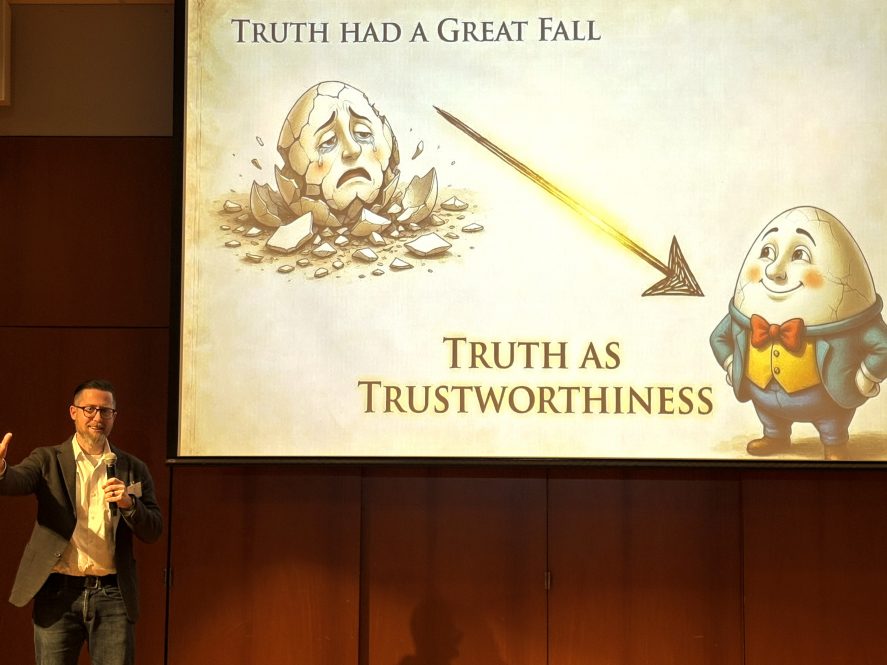
Mark Dickson (CLAS) summarizes years of research into a quick pitch during the Three-Minute-Thesis competition, hosted by the UConn Graduate School at the Dodd Center for Human Rights. Photo by Matt Engelhardt.
It is no small feat to summarize years of research into a three-minute presentation. On Wednesday, Apr. 8, dozens of UConn graduate students and Ph.D. candidates rose to the occasion.
The Graduate School hosted a Three-Minute-Thesis competition at the Dodd Center for Human Rights. The event challenged students to summarize their graduate and doctoral theses and dissertations into short presentations before an audience of peers, family, and advisors.
"I am just excited to hear from the students, in their own words, the impact and the value of their graduate research," said Leslie Shor, UConn vice provost for graduate education and dean of the Graduate School.
The Three-Minute-Thesis competition evolved from a program at the University of Queensland in 2008. At the time, Australia was experiencing a severe drought. The former dean of the Queensland graduate school quipped that graduate students should be able to explain their research to a general audience in three minutes or less - the same amount of time requested that people limit their showers.
Since the first challenge, the program has gone global, with hundreds of events held annually at institutions throughout the world. The goal is for the researchers to describe their thesis and dissertation topics in a manner easily understandable by all attendees, regardless of previous knowledge.
Appropriately, UConn's competition was held as part of Graduate Student Appreciation Week. The celebration includes a series of events honoring the work, research, and contributions that graduate students make to the University, as well as offering them professional development and networking opportunities.
The Three-Minute Thesis was divided among three divisions: master's degrees and professional/clinical doctorates; Ph.D. candidates in arts, humanities, and social sciences; and STEM Ph.D. candidates. Judges selected one winner from each division, with $1,000 prizes awarded. Runners-up in each category received $750. Additionally, attendees in-person and remotely voted on a "people's choice" winner for the respective categories, with each winner earning $500.
Tracy Geha (CLAS), who is seeking a master's degree in French and Francophone studies, piled up the accolades at the challenge, earning first and people's choice in her group as well as overall winner. For the latter, Geha received an additional $5,000. As the overall winner, Geha will represent UConn at a nationwide competition.
One of the participants - Muireann Nic Corcráin - presented immediately after successfully defending her dissertation for a doctorate in applied linguistics. She joked that she had just finished a 25-minute defense only to now have to summarize her work in 180 seconds.
The Three-Minute-Thesis winners are:
Category 1: Master's Degrees; Professional/Clinical Doctorates
First: Tracy Geha (CLAS), "World Languages: The Cognitive Benefits We Fail to Market"
Runner-Up: Amelia Hickey (CLAS), "The Hidden Role of Women in Trafficking Networks"
People's Choice: Tracy Geha
Category 2: Arts, Humanities, and Social Science Ph.D.
First: Urvi Kaul (CLAS), "Biological and Social Narratives of Displacement"
Runner-Up: Daniela Dominguez (CLAS), "Imaginaries of Mexican Infrastructure"
People's Choice: Rui Wu (CLAS), "Mapping Weight Stigma Online: What Social Media Platforms Reveal"
Category 3: STEM Ph.D.
First: Meshach Ojo (ENG), "From Decades to Weeks: Tackling Connecticut's Crumbling Foundations"
Runner-Up: Samantha Glass (CLAS), "Tuning into the Arctic: Rethinking How the Polar Oceans Store Carbon"
People's Choice: Yasmin Bimbatti (ENG), "Lower Cost, Less Energy, Cleaner Planet"


