
The Department of the Air Force awarded several contracts for the Collaborative Combat Aircraft program, including Increment 1 air vehicles as well as mission autonomy software, in a push to rapidly field advanced combat capabilities.
These distinct efforts validate acquisition transformation principles to secure a critical operational advantage: decoupling hardware from software. By treating mission autonomy as "software sold separately," the Air Force ensures that the warfighter receives state-of-the-art physical platforms alongside agile, easily updatable software, effectively breaking traditional procurement molds.
Building upon decades of responsible, semi-autonomous flight development, CCA represent the next critical evolution of airpower. CCA are designed to seamlessly integrate with crewed fighters to extend reach, awareness and survivability in contested environments. This human-machine teaming will serve as a powerful deterrent, signaling to adversaries the futility of challenging U.S. airpower.
"Collaborative Combat Aircraft change how we project power and generate mass in highly contested environments," said Air Force Chief of Staff Gen. Ken Wilsbach. "Delivering this capability to our warfighters faster ensures our forces maintain the tactical edge required to deter and, if necessary, defeat any adversary."
The Hardware: Accelerating physical mass
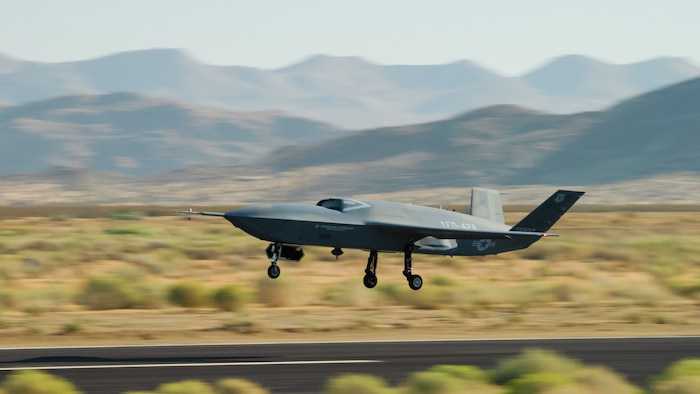
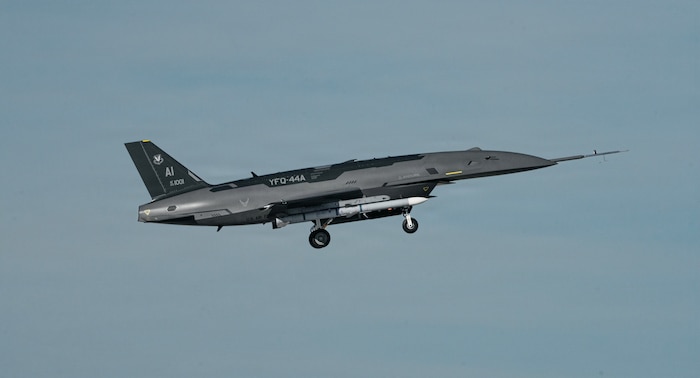
The Air Force awarded engineering and manufacturing development and production contracts to General Atomics, FQ-42, and Anduril, FQ-44, for CCA Increment 1.
Awarded four months ahead of schedule, these contracts signify that the FQ-42 and FQ-44 meet rigorous mission requirements and are ready for full-scale manufacturing. The decision follows a competitive source selection process, identifying the systems as the most capable and cost-effective solutions to maintain air superiority in an increasingly complex and contested global threat environment.
"By moving fast from competitive selection into full-scale manufacturing, we position ourselves to field highly credible and combat-ready semi-autonomous systems to stay ahead of the pacing challenge," said Secretary of the Air Force Troy Meink. "These contracts reaffirm our confidence in the strategic path forward for the program to procure over 150 combat capable CCA by the end of the decade."
The Software: Accelerated fielding and unmatched flexibility
Equally critical to the CCA ecosystem is the mission autonomy software. The Air Force awarded mission autonomy production contracts to a pool of six vendors, establishing a competitive marketplace for the program.
The baseline, six-year contract vehicle provides the framework for continuous competition and rapid software development. The following vendors have been selected for this baseline contract pool:
• Anduril
• General Atomics
• Lockheed Martin
• Northrop Grumman
• RTX Collins Aerospace
• Shield AI
Additionally, the Air Force has competitively awarded production options to Anduril, RTX Collins Aerospace, and Shield AI, to accelerate the delivery of critical mission autonomy software. This targeted award, based on the vendors' ability to meet aggressive schedule and affordability requirements, will fund the first of two six-month competitive phases designed to speed the fielding of operational software to the warfighter.
While the baseline contract establishes a continuous competitive arena, the competitive awards are designed to deliver capability faster. Following the initial six-month period, the Air Force will evaluate the vendors' progress and execute a second competitive award period. This performance-based competition will culminate in the selection of a primary mission autonomy provider for CCA Increment 1, with award planned for selection by summer 2027.
"Mission autonomy is the cornerstone of the CCA concept, and leveraging a competitive, multi-vendor environment ensures we capture the latest technology," Meink said. "This approach guarantees our Airmen are equipped with state-of-the-art capabilities today but keeps the door open for the breakthroughs necessary to maintain air superiority."
Furthermore, this software contract leverages a first-of-its-kind award fee exposure strategy, which enables operator feedback and combat performance to determine what the Air Force pays for mission autonomy. The Air Force will only pay the entire licensing fee if a vendor provides a combat capability aligned with warfighter needs and feedback. The licensing approach also allows the Air Force to award software licenses to any of the six vendors within the pool at any point over the next six years. This approach ensures the Air Force can procure the best-performing and most affordable solutions as technology evolves.
A Unified Evolution of Airpower
A key enabler of this strategy is the government-owned Autonomy Government Reference Architecture (A-GRA). Continuous A-GRA compliance is required for all vendors and serves as the foundational open systems architecture that decouples software from hardware. This ensures that mission autonomy software from any vendor in the pool can be easily integrated, quickly updated, and ported across different physical aircraft platforms, giving the warfighter unparalleled operational flexibility to adapt to evolving threats.
"Open systems architecture is critical in modern warfare," Wilsbach said. "It allows us to capitalize on the most advanced autonomy solutions to ensure we incorporate the best technology in our weapon systems."
The Air Force intends to field approximately 1,000 combat-capable CCA, employing an acquisition strategy built on continuous competition to drive down cost over time while scaling fighter capacity.


