
By Tina Meketa, University Communications and Marketing
At the University of South Florida, student innovation doesn't stop at the classroom door - it accelerates.
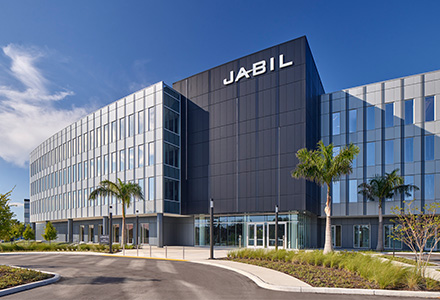
Jabil headquarters in St. Petersburg [Photo courtesy of Jabil]
Through a growing partnership with Jabil, USF engineering students are turning ideas into real-world solutions - and in some cases, into technologies with the potential to reach patients. Jabil is a global engineering, supply chain and manufacturing solutions provider and one of the largest health care manufacturing solutions providers worldwide.
Headquartered in St. Petersburg, Jabil plays a significant role in preparing USF students for the workforce. Its engineers serve on academic advisory boards, helping guide curriculum to meet industry needs, and the company sponsors capstone projects for electrical and medical engineering students - year-long assignments that culminate at the end of their senior year.
"Our capstone program is a poster child for excellence in collaboration with industry. We've developed a synergetic relationship with Jabil that has led to many successes."
Souheil Zekri
Assistant Chair of the USF Department of Medical Engineering and Associate Professor of Instruction
Where bold ideas take shape
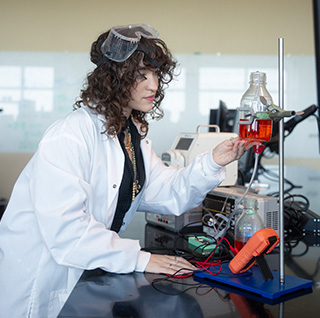
Sophia Alonso and her early prototype of a non-invasive flow sensor for medical tubing [Photo courtesy of Sophia Alonso]
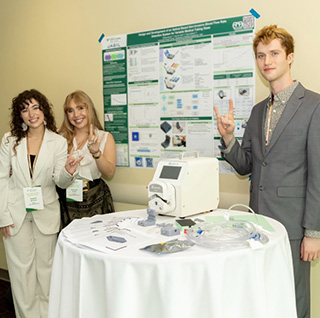
Alonso and her classmates presented their capstone project to Jabil engineers [Photo courtesy of Sophia Alonso]
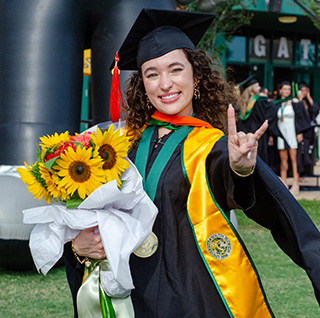
Upon graduation, Alonso secured an internship, followed by a full-time position at Jabil
For Sophia Alonso, that opportunity started with a single project and turned it into a career.
Alonso, who completed her undergraduate and master's degrees in biomedical engineering, began working with Jabil during her senior capstone project. What started as a student prototype grew into a deeper collaboration, with Jabil supporting her through graduate work and serving as the foundation of her master's thesis - a level of involvement that is uncommon among industry partners.
"I had the perfect transition from school into industry," said Alonso, who interned with Jabil and was hired full-time as a product verification engineer in January. "It was super smooth, and I feel really fortunate."
Throughout the process, Alonso worked closely with Jabil engineers, spending several days a week at the Jabil Innovation Center refining her design and gaining hands-on experience in a professional setting.
Her original concept, a non-invasive flow sensor for medical tubing, gained momentum during a capstone presentation. Jabil engineers recognized its potential to address a critical, unsolved challenge in dialysis care - and the project continued beyond graduation as an ongoing collaboration.
Turning innovation into impact
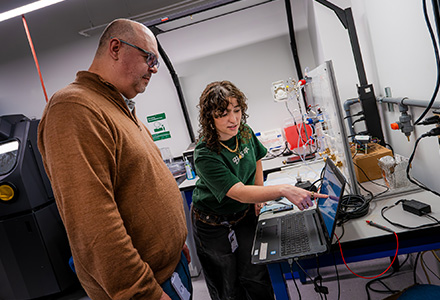
Jabil engineer Ben Kellam and Sophia Alonso [Photo by Andres Faza, University Communications and Marketing]
That idea evolved into a device designed to detect venous needle dislodgement - a dangerous complication during dialysis that can lead to rapid blood loss if not caught immediately.
The solution: An optical sensor that monitors blood flow through tubing and detects subtle changes in real time, enabling faster intervention.
"These are the kinds of challenges that don't have great solutions yet," said Jabil engineer Ben Kellam. "When we saw the potential, we knew it was something worth pursuing. It's not common for us to take a capstone project and move it toward a product. That's what makes this so unique."
Unlike most classroom projects, this one didn't end at graduation.
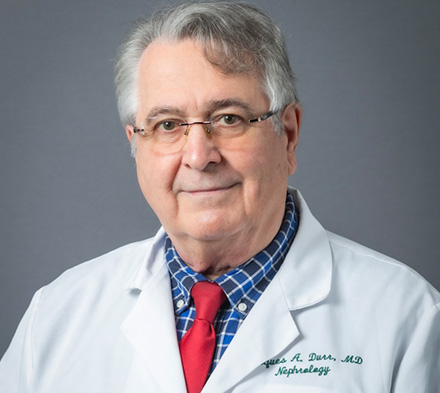
Dr. Jacques Durr, professor of internal medicine [Photo courtesy of USF Health]
Alonso continued advancing the technology, working directly with Jabil engineers to test, refine and validate the concept using increasingly realistic clinical models. Today, the project is patent-pending and in the early stages of clinical investigation with future commercialization under consideration
"This project is an example of how engineering innovation, in collaboration with clinicians, can directly address unmet clinical needs," said Dr. Jacques Durr, professor of internal medicine at the USF Health Morsani College of Medicine. "Venous needle dislodgement remains a well-recognized and potentially life-threatening complication in dialysis care. A non-invasive, real-time monitoring approach has clear clinical value and may extend to other extracorporeal therapies such as continuous renal replacement therapy and plasma exchange, all of which are routinely performed at Tampa General Hospital and USF."
A launchpad for talent
The partnership is also building a direct pipeline from classroom to career.
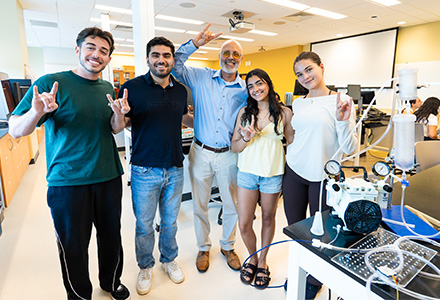
Souheil Zekri, assistant chair of the Department of Medical Engineering, and USF students Gabriel Montoro Ortigoso, Ibrahim Al-Qraquly, Fernanda Vieira Masson and Olivia Guanella Cronenbold [Photo by Andres Faza, University Communications and Marketing]
Jabil sponsors multiple USF capstone projects each year and has supported more than a dozen teams over the past several years. One of those teams is dedicated to advancing the Jabil Clot Retrieval System - a next-generation device concept designed to improve aspiration thrombectomy procedures by reducing blood loss and limiting the risk of air entering the bloodstream during clot removal.
A defining element of the project is direct collaboration with engineers inside the Jabil Advanced Catheter Development Lab, where students are working side by side with industry experts to design and refine catheter concepts.
"Working alongside engineers at Jabil and having access to their manufacturing and prototyping facilities has been an incredible learning experience," said biomedical engineering major Ibrahim Al-Qraquly. "It has given my colleagues and me a real look into how engineers work in industry and what it feels like to develop and manufacture technology in a professional setting. Seeing the machines and manufacturing capabilities firsthand has been very inspiring."
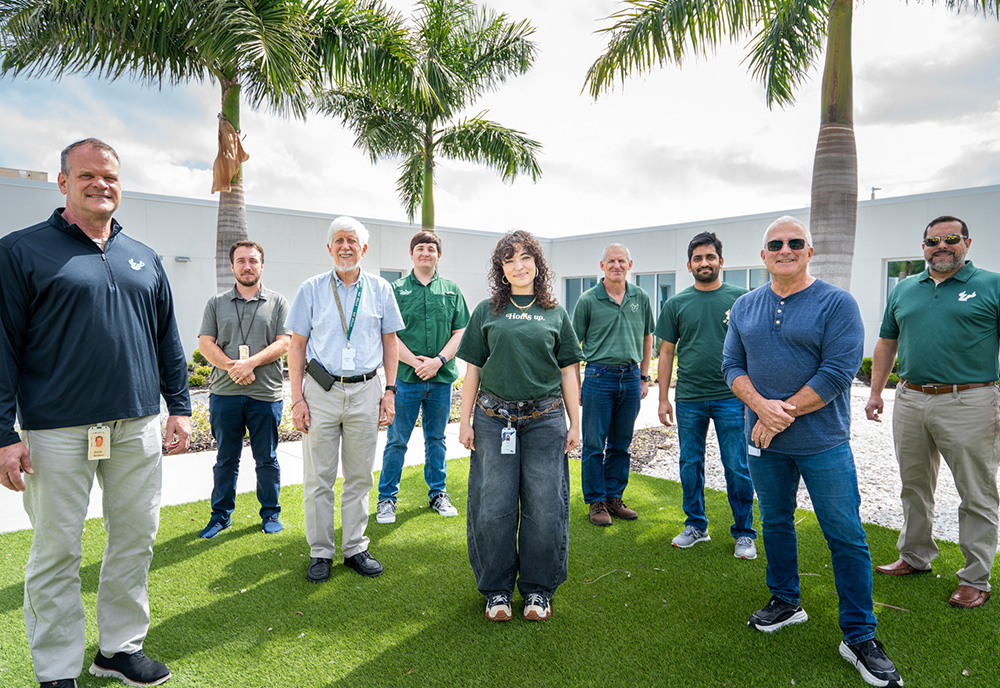
Jabil employs many USF alumni at its St. Petersburg headquarters [Photo by Andres Faza, University Communications and Marketing]
Many USF students go on to join Jabil - with a large percentage at the St. Petersburg headquarters being graduates of USF.
"We get to know students before they graduate - how they think, how they collaborate," Kellam said. "That makes the transition into the workforce much easier."
From concept to commercialization
Capstone projects are designed to move quickly, often just months from idea to prototype. Through industry collaboration, students gain the opportunity to take those ideas further.
"You only have a short time during capstone, so it's rapid prototyping and quick iteration," Alonso said. "Being able to continue the project and really develop it - that's where you see its full potential."
That extended runway has allowed the team to evolve from basic lab setups to advanced testing environments that mirror real clinical conditions, bringing the technology closer to practical use.
Real-world experience. Real-world impact.
The USF-Jabil partnership is redefining student learning by blending education, research and industry into a continuous pipeline of innovation.
From first concepts to patent-pending technologies, students are gaining hands-on experience in solving real problems - while companies gain fresh ideas and future talent.
"The translational experience is what makes this special. Students are taking ideas and turning them into something that can truly make a difference."
Souheil Zekri
USF Department of Medical Engineering


