
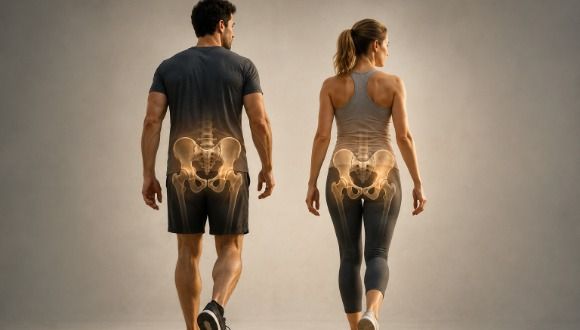
• TAU researchers compared male Neandertal pelvises with modern human pelvises and found that Neandertal males more closely resembled modern human females in most measurements and proportions.
• The findings suggest that the modern human male pelvis—not the Neandertal pelvis—may represent the evolutionary innovation.
• In modern human males, the position of the hip joints may allow muscles to act like springs, absorbing impact, storing energy, and releasing it with each step.
• The researchers suggest that childbirth-related constraints kept the female pelvis closer to the ancestral structure, helping explain some of the anatomical differences between male and female pelvises.
A new study at the Department of Anatomy and Anthropology of Tel Aviv University, and published in Scientific Reports, offers an explanation for one of the striking differences between men and women: the evolutionary development of the modern human pelvis. By comparing Neandertal pelvises with those of modern humans, the researchers reached a surprising conclusion: the unusual structure of the pelvis may not be that of the Neandertal, as has been assumed for decades, but rather that of the modern human male. According to the researchers, the male pelvis evolved into a unique biomechanical shock absorbing mechanism that stores energy and makes long-distance walking more efficient.
Led by Professor Yoel Rak of the Department of Anatomy and Anthropology at Tel Aviv University, and conducted in collaboration with researchers from Spain, the Technion, Bar-Ilan University, and Ono Academic College, the study is based on a comparison of two nearly complete male Neandertal pelvises, one from Kebara Cave in Israel and the other from the Sima de los Huesos site in Spain, with dozens of modern human pelvises. Surprisingly, despite their large size and robust construction, the Neandertal pelvises were found to resemble those of modern human females in most measurements and proportions rather than those of modern human males.
Rethinking the Neandertal Pelvis
For many years, the Neandertal pelvis has been regarded as an anatomically unusual structure requiring a functional explanation of its own. The new findings, however, require a new look at Neandertal pelvises. The ancestral configuration may have been retained in Neandertals and in modern human females, while the modern human male pelvis underwent substantial evolutionary modification, giving rise to a distinctive anatomical configuration.
The central finding of the study is that the hip joints of modern human males are positioned farther forward on the pelvic ring than those of both modern human females and male Neandertals. According to the researchers, this shift created a new mechanical system in which the anterior thigh muscles, attached to the front of the pelvis, function much like a spring, while body weight acts on the posterior part of the pelvis .
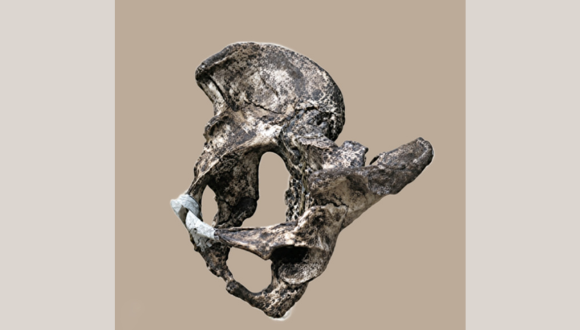
The Neanderthal pelvis
A Natural Spring in Every Step
Professor Rak explains that during every step of bipedal walking, the body's center of mass drops downward. This drop traumatizes the joints and requires energy to raise the body again in preparation for the next step. According to the new model, the distinctive geometry of the male pelvis enables the thigh muscles to cushion the drop of the body's center of mass, store potential energy during the step, and then release that energy immediately afterward- effectively "springing" the body upward into the next step.
In this way, the pelvis functions as a natural shock-absorber and energy-return system. It may reduce energy expenditure, improve walking efficiency, and thereby provide a significant advantage during long-distance travel on foot. The change in the position of the hip joints also required additional structural adaptations, including the thickening of the pubic bone and deepening of the anterior portion of the pelvis to withstand the new mechanical loads.
Why Did Male and Female Pelvises Evolve Differently?
Modern human females, by contrast, could not adopt the full suite of these modifications. According to the researchers, the constraints imposed by childbirth require a relatively shallow pelvis and a sufficiently wide birth canal. As a result, the female pelvis remains closer to the ancestral configuration-the same general configuration found in male Neandertals.
Professor Ella Been of Ono Academic College, a co-author of the study, adds: "This study demonstrates that questions about human evolution are not confined to the distant past. Understanding the evolution of our walking mechanism can contribute to contemporary research in biomechanics, musculoskeletal medicine, rehabilitation, and injury prevention. The perspective provided by the Neandertals helps us better understand the modern human body."
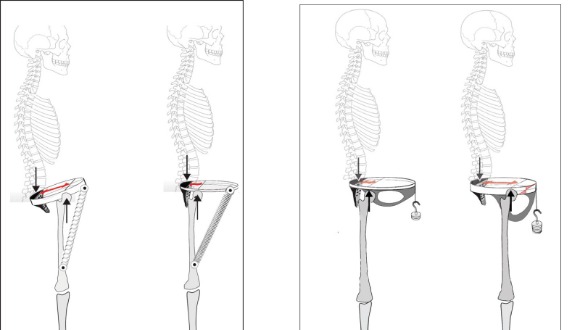
A reconstruction of the skeleton
The Evolutionary Innovation May Be Us
Professor Rak emphasizes that the findings of the study change the way we understand the evolution of the human pelvis. It is not the Neandertal pelvis that is the anomaly requiring explanation. Rather, it is the pelvis of the modern human male. The mechanism that evolved within the human male represents the evolutionary innovation.
The researchers note that the study presents a new biomechanical model that may explain a substantial part of the human pelvis's sexual dimorphism, the anatomical differences between females and males. The research also demonstrates that even in human macroscopic anatomy, a field that might appear to have been thoroughly explored, there is still potential to uncover previously unrecognized structures, geometries, and mechanisms of biological significance.


