
New data from Europe's leading climate agency shows 2025 was just 0.13°C away from being the hottest year on record, underscoring a stark truth: global heating fuelled by climate pollution is harming Australians right now.
The Copernicus annual global climate summary showed 2025 was the third hottest year on record, and that the past 11 years have been the 11 hottest years ever documented.
For the first time, Earth's average temperature over three consecutive years (2023-2025) rose above 1.5°C of global warming - a threshold scientists warn dramatically increases the risk of extreme weather and human harm.
Climate Councillor and leading scientist, Professor Lesley Hughes, said: "This latest climate data reveals what Australians are already experiencing: Pollution from coal, oil and gas is heating our atmosphere and oceans, driving worsening extreme weather and battering Australian communities and ecosystems.
"This report shows again that fossil fuels are the primary driver of the volatile and dangerous weather we are experiencing. Already, just a few weeks into 2026, Australians have been pummelled in the same week by devastating bushfires and heatwaves in Southern Australia, and floods and a tropical cyclone in Queensland.
"All signs point to the need to act right now, not tomorrow. Every action to cut climate pollution helps secure a safer future for ourselves and our families.
"Australia is reducing pollution in our energy sector but we need to go harder and faster right across our economy. Our leaders can't keep talking about this crisis and also rubber stamp new coal and gas approvals.''
Climate Councillor and leading economist, Nicki Hutley, said: "Climate pollution is driving more dangerous and costly disasters today, and Australians are footing the bill. In 2025, the world's third hottest year, we saw floods in Queensland, NSW, and storm damage from Cyclone Alfred that cost more than $2 billion in insured losses. "Even Australians who avoided flood, storm or fire damage will still pay ever higher insurance premiums.
"We also know that the cost of climate-fuelled disasters is wide ranging. Our research with PropTrack shows homes in flood zones are collectively worth about $42 billion less due to the risk of floods. We are also paying through lost farm production and higher food prices, lost productivity in sectors such as construction, and higher health costs.
"As an economist, the cost/benefit equation of climate action is a no-brainer. Letting climate change rip is far more expensive than the investment needed in renewable energy and storage, cleaner transport, and other sectors. We just need to get on with it and fast."
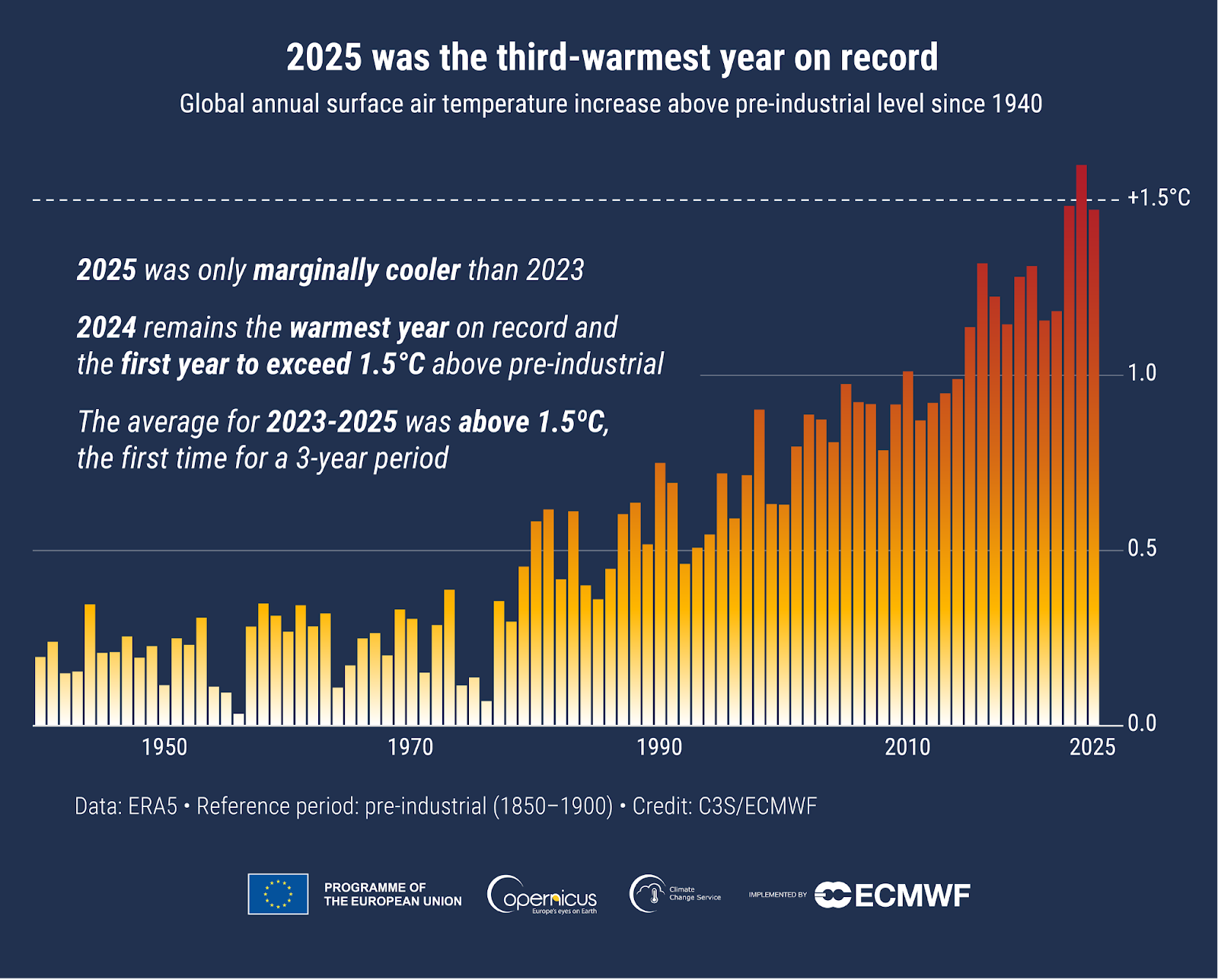
Copernicus' key climate records from 2025:
In 2025, half of the global land area experienced more days than average with strong heat stress (days of 32℃ or above), the leading cause of global weather-related deaths;
The Antarctic experienced its hottest annual temperature on record and the Arctic its second hottest;
In February 2025, the combined sea ice cover from both poles fell to its lowest value since at least the start of satellite observations in the late 1970s;
January 2025 was globally the hottest January on record.
Locally Australia's Bureau of Meteorology Data also showed:
Australia endured its fourth-hottest year in 2025 since national records began in 1910, with large regions experiencing extreme heatwave conditions between January and March, and October to December;
Australia's average maximum temperature was 1.48°C above the 1961–1990 average, the equal fourth-hottest on record.;
Our nation has experienced nine of its 10 hottest years on record since 2013.


