The 2025 Nobel Prize in Chemistry was awarded to three scientists-Distinguished Professor Susumu Kitagawa (Kyoto University, Japan), Professor Richard Robson (The University of Melbourne, Australia), and Professor Omar Yaghi (University of California, Berkeley, USA)-for the development of "metal-organic frameworks (MOFs)." Professor Masaki Kawano (Department of Chemistry, School of Science, Institute of Science Tokyo (Science Tokyo)) explains the reasons for the award, the history of MOF development, and application areas.
Please tell us the reasons for the 2025 Nobel Prize in Chemistry and an overview
Kawano The reason for the award is the development of "metal-organic frameworks (MOFs)." MOFs are materials formed when metal ions and organic compounds bind together.
MOFs have two major features. The first is that a wide variety of MOFs can be created by changing the combination of metal ions and organic compounds. There are as many as 80 kinds of metal ions, and one can freely choose the number of "hands" by which they bind to organic compounds. In addition, organic compounds have structures in which carbon atoms are linked together, and there are millions of kinds. Therefore, depending on how metal ions and organic compounds are combined, MOFs with various three-dimensional structures can be freely designed and constructed. For this reason, MOF research is also called "molecular architecture." The second feature of MOFs is that they contain innumerable nanoscale pores (nano means one-billionth of a meter). For example, in the case of a 1 cm³ cube-shaped MOF, the countless pores give it a surface area comparable to that of a soccer stadium.
Because of these two features, MOFs can take up large amounts of gas molecules. If the structure is devised well, it is also possible to selectively adsorb only the target gas. Specific application examples reported include:
- adsorbing trace amounts of water vapor in desert air to produce drinking water
- selectively adsorbing and capturing only carbon dioxide, a greenhouse gas, from the air
- adsorbing only toxic gases to purify the environment
For these reasons, MOFs have rapidly attracted attention-especially since 2000-as a key technology for a sustainable society.
Please tell us about the history of MOF development and the achievements of the three laureates
Kawano It is often said that "it takes 30 years to win a Nobel Prize," and the beginnings of MOF research also go back about 30 years. The first person to create the initial impetus was Professor Richard Robson.
In the 1970s, Professor Robson was preparing molecular models of diamond crystals for a university chemistry lecture. At that time, he reportedly conceived the idea that new three-dimensional structures might be created by combining molecules. After continuing his research for about ten years, in 1989 he reported a new structure formed by linking copper ions and organic molecules. In that paper, Professor Robson made an important prediction: "Because this substance has countless pores, various molecules can be confined inside it, recovered, or stored." I remember being deeply impressed when I read that paper at the time-he had not only created a substance with a new structure but also foreseen its usefulness with remarkable vision.
Meanwhile, for Professor Kitagawa, the starting point of MOF research was his discovery that an infinitely extended porous substance could be constructed from copper ions and organic compounds. He named this substance a "porous coordination polymer (PCP)." PCP is essentially the same as an MOF. It was Professor Yaghi, who discovered a substance with a similar structure around 1997, who named it "MOF."
Professor Kitagawa further focused on the fact that MOFs can build a variety of three-dimensional structures depending on the combination of metal ions and organic compounds, and he began research on making MOFs adsorb specific gases. Until then, porous gas adsorbents included zeolites and activated carbon, but these materials are rigid, and because pore sizes and related features cannot be controlled, they cannot be used to selectively distinguish which gases are adsorbed. In contrast, Professor Kitagawa went on to develop one flexible and highly original MOF after another that could adsorb specific gases.
The MOFs developed by Professor Kitagawa had a unique characteristic: they were soft, and their three-dimensional structures changed dynamically. A MOF reported in 1997 had a structure like timber joinery stacked in layers. When it adsorbs gas, the layers slide sideways, enlarging the pores; when the gas is recovered, the layers return and the pores become smaller-meaning the three-dimensional structure changes dramatically. This enabled rapid adsorption and desorption of gases.
In fact, when Professor Kitagawa began developing MOFs, he says almost no one paid attention. Finding potential in the countless pores of MOFs-then regarded as "useless"-and continuing basic research is what has led to Professor Kitagawa's achievements today. His guiding motto, "The usefulness of the useless" embodies that conviction.
In contrast to Professor Kitagawa, Professor Yaghi aimed for extremely robust MOFs. Among them, his representative work "MOF-5," which combines zinc ions and organic compounds, drew great attention for its highly stable structure. It has a network structure like a jungle gym, and even when heated to 350°C with nothing inside the pores, its three-dimensional framework does not collapse at all.
Professor Yaghi was born in 1965 in Amman, the capital of Jordan, as a Palestinian refugee child. At his parents' urging, he studied abroad at a university in the United States and, after enduring considerable hardship, became a professor at the University of California, Berkeley. He says he was captivated by the beauty of MOF three-dimensional structures, and that his pursuit of beauty became the driving force behind his research.
Please tell us about the current state of MOF research worldwide and initiatives at Science Tokyo
Kawano MOFs can selectively capture gases such as hydrogen, methane, carbon dioxide, and nitrogen from the air. For this reason, there are high expectations for them in fields such as energy, resources, and the environment. As practical examples, it has already been reported that MOFs can adsorb trace amounts of water vapor in desert air to produce drinking water, or selectively adsorb and capture only carbon dioxide, a greenhouse gas, from the air. In addition, attention is growing in a new field-medicine. Applications under consideration include drug delivery systems, in which pharmaceuticals are loaded into MOFs and taken orally to deliver drugs to the necessary locations in the body.
As of November 2025, there are 44 MOF-related startup companies worldwide. Of these, three are Japanese companies, and one of them-TEKMOF ↗-was founded in February 2024 with my involvement at the core. TEKMOF provides contract services and consulting for molecular structure analysis using MOFs, and researchers from Science Tokyo are also participating. If you are interested in MOFs, please come and visit Science Tokyo and TEKMOF. I hope we can advance research and development together.
* This article is based on the presentation given at Science Tokyo Nobel Prize Lecture, held online on Wednesday, November 26, 2025.
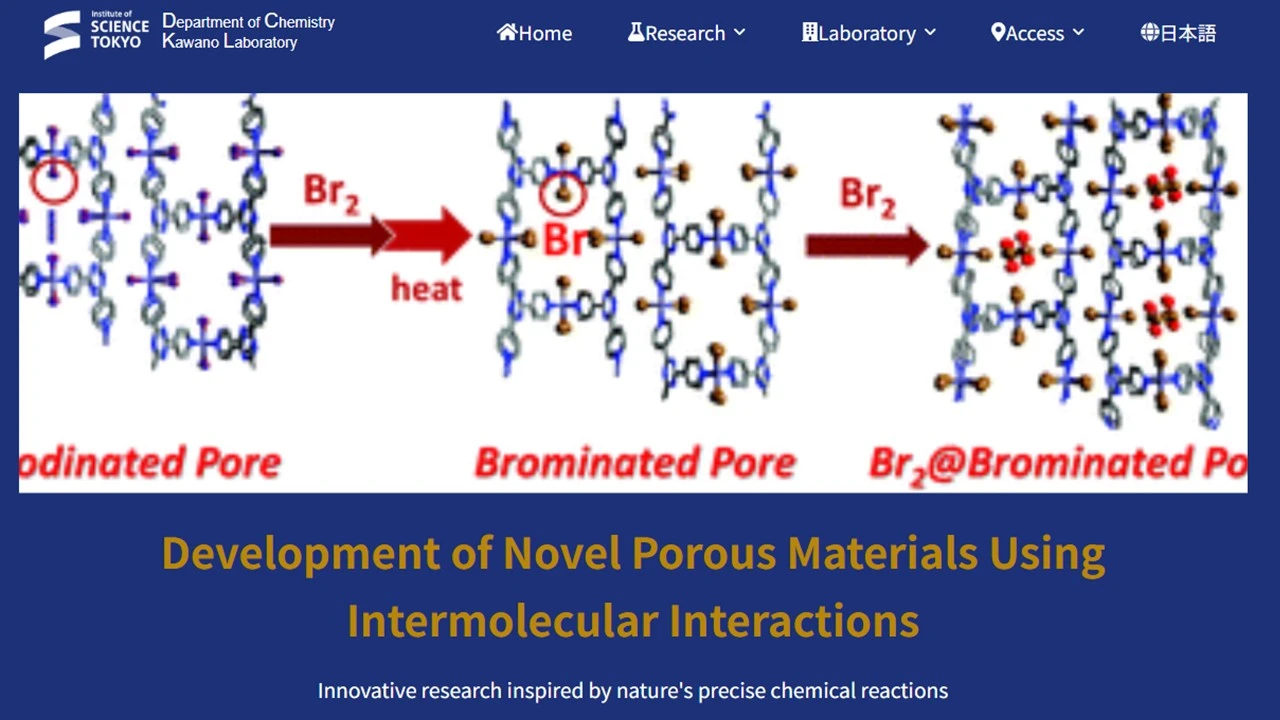
Discover More About Professor Kawano's Work
Ongoing similar research at Science Tokyo
As with metal-organic frameworks (MOFs), our research focuses on developing crystalline porous materials through the self-assembly of metal complexes, and more recently, we have been exploring their use as catalytic materials toward artificial photosynthesis

Environment and Energy Lab Murakami Group
We are conducting research on covalent organic frameworks (COFs), ordered porous materials that emerged about 10 years after MOFs, and are developing applications for CO₂ capture and all-solid-state batteries, with the aim of implementing them in society