
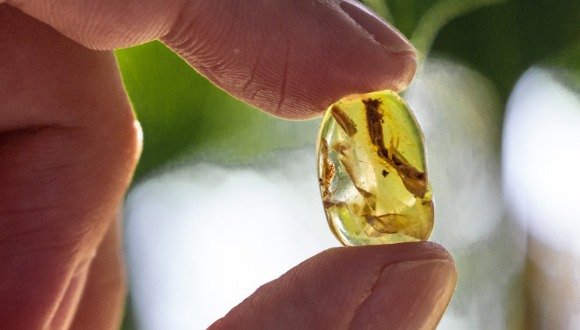
Imagine a lizard escaping danger by leaving its tail behind, still wriggling as the animal darts away. It's a familiar survival trick among lizards today, but how far back does this ability go? A new Tel Aviv University study offers a rare glimpse into its ancient origins through a piece of amber just 18 millimeters long, discovered in northern Myanmar. Inside it, researchers identified a lizard tail that detached from its body approximately 99 million years ago. According to the team, the fossil provides the best-preserved direct evidence yet of caudal autotomy, the ability of a lizard to deliberately shed its tail as a defense mechanism.
The study was conducted by Dolev Fabrikant, a PhD candidate at Tel Aviv University's New Environmental School, and Dr. Leonidas-Romanos Davranoglou of TAU's School of Zoology and Steinhardt Museum of Natural History, in collaboration with researchers from the National and Kapodistrian University of Athens and Israel's Volcani Institute. The findings were published in Palaeontologia Electronica.
An ancient escape preserved in amber
The researchers explain that earlier reptile fossils have provided evidence of tail-shedding through natural fracture planes in tail vertebrae and regenerated tails. These features suggest that an animal had the ability to shed its tail, but fracture planes alone cannot always establish whether it actually did so voluntarily.
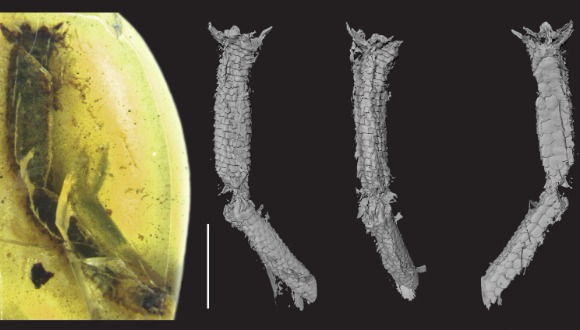
In the newly discovered fossil, the detached end of the tail contains exceptionally well-preserved features that allowed researchers to examine exactly how the separation occurred.
For years, the significance of the amber went unnoticed. What initially appeared to be a tiny twig or a fragment of an insect caught Fabrikant's attention when he examined the specimen more closely. "I realized that what seemed to be a twig was covered in tiny scales," he recalls. "It was a lizard's tail." When Fabrikant shared his discovery with his supervisor, the reaction was immediate.
"I nearly jumped out of my chair," says Dr. Davranoglou. "I instantly realized that this tiny fossil could open an extraordinary window into the past, helping us understand the history of one of the most widespread survival strategies among reptiles. Until now, we could only speculate on whether ancient lizards could shed their tails. We now have direct evidence that one could."
An ancient escape preserved in amber
Because the amber is cloudy and the fossil is so small, a conventional microscope could reveal little of its finer details. The researchers therefore used micro-CT scanning at the Volcani Institute. "Micro-CT takes X-ray images from many angles and combines them into a three-dimensional reconstruction. It allowed us to examine structures hidden by the amber without needing to cut this one-of-a-kind piece open," explains Dr. Ahmed Nasser, Head of the institute's Inter-Institutional Analytical Unit.
At the point where the tail detached, the scans revealed a distinctive ring of tissue resembling the structure found in tails shed by living lizards. The separation was also relatively clean and symmetrical, without the damage patterns typically associated with accidental injury.
Despite the fossil's remarkable preservation, the tail alone cannot reveal exactly which group of lizards the animal belonged to. "Although we can securely identify this specimen as a lizard, we lack the skull and other skeletal features that would allow a more secure identification. Possible affinities include the groups containing today's wall lizards or, alternatively, slow worms and monitor lizards," says Apostolos Christopoulos, a PhD candidate at the National and Kapodistrian University of Athens.

Research team (Left to right): Dr Ahmed Nasser, Dolev Fabrikant & Dr Leonidas-Romanos Davranoglou
The researchers also cannot determine what caused the lizard to shed its tail. It may have become trapped in sticky resin and detached its tail to escape. Alternatively, it may have shed its tail during a predator attack, with the discarded tail subsequently landing in resin. The fossil cannot tell us whether the lizard survived or later regrew its tail. What it does reveal is that this remarkable defense mechanism was already present in lizards approximately 99 million years ago.
Preserved in a tiny piece of ancient resin, small enough to rest on a fingertip, is evidence of a survival strategy that lizards continue to use in gardens and on sunlit walls today.


