
Scientific discovery is often tedious, expensive, incremental trial and error, but the advent of artificial intelligence (AI) is accelerating the process. A multi-institutional team based in China recently used AI to identify a key characteristic of compounds called catalysts that are used to initiate and speed up the chemical reactions that convert carbon dioxide into molecules that can be used to develop sustainable fuels. The team then used the AI - dubbed Catalysis AI Agent by the researchers - to guide their catalysts designs, ultimately discovering the universal design principle for copper-based single-atom alloy (SAAs) catalysts.
They published their results on Feb. 24 in Angewandte Chemie International Edition.
"Copper-based SAAs represent a promising strategy for optimizing the electroreduction - the process of breaking down or converting a compound into something else via electrochemical reactions - of carbon dioxide to multi-carbon products," said co-corresponding author Hao Li, distinguished professor at Advanced Institute for Materials Research, Tohoku University.
The challenge, Li said, is that electroreduction catalysis can be induced with a broad variety of chemical additions to produce specific carbon products. The diversity has not yet been rationalized, meaning no one had developed guidelines to designing copper-based SAAs that could produce the desired carbon products.
In an effort to provide such guidelines, the researchers turned to Catalysis AI Agent. A type of AI called a large language model (LLM), the Catalysis AI Agent learned by training with a massive database built by Li and his team. The database, the Digital Catalysis Platform or DigCat, is currently the largest experimental database and AI platform available for catalysis research.
"Stage one of our systematic investigation was to develop the powerful LLM-based Catalysis AI Agent and use it to mine the DigCat database," Li said, explaining that it examined the catalysis research data available to identify trends or similarities.
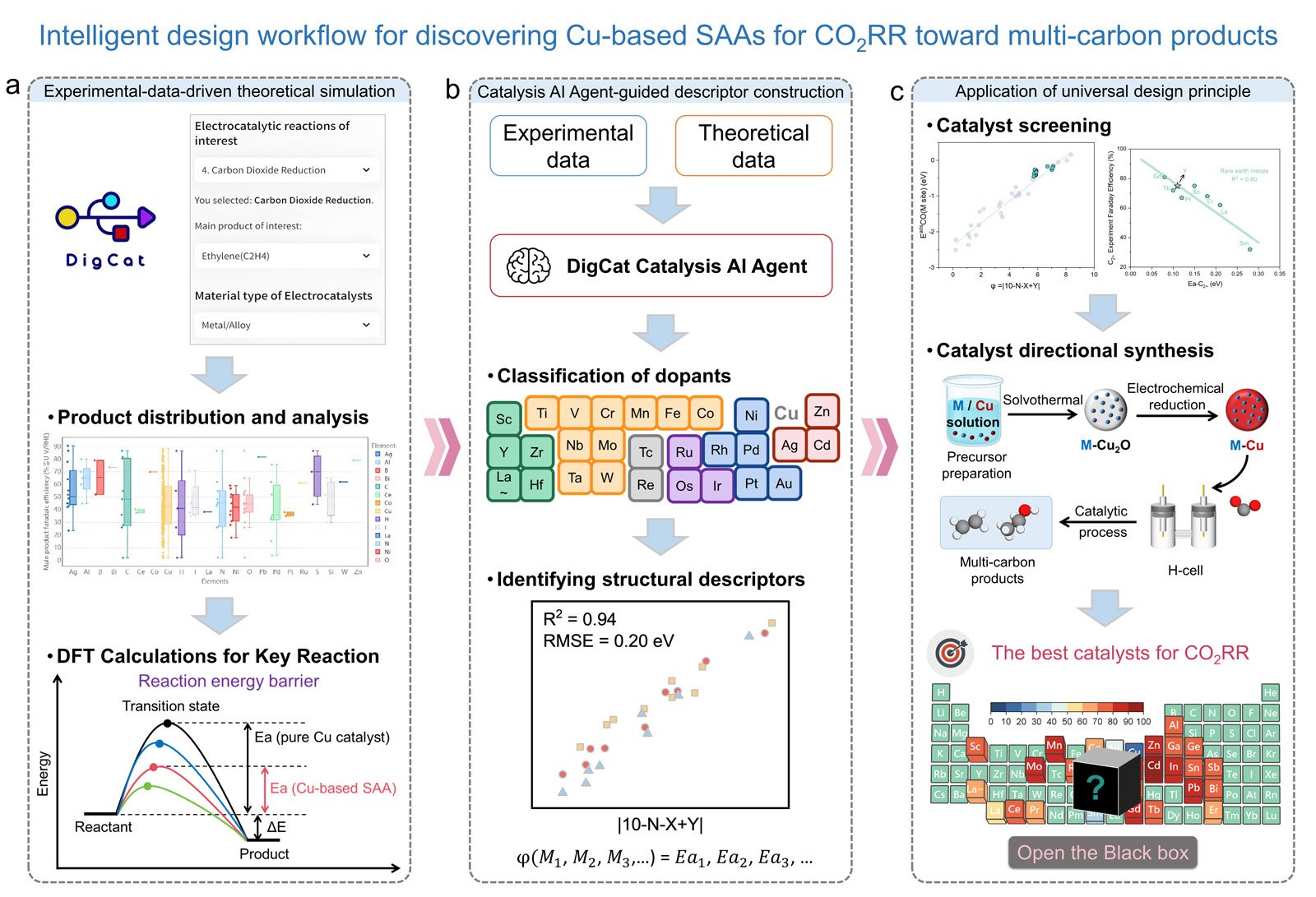
The Catalysis AI Agent found that copper-based SAAs appeared to produce the desired carbon products by promoting the formation of certain compounds rather than suppressing the development of other byproducts. This insight prompted the researchers to use the Catalysis AI Agent to analyze correlations between experimental and theoretical data, which led to the revelation that the additives - called dopants - that could be used to induce specific carbon products need to be classified before researchers can elucidate how they interact with a compound and produce a predictable reaction.
With this understanding, the researchers established an energy descriptor - a way to describe the amount of energy needed for specific reactions - to classify SAAs and accurately capture the trends toward certain products in copper-based SAAs.

The researchers were also able to develop what Li called a "remarkably simple structural descriptor" to directly predict the energy activation of carbon products. They tested the approach experimentally and found it could not only describe copper-based dopants, but also other types of metal dopants.
"This universal design principle unravels the promotional mechanism and structure-selectivity relationships governing copper-based SAAs for carbon dioxide electrochemical reduction for carbon products," Li said. "This paradigm shift, moving from empirical trial-and-error towards AI-accelerated and theory-guided catalyst design, holds substantial promise for expediting the discover of next-generation materials. Most strikingly, our study highlights a transformative paradigm in materials science, where a well-trained scientific AI agent and large-scale experimental database not only predict and rationalize catalyst performance, but also inspire generalizable design principles for future discovery."

- Publication Details:
Title: Catalysis AI Agent Guides Discovering the Universal Design Principle of Cu-Based Single-Atom Alloy Catalysts for CO2 Electroreduction
Authors: Xuning Wang, Zhong Li, Di Zhang, Hao Li, Haoxiang Xu and Daojian Cheng
Journal: Angewandte Chemie International Edition


