
National meteorological and agricultural authorities from 15 countries across Africa, Asia, the Middle East, and Latin America gathered in Abu Dhabi from November 9 to 13, 2026 , for an intensive, hands-on training program designed to harness AI for agricultural weather services.
Organized under the AIM for Scale initiative and convened by the International Affairs Office at the UAE Presidential Court, the week-long program equipped national institutions to independently evaluate, run, and integrate state-of-the-art AI weather models into pilot and operational workflows for smallholder agricultural decision-making. The program was hosted at the Mohamed bin Zayed University of Artificial Intelligence (MBZUAI) and the National Center of Meteorology (NCM), with support from the University of Chicago.
Through its technical advisory efforts under AIM for Scale , WMO contributed to the program's focus on aligning advanced technological innovations with global meteorological standards, observation frameworks, and sustainable national service delivery.
While AI-driven weather forecasting models offer unprecedented speed and resolution, realizing their real-world value requires more than access to new code. National institutions must be equipped to rigorously benchmark these models, verify their outputs, localize them for regional contexts, and translate complex meteorological outputs into actionable advisories for smallholder farmers.
The 2026 training program featured two parallel, deeply interconnected tracks that converged on the shared goal of enabling each participating country delegation to leave with a minimum viable product (MVP) for an agricultural weather service:
- Weather Track: Focused on running and evaluating AI models, hands-on benchmarking, and downscaling global forecasts to regional and local scales.
- Agriculture Track: Concentrated on turning forecast variables and thresholds into practical farm-level recommendations, ensuring effective communication through extension services.
Joint sessions also allowed participants from both groups to explore integration of multi-hazard early warning systems, climate services co-production, and long-term operational planning.
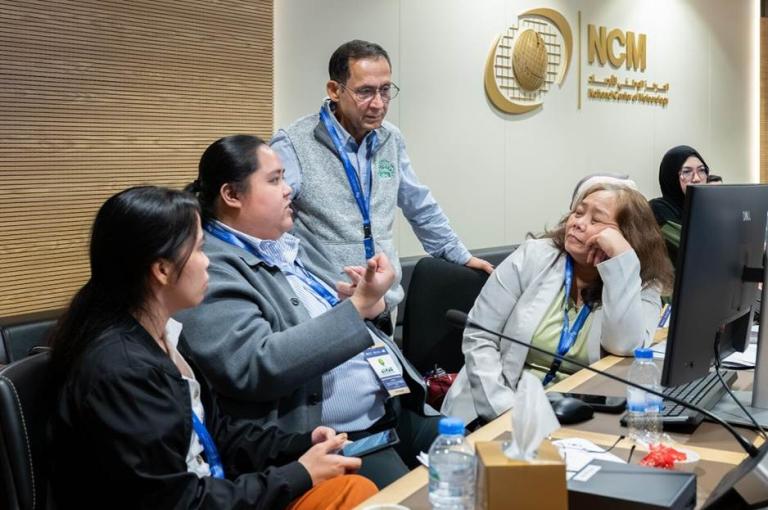
Building on a successful first training in 2025 with six countries: Bangladesh, Chile, Ethiopia, Kenya, Nigeria, and the United Arab Emirates, the AI Weather Forecasting for Agriculture Training Program expanded significantly in its second year. In 2026, representatives from Bolivia, Colombia, Indonesia, Pakistan, Peru, the Philippines, Rwanda, Senegal, and Sierra Leone joined representatives from the inaugural cohort. Both cohorts brought together representatives from National Meteorological and Hydrological Services, Ministries of Agriculture, and other related organizations.
With the ambition of building capacity across 30 countries by 2027, the AI Weather Forecasting for Agriculture Training Program aims to empower national institutions to deliver forecasts that help farmers make better-informed agricultural decisions and investments, strengthening productivity and resilience to increasingly unpredictable weather.
By combining advanced AI forecasting tools with targeted capacity development, AIM for Scale and WMO are enabling countries to build self-sustaining weather advisory services. Placing accurate, timely weather intelligence directly into the hands of farmers empowers them to make critical decisions on planting, irrigation, and harvesting, protecting rural livelihoods and bolstering global food security.


