
Imagine self-driving tractors and robots that pick fruits, prune trees and remove weeds dotting farms across New York state.
To make that dream a reality, Cornell has launched the Center for Agricultural Robotics and Intelligence. The center launched at a ribbon-cutting ceremony on Nov. 19 at Cornell AgriTech in Geneva, New York, where the initiative is based.
Its mission is to develop robotics and artificial intelligence to advance specialty crop systems. The center's team will build prototypes with the intention to eventually collaborate with industry partners to scale up to manufacturing so growers might operate their farms more efficiently. The plan includes traininggrowers and technicians on the new equipment and encouraging a pipeline of young engineers to develop future technologies.
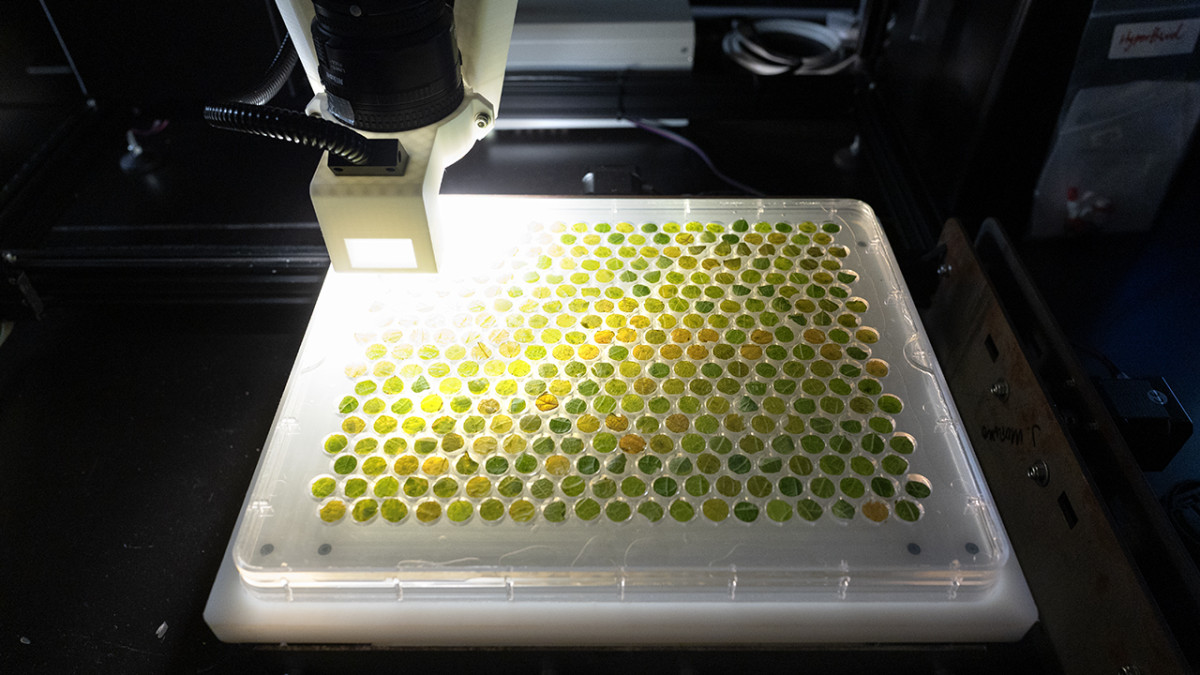
A panel of grape leaf samples is put under the microscope of the Hyperbird spectroscopy machine at Cornell AgriTech in Geneva, New York.
"In recent years, we have received more and more requests to know what technology is available at Cornell that can help mitigate the labor shortage crisis in our agriculture and food industry," said Yu Jiang, assistant professor in the School of Integrative Plant Sciences in the College of Agriculture and Life Sciences (CALS) at Cornell AgriTech and a co-leader of the center. Roboticist Hadas Kress-Gazit, the Geoffrey S.M. Hedrick Senior Endowed Professor in the Cornell Duffield College of Engineering, is the other co-leader.
Labor can account for up to four-fifths of farm costs, Jiang said. "There are many other issues facing agriculture, but now, at least for specialty crop growers, labor is the main challenge that everybody is panicked about," he said.
Specialty crops such as fruits, vegetables and grapes are worth more than $115 billion a year to U.S. farms, accounting for more than 20% of U.S. agricultural production.
On the scientific research side, the initiative will develop robots that can assume labor intensive data collection. This could include collecting plant tissue samples, or processing those samples with greater accuracy and speed than current methods, to conduct larger experiments.
For example, HyperBird, a laboratory robot, can analyze hundreds of leaf samples within a few hours for observable traits related to disease resistance and can spot grape diseases before they are visible. It was developed by Jiang and colleagues, Katie Gold, assistant professor of grape pathology and Susan Eckert Lynch Faculty Fellow at Cornell AgriTech in CALS, and Lance Cadle-Davidson, Ph.D. '03, a research plant pathologist at the USDA's Agricultural Research Service, created
The PhytoPatholoBot is another robot family already developed by Jiang and Gold, which can autonomously scout for grape diseases in vineyards in near-real time, with an accuracy that matches trained human scouts.
The group is piloting a number of other autonomous robot technologies, including strategies for weeding and mowing, on-farm transportation, pruning and harvesting that require minimal human supervision.
The team is accounting for potential bottlenecks that could occur with fabricating prototypes, testing them in field conditions, getting them manufactured and bringing these technologies to the fields, while also training engineers and skilled technicians to build and operate them.
To these ends, Cornell AgriTech has built a 1,050-square foot shared maker space for making prototypes, with advanced fabrication tools, including a laser cutter and welder that is precise and low-cost to operate. Two test fields, also at AgriTech, will be dedicated to orchard testing and vegetable crops, with wireless internet and high precision GPS.
Partnerships extend across Cornell to incorporate researchers in biological and environmental engineering in CALS; Cornell Robotics, aerospace engineering and electrical and computer engineering in Duffield Engineering; and computer specialists in the Cornell Bowers College of Computing and Information Science.
"Once we develop our prototypes, we can also distribute them to our research extension centers and laboratories so they can demonstrate them with growers immediately," Jiang said. This work will take place at Cornell AgriTech's Long Island Horticultural Research and Extension Center in Suffolk County; Cornell AgriTech's Hudson Valley Research Laboratory; and Cornell AgriTech's Lake Erie Research and Extension Laboratory.
In this way, developers will get continuous feedback on fine-tuning the tools. "This closed-loop framework will help researchers push the boundary much faster and boost products across the finish line to engage industry partners to commercialize them and get them to growers," he said.
Also, instead of robotics taking jobs away from people, the initiative plans to upskill farm workforcethat can operate and maintain the robots. "They can develop new skill sets and hopefully transition into a better working environment and better payment," Jiang said.
On the other end of the workforce spectrum, the group will also train a younger generation of new roboticists, by bringing engineering students into agriculture. A partnered Master of Engineering program with Cornell Robotics will include students spending a paid summer developing protypes and solving agricultural issues important to growers.
To address other barriers to adoption, the group is creating an open-source technology ecosystem, allowing users to tinker and experiment with systems to optimize them for their uses. Feedback may then help developers at AgriTech fine-tune robots.
A major grapevine nursery has shown interest in purchasing the PhytoPatholoBot once they are manufactured and have discussed their willingness to change their planting systems and procedures to accommodate using the robots, Jiang said.
"These robots demonstrate the value to the growers, which then helps them think differently about using them," Jiang said.
The center is funded by Cornell University, the Goichman family, and the Genessee Valley Regional Market Authority.


