Like humans, female northern paper wasps recognize each other by their faces.
A new study, published Nov. 23 in the journal Cell, shows that paper wasps accomplish this task thanks to a group of neurons that are surprisingly similar to cells for recognizing faces found in human brains.
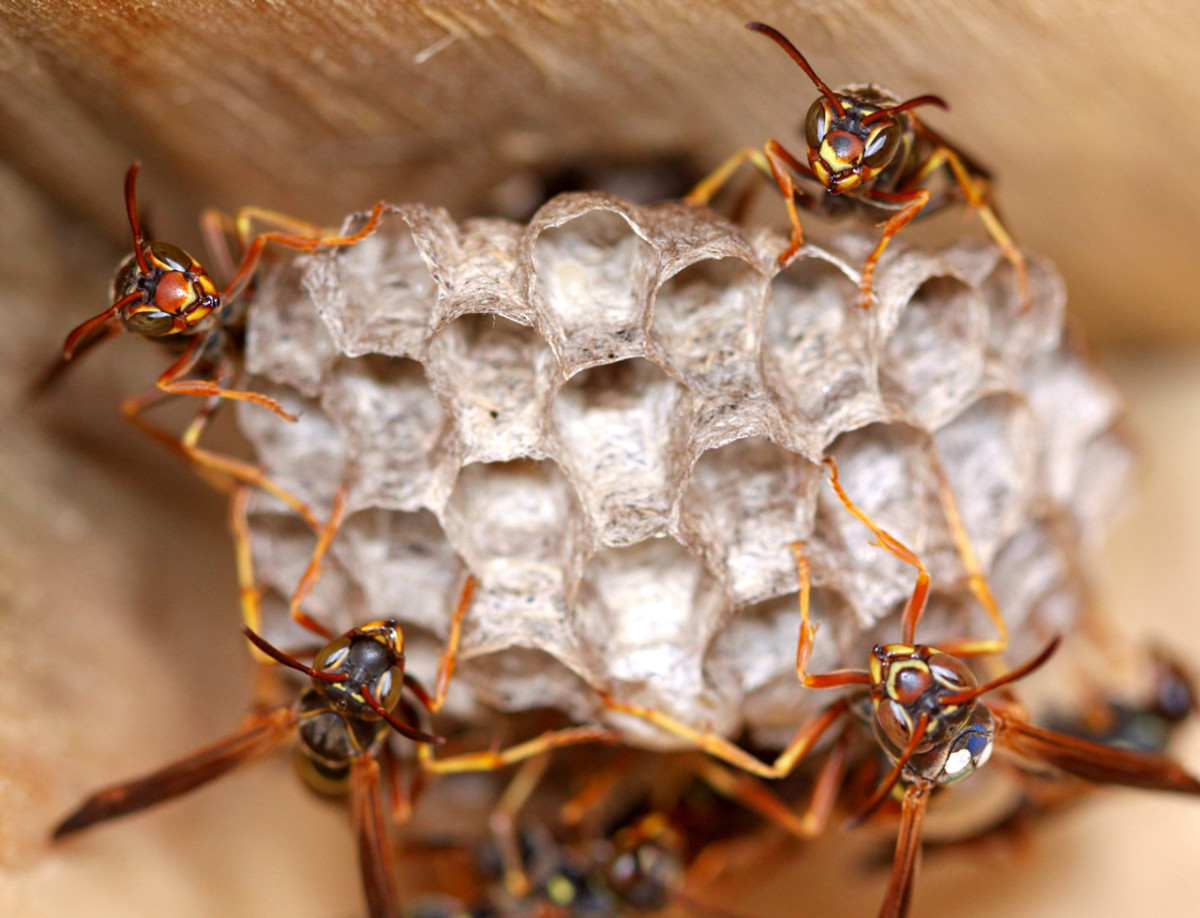
A nest of Polistest fuscatus wasps showing facial pattern diversity.
The common ancestor of primates and these social wasps likely lacked the vision to see objects, suggesting the traits must have evolved independently in each species as an analogous solution to the same problem.
The findings suggest that such specialized brain circuits are the most efficient way for organisms to tell individuals apart.
Female northern paper wasps (Polistes fuscatus), found in the eastern United States, have distinctive faces, unlike their male counterparts. Each spring, potential queens make new nests, often in small groups of up to five sisters. In these groups, the females use individual facial recognition to mediate their social interactions and dominance rank among the wasps.
In primates and humans, a specific subset of neurons known as face cells are crucial for telling individuals apart. This is surprising because faces are not inherently more complex than other visual objects,yet they still get their own dedicated circuit. The study provides new insights into the importance of social recognition.
"Here is a species that is very different from us that is solving a similar cognitive problem, all the way down to how their cells are organizing information," said Michael Sheehan, the William T. Keeton Professor in Biological Sciences in the Department of Neurology and Behavior in the College of Agriculture and Life Sciences (CALS) and the paper's senior author.
The first author is Christopher Jernigan, a former postdoctoral researcher in Sheehan's lab, now anassistant professor at Wake Forest University.
"When the same neural circuit solution has evolved in two very different species, it suggests that there's something about this scheme, this kind of organization of how information is processed, that is probably very efficient," said Sheehan, also associate professor of neurobiology and behavior (CALS) and a Nancy and Peter Meinig Family Investigator.
In the study, the researchers inserted electrodes into the brains of female wasps and recorded the electrical activity of neurons across many visual processing areas of the brain. In one localized region, they found cells with activity strikingly similar to the face neurons in primates that specifically recognize faces.
"When we showed them forward-facing pictures of other wasps, these neurons became super excited," Sheehan said. "But if you show them a wasp from the side, they don't respond. If you show them a different insect from the front, like a fly or a bee, they don't care."
When the researchers put wasp faces on different bodies in different postures - even though the face was a small part of the overall image - it became clear that the wasps were specifically cued into differencesin the faces.
While these cells that recognize faces were all localized in one region, individual neurons responded in idiosyncratic ways.
"In some cases, we could show statistically that certain neurons had a preference for markings of one particular part of the face, whereas another neuron from the same wasp might have a preference for markings on a different part of the face," Sheehan said. So, these cells are not only distinguishing that a face belongs to a wasp but are also encoding information about which wasp they are seeing. "And that is essentially what exists in primates, as well," he said.
The brains and eyes of primates are much more complex than wasps; primate brains have billions of neurons while wasp neurons number about a million. Similarly, unlike primates, insects have compound eyes, made up of thousands of individual facets.
"We have two brains that have independently come up with a solution to the same problem," Sheehan said. "It turns out all the way down to how their cells are organizing information are pretty similar."
Next steps may include comparing wasps that recognize faces with those that can't, to better understand how the information processing has evolved. Other closely related species of wasps lack individual facial recognition, presenting an opportunity to learn how new information processing arises during the evolution of biological intelligence.
Lorenz Mammen, a doctoral student in Sheehan's lab, is a co-author of the study, which was funded by the National Institutes of Health.