
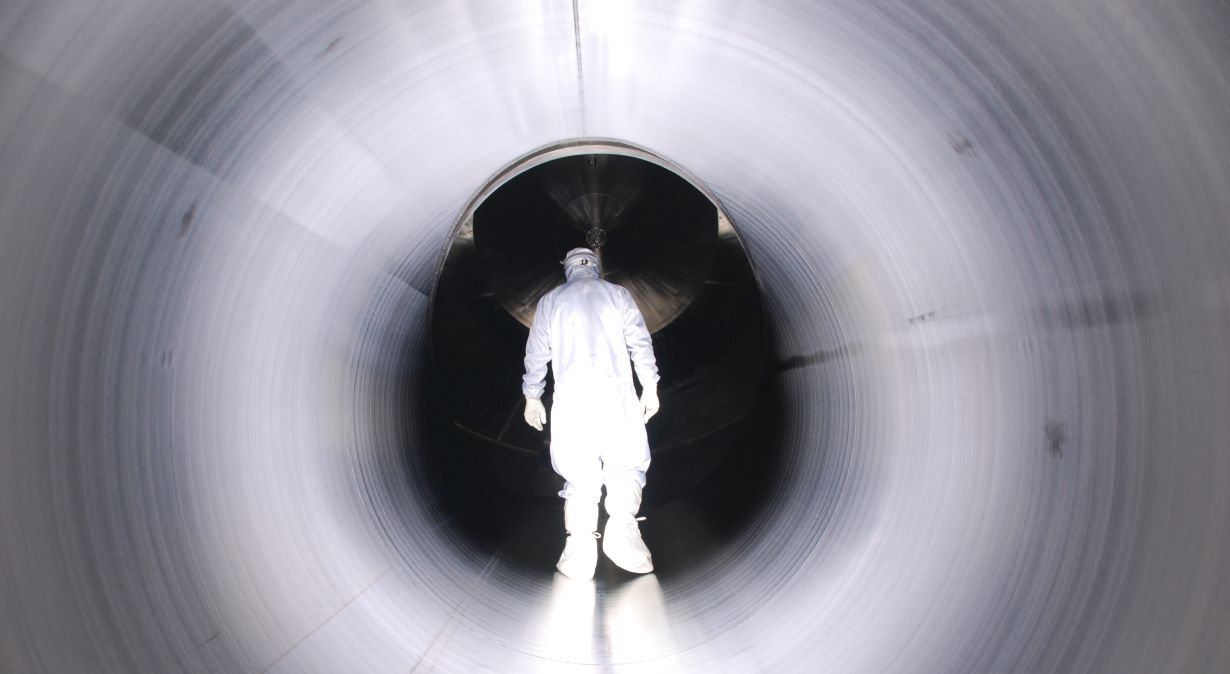
Mit dem internationalen KArlsruhe TRItium Neutrino Experiment (KATRIN) am Karlsruher Institut für Technologie (KIT) suchen Forschende nach der Masse von Neutrinos - also nach sehr leichten, elektrisch neutralen Elementarteilchen. Weil sie so schwer nachweisbar sind, werden sie auch Geisterteilchen genannt. Mit höchster Präzision haben die Forschenden nun nach einem vierten Neutrino-Typ gesucht - und dabei neue Grenzen für die Physik dieser Teilchen gesetzt. Die Ergebnisse in der Fachzeitschrift Nature (DOI: 10.1038/s41586-025-09739-9 ).
Neutrinos are among the most abundant particles in the universe, yet they are extremely difficult to detect. The Standard Model of particle physics includes three types. Through neutrino oscillations, it has been shown that they have mass and can transform into one another. For years, however, puzzling experimental anomalies have suggested the presence of a fourth, sterile neutrino, one that interacts even more weakly. Detecting such a particle would fundamentally transform our understanding of particle physics.
The KATRIN experiment, operated at KIT to determine the neutrino mass, has now made a significant contribution to the search for new physics beyond the Standard Model. In a recent study, the KATRIN collaboration demonstrates that the properties of these sterile neutrinos can be further constrained. No corresponding signal was found, significantly challenging previous indications of this particle from other experiments.
No Evidence for Sterile Neutrinos - Earlier Anomalies Ruled Out"
"Our new result is fully complementary to reactor experiments such as STEREO," explains Thierry Lasserre (Max-Planck-Institut für Kernphysik) in Heidelberg, who led the analysis. "While reactor experiments are most sensitive to sterile-active mass splittings below a few eV², KATRIN explores the range from a few to several hundred eV². Together, the two approaches now consistently rule out light sterile neutrinos that would noticeably mix with the known neutrino types."
The KATRIN experiment examines the beta decay of tritium. In this process, the energy spectrum of the resulting electrons is measured, which is altered by the neutrino mass. An additional neutrino would cause another characteristic distortion-a kind of kink-in the electron energy spectrum.
"In the measurement campaigns underlying this analysis, we recorded over 36 million electrons and compared the measured spectrum with theoretical models. We found no indication of sterile neutrinos," says Kathrin Valerius of the Institute for Astroparticle Physics at KIT, co-spokesperson of the KATRIN collaboration. "This allows us to exclude a large region of parameter space that previous anomalies in reactor neutrino and gallium source experiments had suggested. We were also able to refute the results of the Neutrino-4 experiment."
With a high signal-to-background ratio ensuring that almost all detected electrons come from tritium beta decay, KATRIN achieves a very clean measurement of the spectral shape. In contrast to oscillation experiments, which study how neutrinos change state after traveling some distance, KATRIN probes the energy distribution at the point of creation. Both approaches complement each other and together provide a robust test that practically rules out the existence of light sterile neutrinos.
Outlook: More Data, New Technology, Greater Reach
Data collection at KATRIN will continue until the end of this year. "By then, we will have recorded over 220 million electrons in the region of interest," says Valerius. "This improves the statistics by more than a factor of six and allows for even more precise conclusions."
Starting in 2026, KATRIN will be upgraded with the new TRISTAN detector. This device can directly measure the entire spectrum and extends the search to higher sterile neutrino masses." This next-generation setup will open a new window into the keV-mass range, where sterile neutrinos might even form the Universe's dark matter," says co-spokesperson Susanne Mertens of the Max Planck Institute for Nuclear Physics in Heidelberg.
Originalpublikation
T. Lasserre et al.: Sterile-neutrino search based on 259 days of KATRIN data. Nature, 2025. DOI: 10.1038/s41586-025-09739-9.
In close partnership with society, KIT develops solutions for urgent challenges - from climate change, energy transition and sustainable use of natural resources to artificial intelligence, sovereignty and an aging population. As The University in the Helmholtz Association, KIT unites scientific excellence from insight to application-driven research under one roof - and is thus in a unique position to drive this transformation. As a University of Excellence, KIT offers its more than 10,000 employees and 22,800 students outstanding opportunities to shape a sustainable and resilient future. KIT - Science for Impact.


