
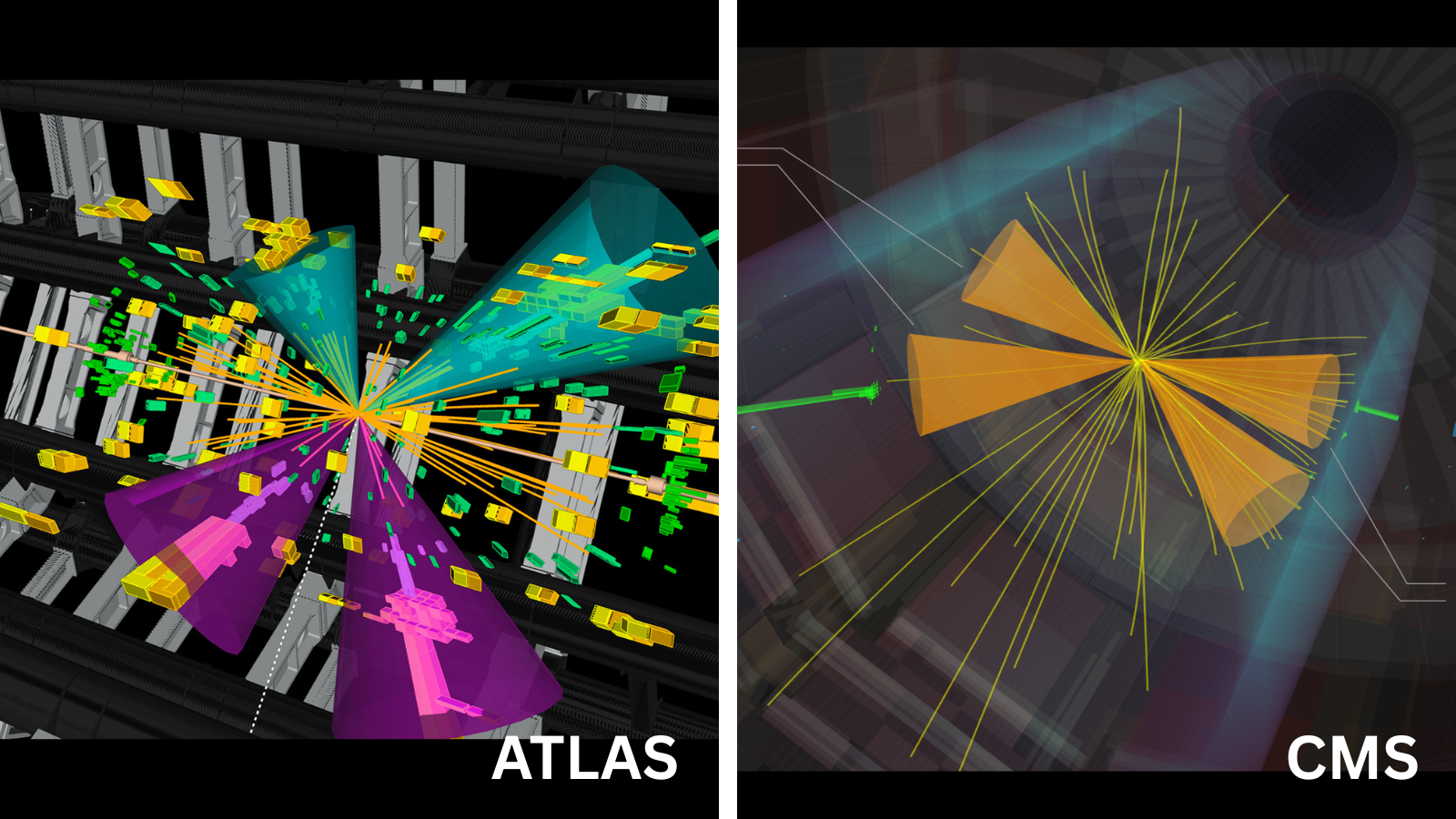
Finding one Higgs boson was hard enough, but physicists at the Large Hadron Collider (LHC) are hunting for something even more elusive: pairs of Higgs bosons. At the recent International Conference on High Energy Physics 2026, the ATLAS and CMS Collaborations presented new constraints on the double-Higgs production rate, providing insight into how the Higgs boson interacts with itself.
The discovery of the Higgs boson in 2012 at the LHC marked the beginning of a new era in particle physics. Since then, researchers at the LHC have investigated and measured how the Higgs boson interacts with other particles, an important mechanism by which these particles get their mass.
However, physicists have yet to observe the Higgs boson interact with itself. Understanding this process would not only test the limits of the Standard Model, our current best working theory for particle physics, but also help shed light on whether the vacuum of our Universe is stable.
The main challenge in studies of double-Higgs production is that the process is incredibly rare. The exact rate of production is still yet to be determined, but based on predictions from the Standard Model, researchers can expect that for approximately every 1500 single Higgs bosons produced in LHC collisions, only one pair of Higgs bosons will be produced.
To look for double-Higgs production, the ATLAS and CMS Collaborations search for signs of the twin Higgs decaying into other particles. Both Collaborations investigated a particular decay channel where one of the twin Higgs decays into a bottom quark and antiquark, and the other into a tau particle and its antiparticle. This is one of the best ways to study double-Higgs production.
Researchers at the LHC had already searched for double-Higgs production using data from the previous LHC runs. Now, by combining this data with the most recent third run of the LHC and deploying novel machine-learning techniques for their analysis, the ATLAS and CMS Collaborations have been able to conduct an even more sensitive search for the double-Higgs from its decay into two bottom quarks and two tau particles. The researchers identified more events than before that appear consistent with double-Higgs production, but still not enough events to observe the process. However, they were able to set new constraints on the double-Higgs production rate.
The ATLAS Collaboration sees a 2.6 standard-deviation excess above what would be expected without double-Higgs production. In other words, the data hints that pairs of Higgs bosons are being produced, although the signal is not yet strong enough for an observation. CMS, in its parallel study, ruled out double-Higgs production rates that are larger than four times the current prediction from the Standard Model. Both Collaborations have also set limits on the Higgs self-coupling parameter, which determines how strongly the Higgs boson interacts with another Higgs boson.
These results are a promising sign for upcoming analyses combining the full LHC Run 2 and Run 3 datasets and all decay modes, which could provide an interesting picture of double-Higgs boson production. Looking further ahead, the High-Luminosity LHC will increase the number of collisions, allowing the experiments to record around six times more data, bringing them ever closer to observing double-Higgs boson production.


