
With grants of up to $5 million, AEA Innovate is enabling university researchers to work alongside industry partners to fast‑track technologies aligned with Australia's national priorities.
Among the projects supported are groundbreaking advancements in MRI imagery and cancer‑detecting capability - technologies with the potential to transform early diagnosis and improve patient outcomes.
Read on to find out more about how these projects will have significant impact across Australia's health and research sectors.
New capability to detect cancer cells early
LaTrobe University and AlleSense have partnered to develop a new national capability for water-scale biophotonics (light-based technologies) manufacturing required for medical devices.
The first application of this capability is the NanoMslide - a revolutionary, stain-free cancer diagnostic platform. It consists of an array of sensors integrated into a microscope slide that can instantly highlight cancerous cells without any chemical staining, making pathology both faster and more accurate.
Professor Brian Abbey from LaTrobe University spoke about how AEA funding will support the mass production of the NanoMslide.
"AEA Innovate funding is a gamechanger for us. It's going to help us move from a successful lab prototype to full-scale production much faster than what we could on our own," Brian said.
"We believe our project will have a profound impact on Australian lives, both in health and economic terms. At its core, NanoMslide enables earlier and more accurate cancer detection, initially focusing on breast cancer, which can save lives by identifying disease at its most treatable stages."
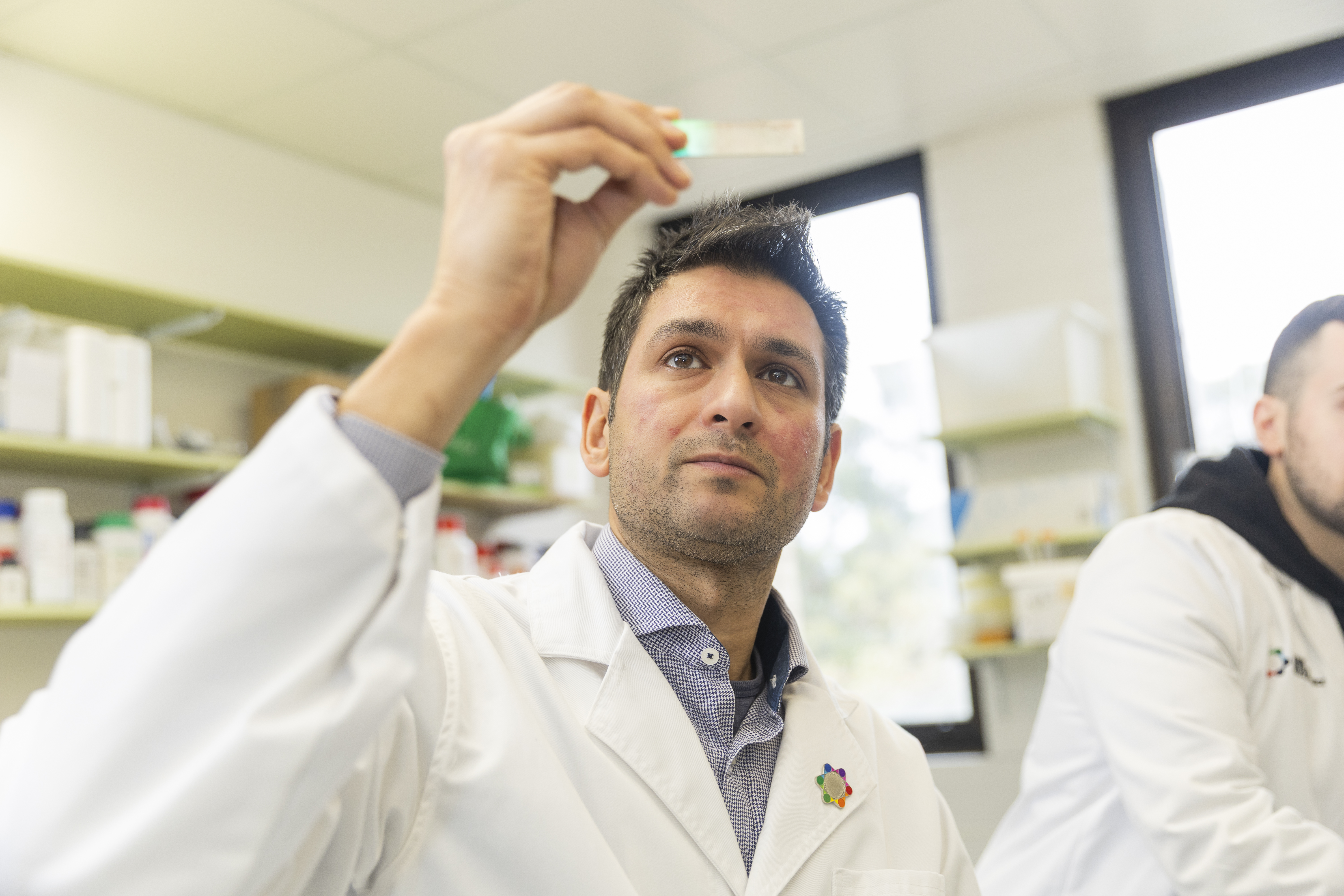
Professor Brian Abbey with the NanoMslide
Portable MRI device to enhance athlete performance
Researchers at University of Queensland have partnered with IntelliDesign to develop a magnetic resonance imaging (MRI) device that is easily transportable to monitor high performance and professional athletes.
The portable MRI scanner can be used at training sessions and during competitions to monitor athletes' muscles and soft tissue, enabling earlier injury detection, better recovery tracking and overall improved performance.
Associate Professor at University of Queensland, Viktor Vegh explained how AEA Innovate funding is helping progress the project.
The AEA Innovate grant will take our technology to system prototype demonstration in the relevant environment, which will include the generation and assessment of musculoskeletal images on professional athletes in collaboration with the next generation of Olympic and Paralympic athletes," Viktor said.
While in the short-term our technologies will not extend beyond use in professional sport (training and monitoring), the AI and machine learning and incorporated quantum technologies may see uptake in other MRI systems, dedicated to a wider range of portable monitoring of the human body."


