
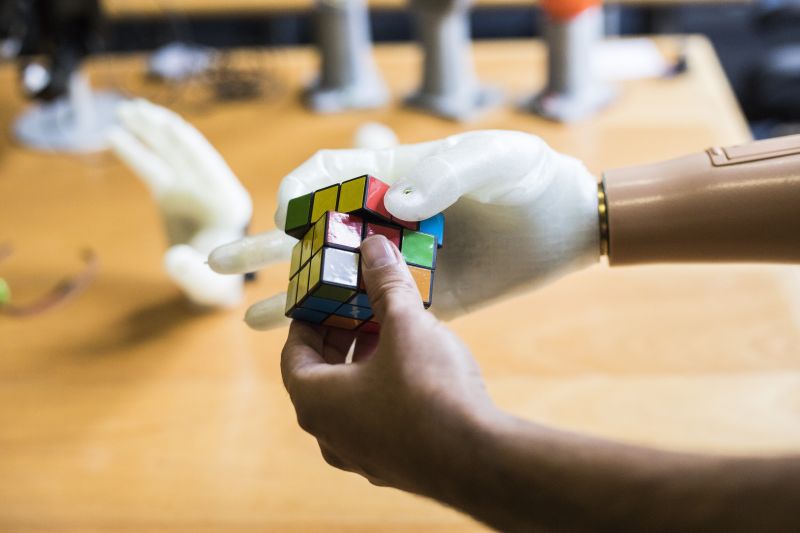
A University of Melbourne start up company is developing cutting-edge bionic prosthetics, designed to be lighter, easier to fit and more reliable to control than many conventional systems.
Almost 24 million people globally live with upper-limb loss, yet access to effective prosthetic arms remains limited.
In high-income countries, only around half of people with upper-limb loss have ever trialled a prosthesis, and 35-40 percent of users ultimately abandon their device, with rejection rates highest among children.
In low-income countries, the access gap is even greater, with only 10 percent of people estimated to trial a prosthetic device.
Senior Research Engineer Dr Alireza Mohammadi and his team interviewed 60 amputees, clinicians and suppliers to identify the limitations associated with current prosthetic devices.
The research team subsequently founded 'Meablex' to address these technological limitations and improve the quality of life for people with upper limb loss.
"Bionic hands are typically made out of rigid and heavy materials like metal and therefore can be hazardous if there's a malfunction," Dr Mohammadi said.
"Our next-generation prosthetics are much safer as we use lightweight soft robotic materials and advanced 3D-printing technologies."
Most commercially available forearm sockets that connect a residual limb to a bionic hand, are not designed to be adjustable.
This can create challenges when a person's limb changes shape due to growth, exercise, temperature, activity levels or natural changes in limb volume throughout the day.
"If someone exercises while wearing a fitted prosthetic socket, their residual limb may temporarily expand due to increased blood flow, causing the socket to become too tight," Dr Mohammadi said.
"As current sockets are not adjustable, the prosthetic will need to be refitted. For growing children, the challenge is even greater as they need to have their fitted sockets regularly replaced to accommodate changes in their body shape over time. This costly process can take several months and during this time the child can't use their bionic hand."
Meablex has addressed this issue by designing adaptable sockets, enabling the user to manually adjust their prosthetic arm in real time.
Current prosthetic arms operate using ElectroMyoGraphy (EMG) sensors that detect electrical activity generated when the user contracts muscles in their residual forearm.
A machine learning model then interprets the electrical activity to decipher the user's intended hand movement.
The user can make different prosthetic hand movements by contracting specific muscles in their residual forearm.
However, these signals can be affected by sweat, electrode placement and changes in socket fit, which may disrupt signal quality and make the device harder to control.
Meablex has developed a new control approach designed to be more reliable in everyday conditions.
"Our system uses magnetic sensors designed to be less affected by sweat than skin-surface electrical sensors," said Dr Mohammadi.
"Our technology combines a lightweight 3D-printed prosthetic hand with a new sensorised socket that detects subtle muscle movement, rather than relying only on traditional electrical muscle signals."
Clinical trials are slated to get underway later this year, with a commercial launch planned for early 2027, following clinical validation and regulatory approval.
Dean of the Faculty of Engineering and Information Technology (FEIT) Professor Thas Nirmalathas said the project exemplified engineering as a critical tool to improving health and wellbeing through new innovations in bionic prosthetics.
"From identifying the problem, to engaging with the community and now to being on the cusp of trialing an innovative state-of-the art fully integrated bionic arm, the team is set to transform the lives of amputees globally," Professor Nirmalathas said.
Meablex was recently awarded$470,000 through Australia's Economic Accelerator (AEA) Ignite program to support the next stage of development, clinical validation and commercialisation.


