
Europe's largest collection of historic school wall posters is housed at the University of Würzburg. More than 2,000 items from the collection are now being prepared for bavarikon, Bavaria's web portal for digitised cultural heritage.
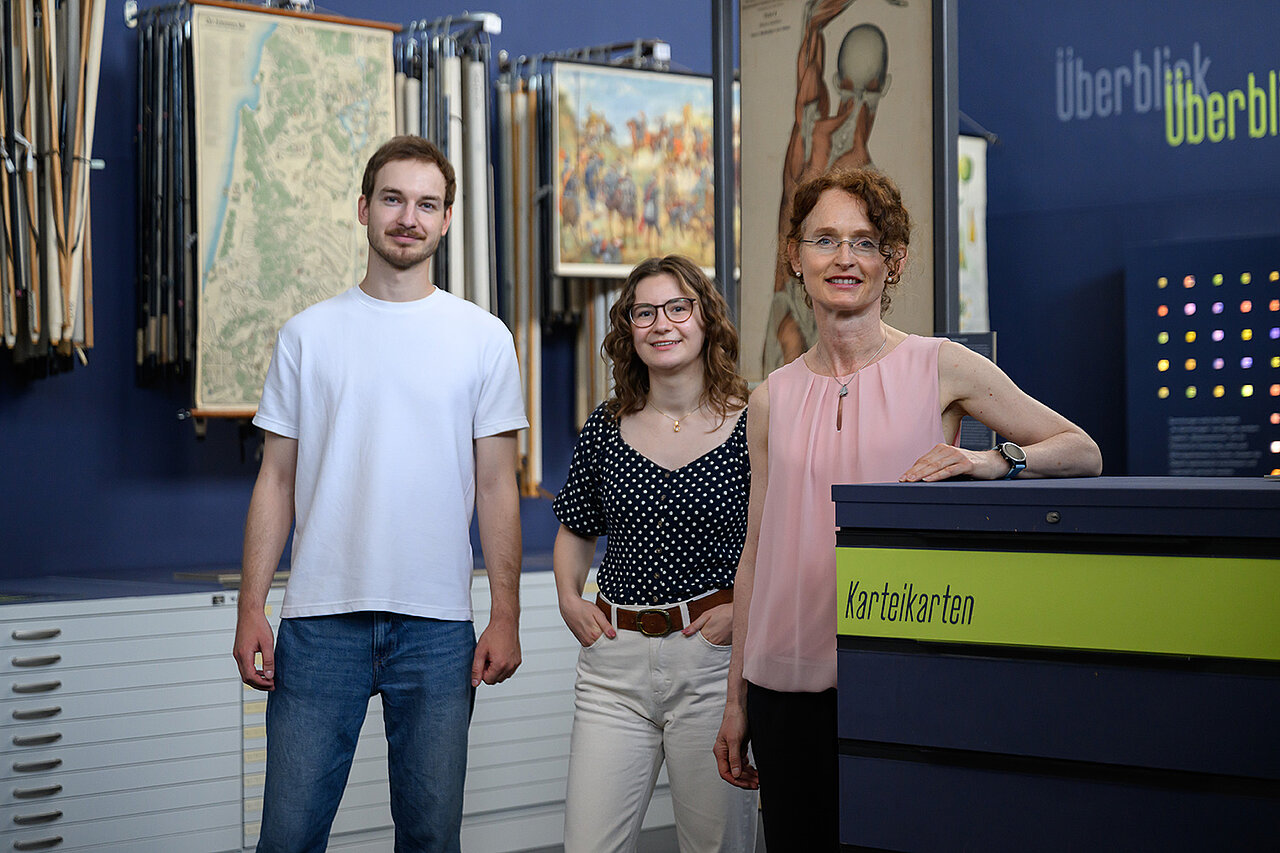
Over the years, the Research Centre for Historical Visual Media at the University of Würzburg has built up a remarkable collection of school wall posters from Germany and other European countries. In its premises on the North Campus, it houses more than 20,000 items spanning 150 years of school history. "This means we have the largest collection of school wall charts in Europe," says Dr Ina Katharina Uphoff, head of the research centre.
The wall charts date from a time before video, projectors or tablets. They enjoyed their heyday in the late 19th and early 20th centuries. They were produced for all school subjects and hung in practically every classroom. As a medium for analogue storytelling, they opened up a wide variety of visual and learning worlds to the children.
bavarikon makes school wall charts accessible
Selected items from the collection are now being added to bavarikon - Bavaria's digital treasure trove of art, culture and knowledge. The bavarikon exhibits, which are accessible to everyone via the web, come primarily from Bavarian museums, archives and libraries.
This recognises the Würzburg school wall murals as significant cultural and intellectual treasures and makes them accessible in the long term for research, education and the general public.
Exactly 2,222 historical school wall charts from Würzburg are to be included in bavarikon.
Among them is a school wall poster from 1912 depicting Königssee. It forms part of the 'Geographical Type Images' series: such images were intended to convey ideas about landscape formations in geography lessons - not only of landscapes in the region, but also of Germany and other countries around the world.
Also being added to this Bavarian treasure trove is a school wall poster depicting a lignite mine. It shows how coal was extracted in open-cast mining, which machines were used in the process, and how the mined coal was transported to power stations.
Anatomical illustrations will also be on display at bavarikon. One of these is the school wall poster 'Protective Structures of the Eye. Vision as a Brain Function' from 1916.
The Free State of Bavaria is funding the project
Before the Würzburg school wall charts appear in bavarikon, there is still work to be done by the Research Centre for Historical Visual Media.
Numerous images from the collection must be retrieved from the archive for bavarikon and catalogued scientifically: the team is researching information about the images and preparing them in such a way that their origin, use and significance become clear. The Digitalisation Centre at Würzburg University Library will then scan the historical items for online display.
The Free State's Ministry of Science and Ministry of Digital Affairs are funding this work. For the two-year project, which began on 1 July 2026, Leopold Kunert is employed as a research assistant and Julia Thieme as a student assistant at the Research Centre.
Another key focus of the project is to raise public awareness of the school murals. Two digital exhibitions are planned. These are intended to showcase different facets of the collection and open up new approaches to visual storytelling from times gone by.


