Biosensors are helping people with chronic conditions worldwide live better lives. However, their measurement accuracy has often been relatively low, limiting the range of possible applications. Researchers at the Technical University of Munich (TUM) have now discovered a way to boost the accuracy of common oxidase biosensors from 50% to 99%, paving the way for new uses.
 Andreas Heddergott / TUM
 Self-monitoring blood glucose and adjusting insulin as needed: Biosensors make this possible for people with diabetes-quickly and without the need for a lab. Biosensors are also used in other areas, but many promising applications require greater precision. For example, measuring creatinine levels, an important indicator of kidney function, has been too inaccurate so far. As a result, the full potential of biosensors remains untapped.
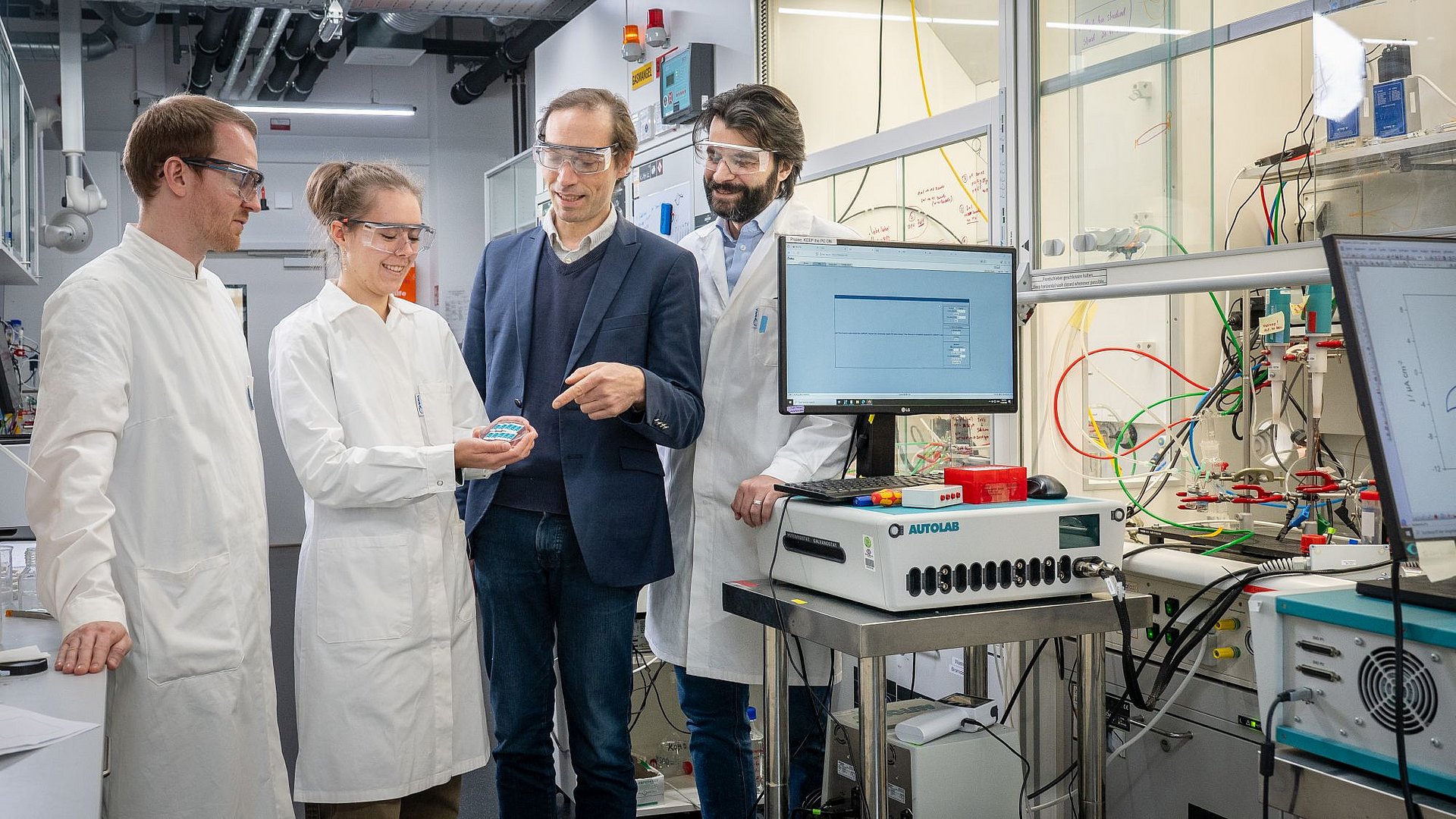
Nicolas Plumeré, Professor of Electrobiotechnology at TUM, Huijie Zhang, former researcher at his professorship and now Professor of New Energy at Nanjing University of Science and Technology in China, and Mohamed Saadeldin, a TUM doctoral student, set out to change that. In a lab study, the accuracy of oxidase biosensors for glucose, lactate, and creatinine was increased from approximately 50% to 99%-without the need for prior calibration. Lactate, for instance, is measured when monitoring critically ill patients. According to the team, this breakthrough opens up entirely new fields of application. Their findings were published in Science Advances .
Oxygen scavenger tidies up inside the sensor
The previous lack of accuracy stems from the way these sensors operate. They use oxidases-enzymes that convert substances like glucose into gluconolactone and electrons. The electrons are transferred to electrodes built into the sensor, generating an electrical current. The higher the concentration of a substance, the stronger the current displayed. The problem: oxidases don't just transfer electrons to the electrode-they also transfer them to oxygen in the environment. These "lost" electrons don't contribute to the current, weakening the signal and causing the measured concentration to appear lower than it really is.
To solve this, the researchers developed an oxygen scavenger: an alcohol oxidase that consumes excess oxygen by converting it into water. Crucially, this alcohol oxidase does not react with the actual target substances-glucose, creatinine, or lactate. After this "clean-up," only minimal oxygen remains, allowing the primary oxidase to transfer nearly all its electrons to the sensor.
From healthcare to agriculture
"We see a wide range of new and expanded applications and the potential to eliminate some lab tests in the future," says Nicolas Plumeré . "In personalized medicine, these biosensors could help calibrate wearable devices, providing more reliable health data, detecting problems early, and supporting accurate medication dosing. There's also potential in AI-driven healthcare, which depends on large datasets that improved biosensors could help generate."
Plumeré also sees opportunities beyond medicine and is already working on practical applications. Building on the LiveSen-MAP research project, his team developed a test based on the same principle to measure nitrogen content in wheat plants. This enables on-site adjustments to fertilization, preventing over-fertilization. For farmers, that means lower costs and reduced environmental impact.
Zhang, H.; Saadeldin, M. G.; Buesen, D. et al.: A universal oxygen scavenger for oxidase-based biosensors. Sciences Advances 2025, DOI: 10.1126/sciadv.adw6133
- Nicolas Plumeré is a professor at the TUM Campus Straubing for Biotechnology and Sustainability .
- The study was funded by the European Union under the Horizon Europe program .